What Is Timing Risk in Retirement Planning?
Timing risk represents one of the most overlooked threats to retirement security. It's the danger of retiring just before or during a market downturn when your investments are temporarily depressed.
When you start withdrawing from your portfolio during market lows, you're forced to sell more shares to generate the same income. This locks in losses that might otherwise recover, permanently reducing your portfolio's ability to grow. Even well-diversified accounts can suffer devastating damage if retirement withdrawal strategy begins at an unfortunate time.
With 2026's increased 401(k) contribution limit of $24,000 and enhanced catch-up contributions reaching $8,000 for ages 60-63, pre-retirees have more opportunities to build wealth, but they also face greater timing risk exposure.
Why Sequence of Returns Risk Is So Dangerous
The mathematical reality is brutal: early losses combined with ongoing withdrawals create a downward spiral that's nearly impossible to escape.
During your working years, market downturns aren't catastrophic because you're still adding money. You're essentially buying investments on sale. But once you retire and flip to withdrawal mode, market timing becomes critical.
Consider two identical $1.2 million portfolios in 2026. Both retirees withdraw $50,000 annually:
- Retiree A experiences strong early returns, then later downturns
- Retiree B faces immediate market crashes, then strong recovery
Even with identical 20-year average returns, Retiree B could exhaust their funds 7-10 years earlier than Retiree A. This sequence of returns risk explains why traditional retirement calculators showing average returns can be dangerously misleading.
Proven Protection Strategies
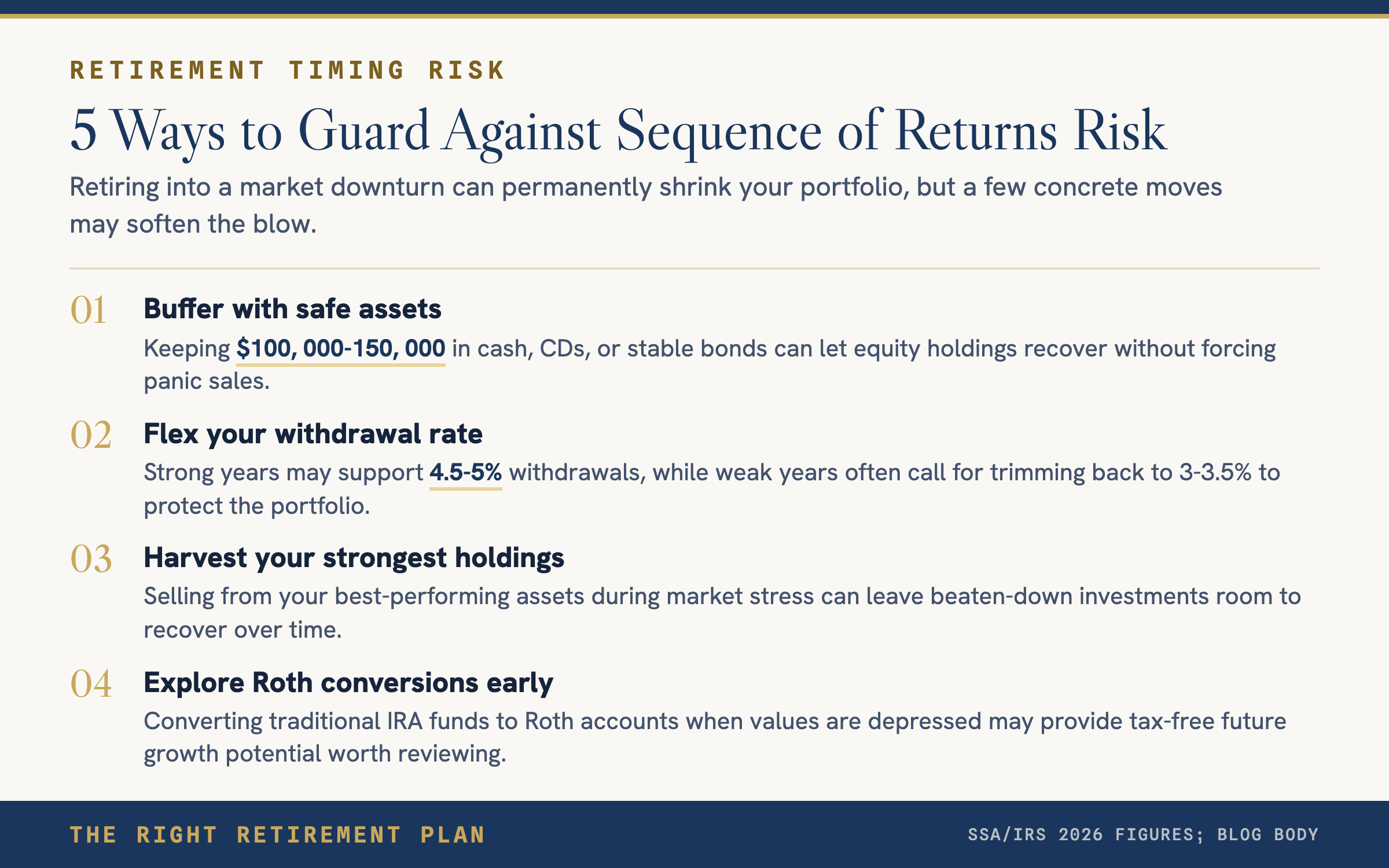
Maintain 2-3 Years of Safe Assets: Keep $100,000-150,000 in cash, CDs, or stable bonds. This buffer allows your equity investments to recover during downturns without forcing panic sales.
Implement Dynamic Withdrawals: Instead of rigid 4% annual withdrawals, adjust based on market performance. Strong years might support 4.5-5% withdrawals, while weak years call for temporary reductions to 3-3.5%.
Strategic Asset Harvesting: During market stress, sell from your strongest-performing holdings while leaving beaten-down investments room to recover.
Consider Roth Conversions: Market downturns create conversion opportunities. Converting traditional IRA funds to Roth accounts when values are depressed provides tax-free future growth potential.
Many Maryland retirees we work with find that combining these strategies with careful Social Security timing creates a robust foundation for retirement income planning.
Ready to stress-test your retirement plan against timing risk? Our Retire Ready Score can help you identify potential vulnerabilities and build a more resilient withdrawal strategy tailored to your specific situation.