Whole Life Insurance Is Not a Retirement Plan

Whole life can be useful insurance. It is usually a poor retirement plan. The math gets clearer when you compare it with taxable investing and direct indexing.

Whole Life Insurance Is Not a Retirement Plan

Every few weeks, someone forwards me an illustration. Whole life. Indexed universal life. Some "10-pay" or "7-pay" structure with a glossy spreadsheet that promises tax-free growth, tax-free income, and a death benefit on top.

The pitch is almost always framed the same way: as a retirement plan. "Tax-advantaged retirement income." "Your own personal bank." "A bond replacement that grows tax-free." Sometimes it is pitched as the better alternative to a 401(k) or an IRA.

Here is the part nobody mentions: there are a hundred ways to save for retirement, and a permanent life insurance policy is the right tool for almost none of them.

Let me be direct about why these products get sold so aggressively. The first-year commission on a 10-pay whole life policy with a $52,000 annual premium is often a very large percentage of the base premium. That is not a conspiracy theory. That is the industry-standard incentive structure.

When a product pays the seller that much, you should expect to see it sold a lot. And you do.

But the bigger issue, for me, comes down to who you are betting on.

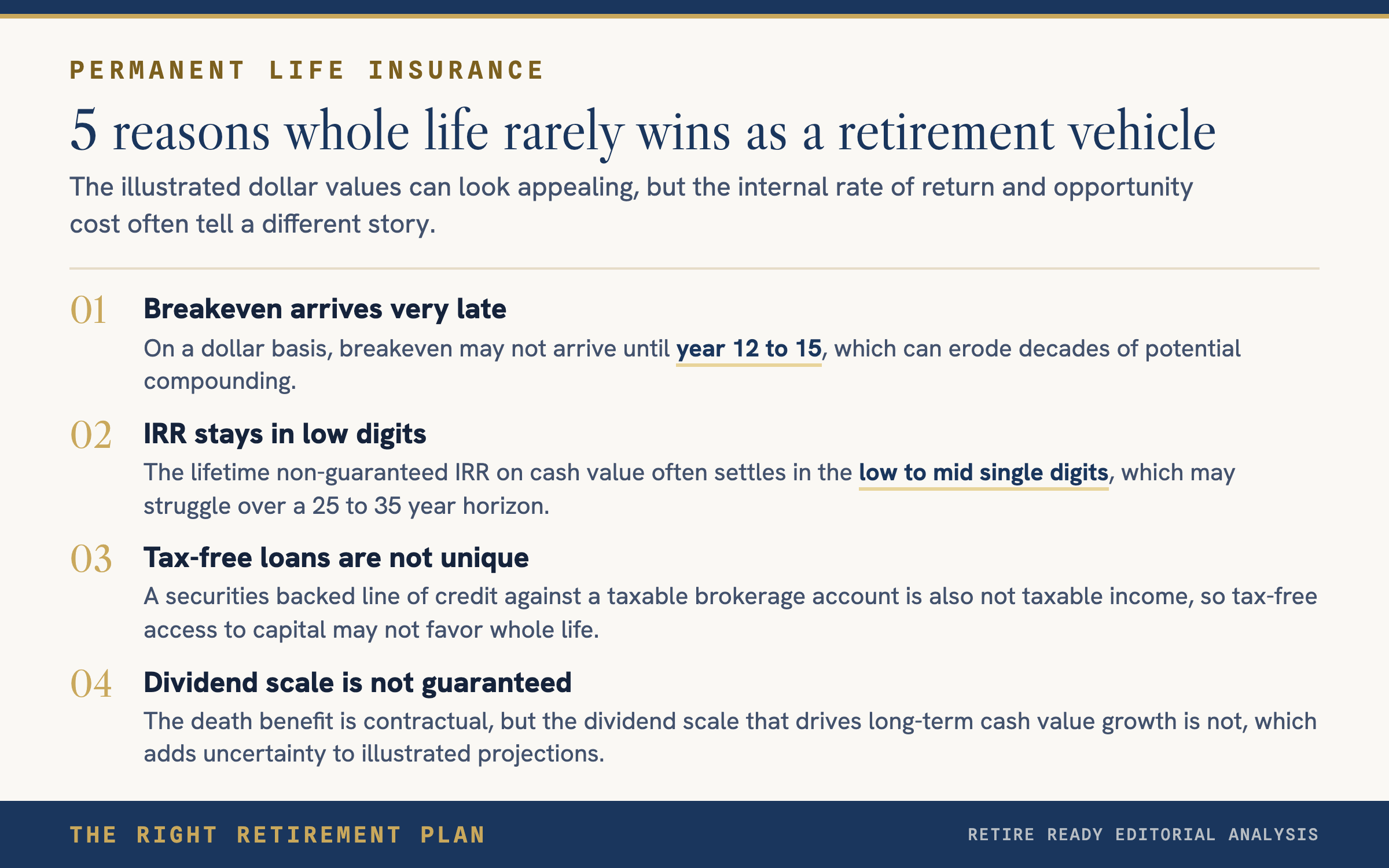
When you buy whole life, you are betting on one insurance company to honor a non-guaranteed dividend schedule for the next 40 or 50 years. The cash value growth shown on the illustration is not fully contractual. It is based on the carrier's current dividend scale, which the company explicitly reserves the right to lower. The death benefit is contractual. The wealth-building number is a projection. There is a difference.

When you invest in a diversified equity portfolio, you are betting on thousands of companies and the people inside them to keep producing, innovating, and turning a profit. You are betting on engineers, operators, logistics teams, bankers, manufacturers, software builders, retailers, and the millions of other people whose work generates the earnings that drive long-term returns.

Over any reasonable time horizon, that is the bet I would rather make.

I saw the inside of this business

Quick disclosure on where I am coming from: I worked at one of the best mutual life insurance companies in the country for a stretch earlier in my career. I saw the inside of the beast.

I realized pretty early on that it was not the right fit for me, because too much of it did not make sense. What I learned in those years is this: insurance companies want their reps to sell more insurance, because that is how the company makes money.

The product roadmap, the training, the compensation grid, the leaderboards, the incentive trips. All of it is engineered around moving more product. The people working there are, by and large, sales people, not advisors. They are not always sitting on your side of the table figuring out what is actually best for your situation. They are often sitting on the company's side of the table figuring out which product on the menu to recommend.

Many of them also wear what are sometimes called dual hats. They hold an insurance license and a securities license, and they may shift between different standards of care depending on which product they are discussing with you. The difference between a fiduciary standard and a suitability-style recommendation is enormous.

The short version: a fiduciary is legally required to act in your best interest. A suitability recommendation has historically been a lower bar. That difference matters when the product being recommended can pay the seller heavily up front.

What the illustration showed

Without identifying the carrier or the client, here is what the proposal looked like:

A 10-pay whole life policy with a $52,000 annual premium. Total scheduled outlay: $520,000 over ten years. The illustration projected non-guaranteed cash values and death benefits based on the carrier's current dividend scale.

At first glance, the dollar values can look fine. By year 25, the cash value may be more than 2.5x what was paid in. Over 35 years, it may be more than 4x.

But these are dollar values, not returns. And once you compute the internal rate of return on the cash value column, which is what you actually earn on your money, the picture changes.

The IRR column the illustration does not show you

In many illustrations, you do not break even on a dollar basis until years into the policy. Through the entire premium-paying period, the return on cash value can be very low. Over a multi-decade period, the non-guaranteed illustrated IRR may settle into the low-to-mid single digits.

That is not nothing. It is real cash value growth.

But it is slow growth, with terrible early-year liquidity, insurance costs, surrender dynamics, and a major opportunity cost. That is the tradeoff being asked of you in exchange for a death benefit you may not need and tax features that are not as exclusive as they are often made out to be.

The same money in a taxable brokerage account

Now run the same scenario through a regular taxable brokerage account: annual contributions into a diversified low-cost equity portfolio for ten years, then held with no further contributions.

No insurance wrapper. Just a taxable account.

Over long periods, the historical equity premium has been difficult for permanent insurance cash value to compete with. Even after taxes, a disciplined taxable portfolio can create substantially more liquid wealth than the projected cash value in many whole life illustrations.

The gap that opens up is the cost of choosing whole life as the retirement vehicle.

Adding direct indexing with tax-loss harvesting

Here is where it gets more interesting. If you are going to invest in a taxable account anyway, modern direct indexing platforms can let you own the individual stocks inside an index instead of a pooled ETF wrapper and harvest losses at the security level.

How that helps: in any given year, even when the index is up, some individual stocks in the index are down. A direct indexing platform can scan for those losses, sell the loser, buy a replacement that keeps the portfolio's exposure intact, and book the loss to offset capital gains elsewhere on your tax return. Losses you do not use can carry forward.

This is not magic, and the benefit varies by tax rate, market path, contribution pattern, and whether you have gains to offset. But for high-bracket investors with taxable assets, tax-loss harvesting can be a real after-tax advantage.

That is the part the insurance pitch tends to ignore. It compares the policy to a lazy taxable portfolio, not a well-managed one.

"But what about the tax-free loans?"

This is the most common rebuttal I hear when the return math gets shown. The pitch is that whole life cash value is a personal banking system: borrow against the policy tax-free while the cash value keeps growing.

The first half is technically true. The second half is where the nuance lives.

Policy loans are loans. Interest accrues. Outstanding loan balances reduce the death benefit. If the policy lapses with a loan outstanding, the tax consequences can be ugly. The policy can become a trap if it is overborrowed, underfunded, or misunderstood.

The alternative is not "never borrow." The alternative is to build wealth in a taxable brokerage account and, when appropriate, use a securities-backed line of credit.

Loan proceeds from an SBLOC are not taxable income. The underlying portfolio can remain invested. The risk is different: market declines can create collateral pressure or margin calls if the loan is too aggressive. That is why loan-to-value discipline matters.

The point is not that SBLOCs are risk-free. They are not. The point is that tax-free access to capital is not unique to whole life.

When whole life actually does make sense

I am not arguing whole life insurance is a scam. It is not. There are situations where permanent insurance can be legitimate, even excellent:

  • Estate planning for families with taxable estates, especially when structured properly.
  • Business succession funding where a death benefit funds a buy-sell agreement.
  • Asset protection in states where life insurance cash value receives meaningful creditor protection.
  • A genuine permanent death benefit need that goes beyond what term insurance can solve.
  • Forced savings for someone who has repeatedly demonstrated that accessible money will be spent.
What whole life is usually not is a competitive wealth-accumulation vehicle for a 25-to-35-year retirement planning horizon.

Questions to ask before you sign

If you are being pitched whole life right now, get these answered in writing before any premium is paid:

1. What problem is this solving?
2. Is the recommending person a fiduciary, commission-based, or both?
3. What is the total compensation on the sale?
4. Could this policy become a Modified Endowment Contract?
5. What would a comparable term policy cost?
6. Have retirement accounts, HSA funding, emergency reserves, and taxable savings been addressed first?
7. What are the surrender charges if your situation changes?
8. Where is the funding coming from, and what are the tax consequences?

If the answers are vague, slow down.

The bottom line

The math on many illustrations looks impressive in dollars and underwhelming in return. The death benefit is real and can be valuable. The tax treatment is real too. But those benefits come with costs, complexity, commissions, and opportunity cost.

If your situation genuinely calls for permanent insurance, get the policy. But get it for the right reason, from someone who will show you the return math clearly, and at the right scale relative to your overall financial picture.

Anything that has to be sold with "just put it in tomorrow and forget about it" can wait a week.

Heath Harris is the Founding Financial Advisor at Compound Advisory LLC, a fee-only fiduciary RIA based in Annapolis, Maryland. This post is for educational purposes only and does not constitute personalized financial, tax, or legal advice. The illustrations and projections discussed are hypothetical, based on stated assumptions, and not guaranteed. Actual results will vary. Past market performance does not predict future results. Consult your own qualified advisors before making decisions about insurance, taxes, or investments.

ShareX / TwitterFacebook

Have questions about your specific situation? Take the free Retire Ready Score →

Want personalized guidance?

Our content gives you the knowledge. A qualified advisor can help you act on it.

Take the Free Assessment