All RMDs articles.
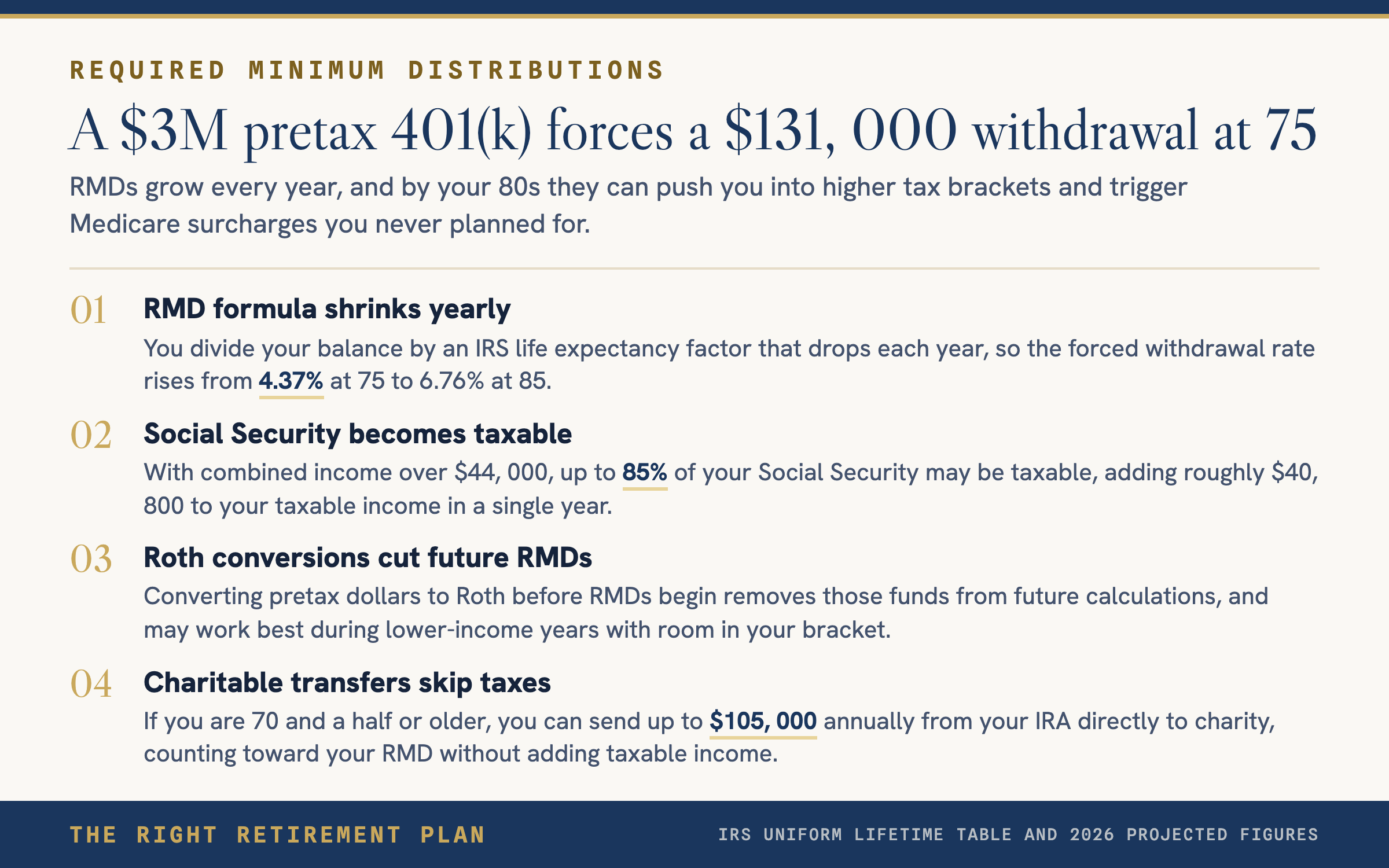
7 publishedRMD Life Expectancy Table: Why Age 75 Forces a 3.77% Withdrawal
The IRS Uniform Lifetime Table forces increasingly larger required minimum distributions as you age, with withdrawal rates jumping from 2.74% at 73 to 3.77% at 75. Understanding these escalating percentages helps Maryland retirees plan for higher tax brackets and potential Medicare surcharges.
Roth 401(k)s Now Match Roth IRAs: $0 RMDs for Life
SECURE Act 2.0 eliminated required distributions from Roth 401(k)s starting in 2024, creating a powerful new wealth-building opportunity for high earners who can now leave tax-free money untouched for life.
A $500,000 Inherited IRA Could Trigger $178,000 in Taxes by Year 10
A $500,000 inherited IRA could trigger $178,000 in taxes by year 10 due to SECURE Act rules requiring non-spouse beneficiaries to empty accounts within a decade. Understanding these requirements can save Maryland retirees and their families significant money.
Missing a $40,000 RMD Could Cost You $10,000 in IRS Penalties
Missing your required minimum distribution triggers a 25% IRS penalty, potentially $10,000 on a $40,000 missed RMD. Learn how to avoid this costly mistake and get penalties waived if you act quickly.
A $500K IRA + $300K 401(k) = Two Separate RMD Calculations
Understanding RMD aggregation rules can save you from costly penalties, you can combine IRA withdrawals but must take separate distributions from each 401(k) account.
RMD Age Jumps to 75 by 2033, Here's Your Timeline
The SECURE Act 2.0 gradually raises Required Minimum Distribution ages to 75 by 2033, giving your retirement accounts more time to grow but potentially creating higher tax bills later.
The RMDs numbers for 2026.
The thresholds that actually move this part of your plan, kept current and sourced.
See the full reference →Frequently asked.
 Social SecurityClaiming strategies, spousal benefits, taxation, and timing.10 articles →
 Tax PlanningBracket math, withdrawal ordering, QCDs, and the tax torpedo.18 articles →
 MedicareParts A/B/C/D, IRMAA, Medigap, and enrollment traps.8 articles →
 Income PlanningSafe withdrawal rates, buckets, bond ladders, sequence risk.32 articles →
Have a question about rmds? Ask a real advisor.
No pitch, no pressure. A free conversation with a fiduciary who has read the same research you have.
Book a free conversation