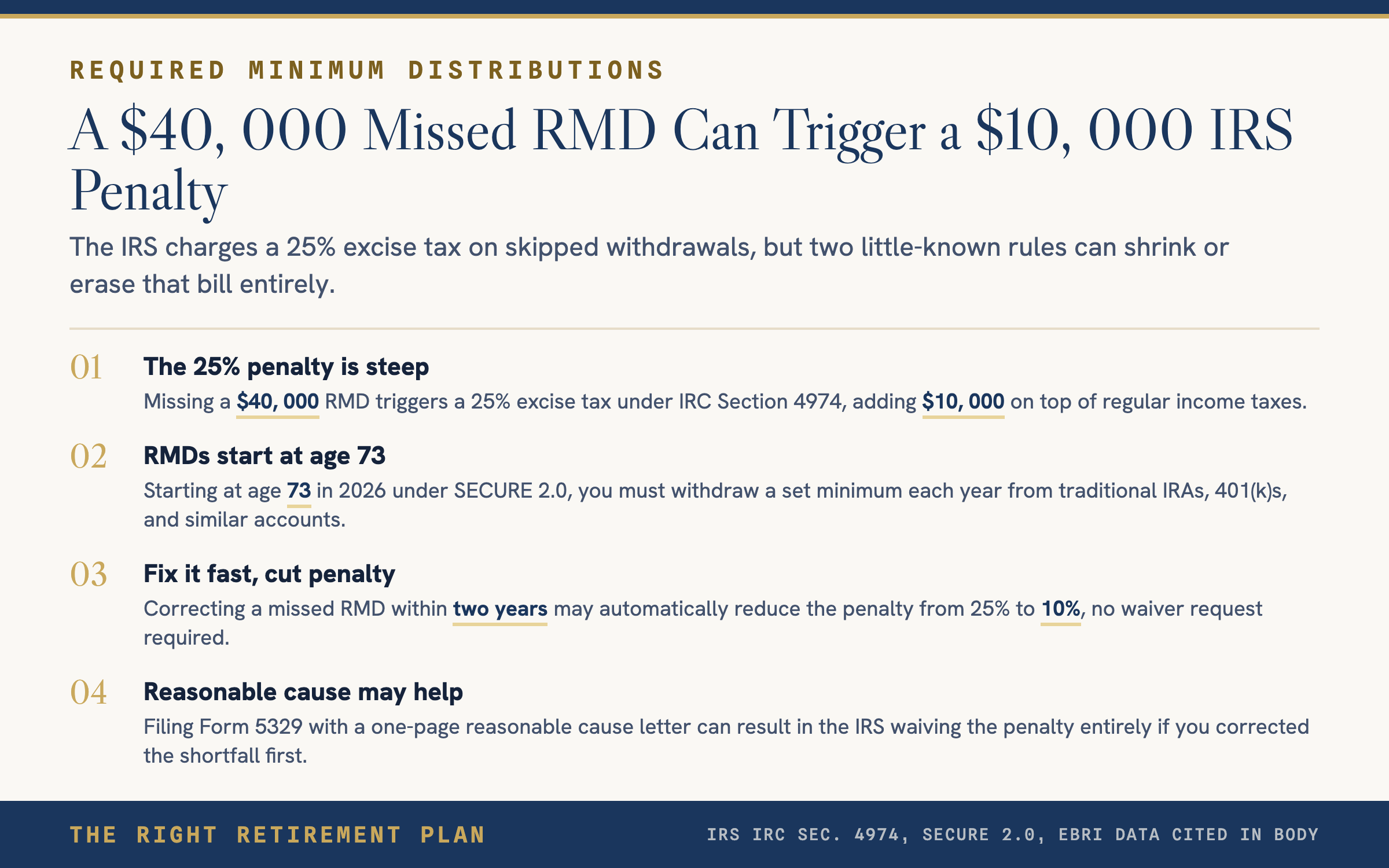
Missing a $40,000 RMD Could Cost You $10,000 in IRS Penalties
The letter arrives from the IRS, and suddenly your stomach drops. You missed a Required Minimum Distribution last year—a $40,000 withdrawal you were supposed to take from your traditional IRA but somehow overlooked. The penalty? A 25% excise tax, meaning you now owe the IRS $10,000 on top of the income taxes you'll pay when you finally take that distribution. This isn't a hypothetical scenario. According to the Employee Benefit Research Institute, approximately 20% of retirees subject to RMD rules make errors in their distributions, with missed deadlines being among the most common and costly mistakes.
The 25% excise tax on missed RMDs ranks among the steepest penalties in the entire tax code—harsher than the penalties for early withdrawal, excess contributions, or even some forms of tax fraud. For 2026, with traditional IRA balances averaging over $500,000 for households approaching retirement according to Vanguard research, a single missed RMD could easily trigger five-figure penalties. Yet here's what most retirees don't realize: the IRS has a well-established process for waiving this penalty entirely if you handle the situation correctly. Understanding both the risk and the remedy could save you thousands.
How the 25% Excise Tax Actually Works
Required Minimum Distributions exist because the federal government allowed your retirement savings to grow tax-deferred for decades—and eventually, the IRS wants its share. Beginning at age 73 for most retirees in 2026 (per the SECURE 2.0 Act provisions), you must withdraw a minimum amount annually from traditional IRAs, 401(k)s, 403(b)s, and most other tax-deferred retirement accounts.
The calculation uses your account balance from December 31 of the prior year divided by a life expectancy factor from IRS Uniform Lifetime Tables. For a 73-year-old in 2026, that factor is approximately 26.5, meaning roughly 3.77% of your balance must be withdrawn. On a $1 million IRA, that's about $37,736—and every dollar of that distribution counts as ordinary income.
When you miss this distribution entirely or withdraw less than required, IRC Section 4974 imposes the excise tax. The math is straightforward but painful:
- Missed RMD amount: $40,000
- Excise tax rate: 25%
- Penalty owed: $10,000
- Plus: Regular income taxes on the $40,000 when eventually withdrawn
- Potential total tax impact: $18,000–$22,000 depending on your bracket
One critical detail: the deadline is December 31 each year, with one exception. If 2026 is your first RMD year (you turned 73 in 2026), you may delay that first distribution until April 1, 2027. However, this creates a double-distribution year—you'll owe both your 2026 and 2027 RMDs in the same tax year, potentially pushing you into a higher bracket or triggering Medicare IRMAA surcharges.
Common Mistakes That Trigger the Penalty
Most retirees who face this penalty didn't intentionally ignore their RMD obligation. The errors typically fall into predictable categories that, once understood, become entirely avoidable.
Multiple account confusion may be the most frequent culprit. If you have three traditional IRAs at different institutions, you must calculate the RMD for each account separately, though you may take the total distribution from any one or combination of accounts. Many retirees miscalculate by using only one account's balance or forgetting an old 401(k) at a former employer entirely.
Inherited IRA complications create another trap. The rules for inherited IRAs differ significantly from personal retirement accounts, particularly after the SECURE Act eliminated the "stretch IRA" for most non-spouse beneficiaries. According to IRS guidance, most beneficiaries who inherited accounts after 2019 must deplete the entire account within 10 years AND take annual RMDs during that period—a requirement many beneficiaries miss entirely.
Qualified Charitable Distributions timing errors catch generous retirees off guard. QCDs—direct transfers from your IRA to qualified charities—can satisfy your RMD while excluding the amount from taxable income. However, the transfer must be completed by December 31. Checks mailed in late December but not cashed until January don't count for the prior year.
Other common triggers include:
- Assuming your financial institution automatically calculates and distributes your RMD (some do, many don't)
- Confusing Roth IRA rules (no lifetime RMDs for original owners) with traditional IRA requirements
- Failing to account for annuities held within IRAs, which have separate RMD calculations
- Death of a spouse mid-year, which changes the calculation method
The IRS Penalty Waiver Process That Actually Works
Here's the information that could save you $10,000: the IRS routinely waives the 25% excise tax for taxpayers who demonstrate "reasonable cause" and have corrected the error. This isn't a loophole or aggressive tax strategy—it's an established administrative procedure outlined in IRS instructions for Form 5329.
To request a waiver, you must take three specific steps:
First, take the missed distribution immediately. Withdraw the full amount you should have taken, plus your current year's RMD if applicable. Document the exact dates and amounts with statements from your financial institution.
Second, file Form 5329 (Additional Taxes on Qualified Plans) with your tax return. On Part IX of the form, report the RMD shortfall, but rather than calculating the 25% penalty, enter zero on the penalty line and attach a letter of explanation.
Third, write a reasonable cause letter explaining why you missed the distribution and what steps you've taken to correct it and prevent future errors. The IRS considers various circumstances as reasonable cause:
- Serious illness of you or an immediate family member
- Death of a family member around the distribution deadline
- Errors by your financial institution or tax advisor
- First-year RMD confusion about deadlines
- Natural disasters affecting access to accounts
This means even without demonstrating reasonable cause, correcting a $40,000 missed RMD promptly reduces your penalty from $10,000 to $4,000. Combined with a reasonable cause waiver request, you could potentially owe nothing—but only if you act before the IRS contacts you. Once you receive a notice about the missed RMD, your leverage diminishes significantly. The retirees who pay the full 25% penalty are typically those who ignore the problem until the IRS forces the issue.
Key Takeaways
- The 25% excise tax on missed RMDs is one of the steepest penalties in the tax code, potentially costing $10,000 or more on a single missed distribution.
- Correcting a missed RMD within two years automatically reduces the penalty from 25% to 10% under current SECURE 2.0 provisions.
- The IRS may waive the penalty entirely if you file Form 5329 with a reasonable cause letter and have already taken the missed distribution.
- Multiple accounts, inherited IRAs, and first-year RMD confusion are the most common triggers for this costly mistake.
- Your financial institution may calculate your RMD, but the legal responsibility for taking it on time rests entirely with you.
- Acting before the IRS contacts you dramatically improves your chances of a successful penalty waiver.
Next Step
RMD planning is just one piece of a comprehensive retirement income strategy. If you're wondering how your current approach handles tax efficiency, distribution sequencing, and penalty avoidance, the free Retire Ready Score provides a quick assessment of where your plan stands across these critical areas.
