A $3M Pretax 401(k) Forces a $113,000 Annual Withdrawal at 75

March 9, 2026· 7 min read
A $3M Pretax 401(k) Forces a $113,000 Annual Withdrawal at 75

Why Your 401(k) Success Could Become Your Tax Problem

You spent decades maxing out your 401(k), watching compound growth work its magic. Now that $3 million balance represents everything you did right. But here's what the accumulation phase never warned you about: the IRS has been waiting patiently for their cut.

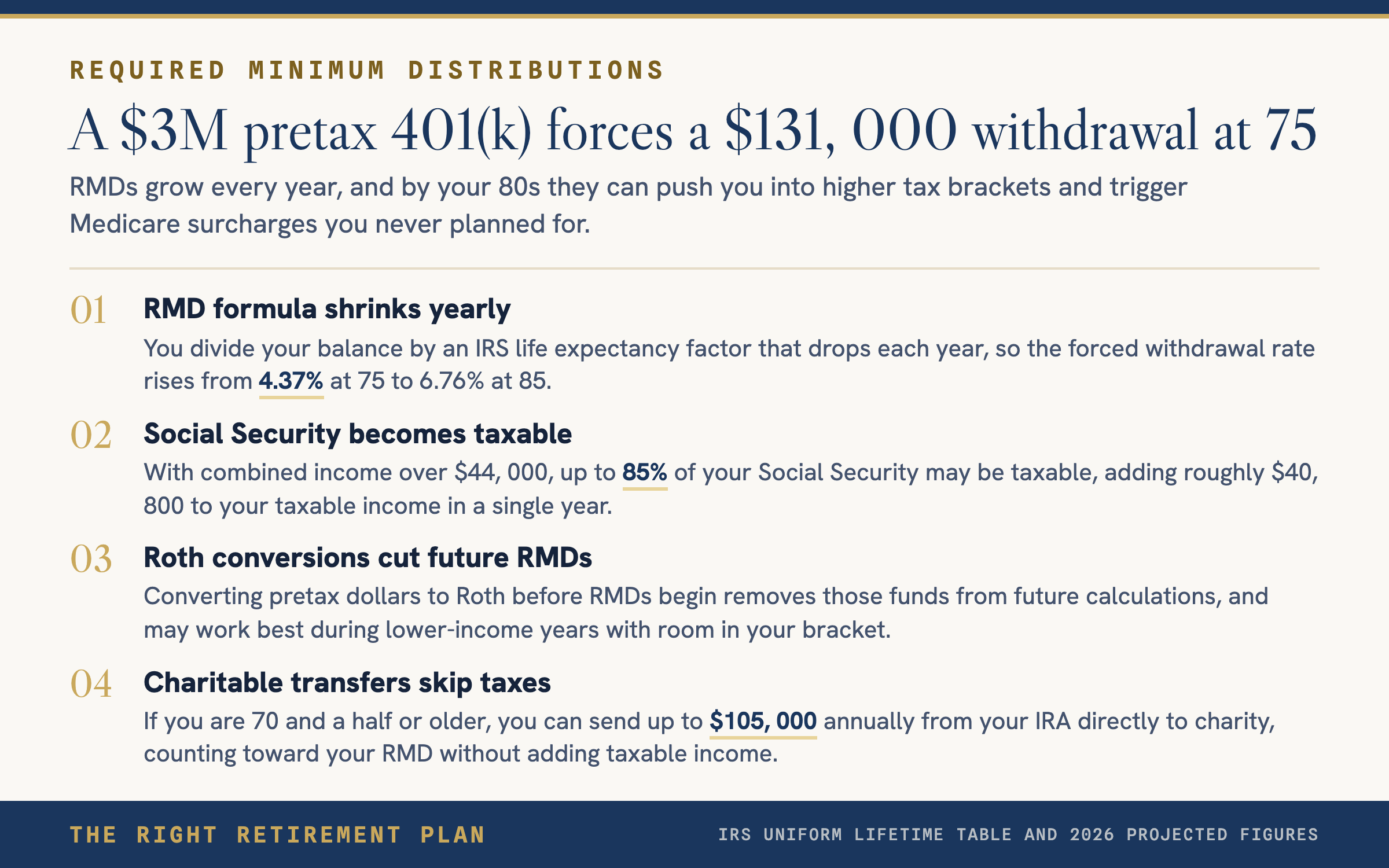
At age 75, a $3 million pretax 401(k) triggers a Required Minimum Distribution of approximately $113,000—money you must withdraw whether you need it or not. That forced income doesn't just create a tax bill; it can push you into higher brackets, trigger Medicare premium surcharges, and make more of your Social Security taxable. According to the Employee Benefit Research Institute, retirees with significant pretax assets frequently underestimate their lifetime tax burden by 20% or more.

The math gets worse with time. As IRS life expectancy divisors shrink each year, your required withdrawal percentage climbs even as your account potentially continues growing. What starts as a manageable $113,000 could balloon to $180,000 or more by age 85.

This article breaks down exactly how RMDs work in 2026, why the compounding effect catches so many retirees off guard, and what strategies may help reduce the long-term impact.

How the IRS Calculates Your Required Withdrawal

Required Minimum Distributions follow a straightforward formula: divide your December 31 account balance by the IRS life expectancy factor for your age. The catch is that this divisor shrinks every year, forcing out an ever-larger percentage of your savings.

For 2026, the IRS Uniform Lifetime Table sets the divisor at 24.6 for age 73, 23.7 for age 74, and 22.9 for age 75. Using that age-75 divisor:

  • $3,000,000 ÷ 22.9 = $131,004 (Note: the exact RMD varies based on prior-year balance and updated IRS tables)
The Social Security Administration reports that many retirees begin RMDs assuming they'll simply withdraw and spend what's required. But consider what happens when your portfolio continues growing despite withdrawals:
  • Age 75: $3M balance, 4.37% withdrawal rate, ~$131,000 RMD
  • Age 80: Assuming 5% annual growth minus RMDs, balance could be ~$3.1M, 5.35% withdrawal rate, ~$166,000 RMD
  • Age 85: Balance potentially ~$2.9M, 6.76% withdrawal rate, ~$196,000 RMD
These projections assume moderate growth and illustrate why RMDs often increase even as you withdraw substantial sums. The divisor at age 85 drops to 14.8, meaning you must withdraw nearly 7% of whatever remains—regardless of market conditions or your actual spending needs.

The IRS provides these tables in Publication 590-B, updated periodically. The SECURE 2.0 Act pushed the RMD starting age to 73 for those born between 1951 and 1959, and to 75 for those born in 1960 or later.

The Tax Bracket Cascade Effect

A $131,000 RMD doesn't exist in isolation—it stacks on top of your other income. For 2026, the federal tax brackets for married filing jointly are projected to be:

  • 10%: $0–$23,850
  • 12%: $23,851–$96,950
  • 22%: $96,951–$206,700
  • 24%: $206,701–$394,600
  • 32%: $394,601–$501,050
Now consider a typical scenario: you're 75, married, collecting $48,000 combined Social Security, and your RMD is $131,000. Here's how the math might unfold:

Social Security taxation: With a combined income (AGI + nontaxable interest + half of Social Security) exceeding $44,000, up to 85% of your Social Security becomes taxable. That's roughly $40,800 in additional taxable income.

Total taxable income before deductions: $131,000 (RMD) + $40,800 (taxable SS) = $171,800

After standard deduction ($32,300 for married 65+ in 2026): ~$139,500 taxable income

This lands you solidly in the 22% bracket—but that's just year one. By age 85, if that RMD climbs to $196,000, your taxable income could push into the 24% bracket or higher, depending on other income sources.

The compounding effect is significant. Research from Vanguard suggests that retirees who don't plan for rising RMDs may pay 15–25% more in lifetime taxes than those who implement strategic withdrawal sequencing earlier in retirement.

IRMAA: The Hidden Medicare Tax on High Earners

Medicare's Income-Related Monthly Adjustment Amount represents an additional cost that surprises many retirees. For 2026, Medicare uses your 2024 Modified Adjusted Gross Income to determine surcharges on Parts B and D premiums.

The 2026 IRMAA thresholds for married filing jointly are projected to be:

  • $212,000 or less: Standard premium (~$185/month for Part B)
  • $212,001–$266,000: +$74.00/month per person
  • $266,001–$332,000: +$185.00/month per person
  • $332,001–$398,000: +$295.60/month per person
  • $398,001–$750,000: +$406.20/month per person
  • Above $750,000: +$443.90/month per person
For a married couple, crossing even the first IRMAA threshold costs an additional $1,776 annually ($74 × 2 people × 12 months). Cross the $332,000 threshold, and you're paying $7,094 extra per year—just for Medicare premiums.

Here's what catches retirees: IRMAA thresholds aren't indexed aggressively for inflation, but RMDs grow with your account balance. A portfolio that grows 7% annually doubles roughly every 10 years. Even after withdrawals, many retirees find their RMDs pushing them into higher IRMAA brackets over time.

The Centers for Medicare & Medicaid Services (CMS) reports that approximately 7% of Medicare beneficiaries pay IRMAA surcharges—but that percentage is growing as more baby boomers reach RMD age with substantial pretax assets.

Strategies That May Reduce Long-Term RMD Impact

While no approach eliminates RMDs entirely, several strategies may help manage their impact over time:

Roth Conversions Before RMDs Begin

Converting pretax dollars to Roth accounts triggers taxes now but removes those dollars from future RMD calculations. A married couple in the 12% bracket with room before the 22% threshold might convert up to $73,050 annually at favorable rates.

The trade-off: you pay taxes today at known rates versus uncertain future rates on a potentially larger balance. Morningstar research suggests Roth conversions generally benefit retirees who expect to be in similar or higher brackets later, have a time horizon of 10+ years, and can pay conversion taxes from non-retirement funds.

Qualified Charitable Distributions

If you're 70½ or older and charitably inclined, QCDs allow direct transfers from your IRA to qualified charities—up to $105,000 in 2026. These count toward your RMD but don't appear as taxable income.

For someone facing a $131,000 RMD who normally donates $20,000 annually, using a QCD reduces taxable income by $20,000 compared to taking the RMD and donating separately.

Strategic Withdrawal Sequencing

The conventional wisdom of "spend taxable first, tax-deferred second, Roth last" doesn't account for the RMD cliff. Some retirees benefit from tapping pretax accounts earlier—especially in lower-income years between retirement and Social Security—to reduce the balance subject to RMDs.

At age 85, the IRS divisor drops to 14.8—forcing out 6.76% of your balance. At age 90, it's 11.4 (8.77% withdrawal). If your $3M portfolio grew to $4M despite earlier withdrawals, you could face RMDs exceeding $300,000 annually in your late 80s.

This isn't a problem you can solve at 85. The window for meaningful RMD reduction typically closes by age 75. Roth conversions become less effective as your time horizon shortens, and the math favors action in your 60s and early 70s.

Key Takeaways

  • A $3M pretax 401(k) requires approximately $131,000 in withdrawals at age 75, increasing each year as IRS divisors shrink
  • RMDs stack on top of Social Security, potentially making up to 85% of benefits taxable
  • IRMAA surcharges add $1,776 to $10,654 annually for couples exceeding income thresholds
  • By age 85, required withdrawal rates reach 6.76%—potentially forcing $200,000+ from a growing portfolio
  • Roth conversions before RMD age may reduce lifetime tax burden but require careful bracket management
  • QCDs offer a tax-efficient way to satisfy RMDs for those who donate to charity

Next Step

Understanding how RMDs affect your specific situation requires knowing where you stand today. The free Retire Ready Score at /quiz takes about two minutes and helps identify which retirement planning factors deserve your attention first.

ShareX / TwitterFacebook

Have questions about your specific situation? Take the free Retire Ready Score →

The Compound Effect

Weekly retirement insights in your inbox.

Plain-English breakdowns of the week’s most important retirement news, tax changes, and strategies. Free. Unsubscribe anytime.

Get THE RIGHT retirement plan for you.

Take the 2-minute Retire Ready Score assessment — free, no email required to start.

Take the Free Assessment →