Index Funds vs. Active Management: What the Data Actually Shows
Every year, the financial industry spends billions of dollars on research analysts, portfolio managers, and trading desks, all trying to beat the market. And every year, the data shows that most of them fail. For retirement investors who need every dollar to count, understanding this reality is essential.
What the SPIVA Scorecard Reveals
S&P Global publishes the SPIVA Scorecard, the most comprehensive study comparing actively managed funds against their benchmark indexes. The results are consistent and damning for active management.
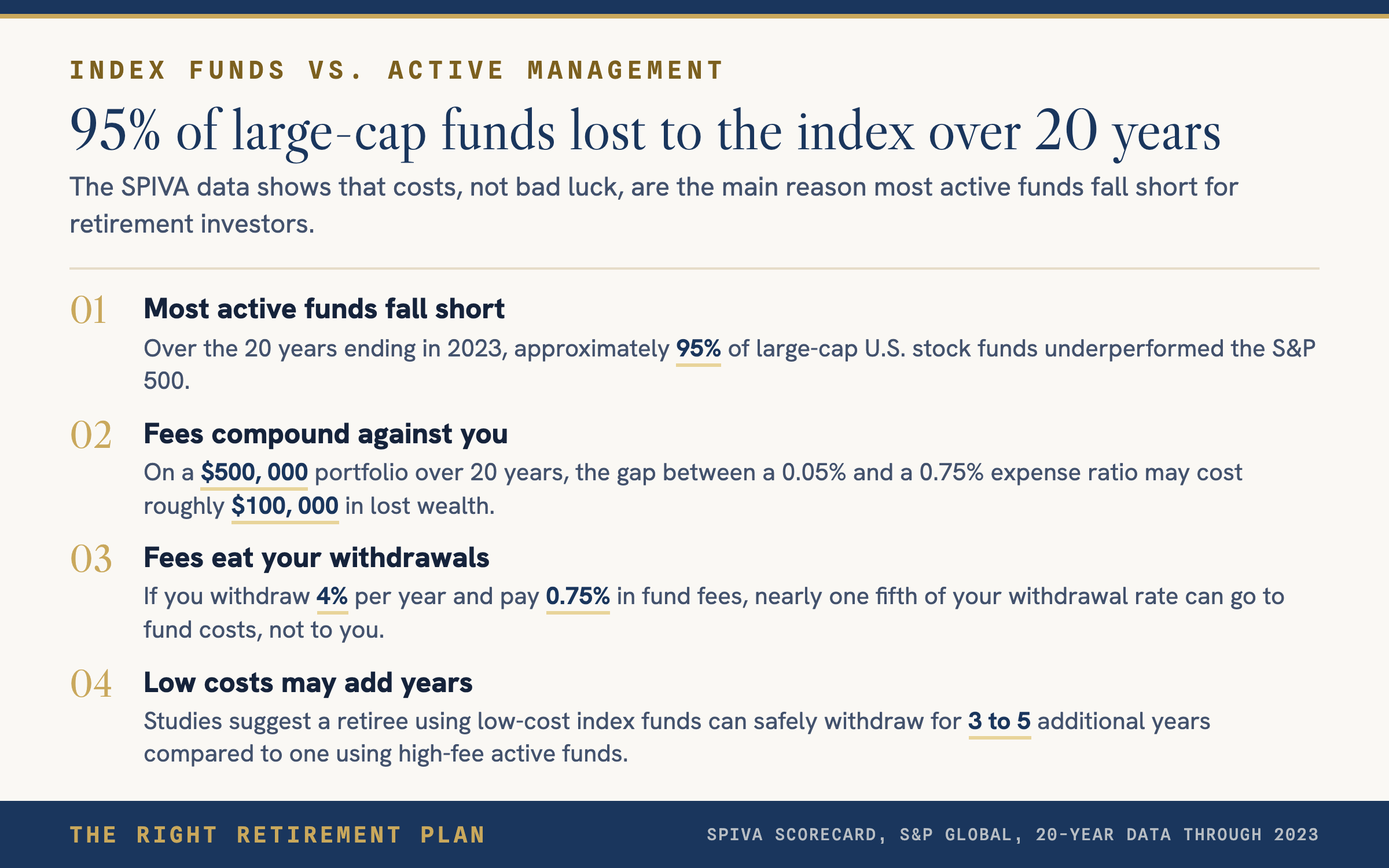
Over the 20 years ending in 2023, approximately 95% of large cap U.S. stock funds underperformed the S&P 500. The numbers are similar for mid cap, small cap, international, and bond funds. Across virtually every category, the majority of professional fund managers failed to beat a simple, low cost index fund.
This is not a fringe finding. It has been replicated across time periods, countries, and asset classes. The evidence is overwhelming.
Why Active Managers Underperform
The primary reason is cost. The average actively managed fund charges an expense ratio of roughly 0.50% to 1.00% per year. A broad market index fund might charge 0.03% to 0.10%. That difference may sound small, but it compounds dramatically.
Consider this: on a $500,000 portfolio over 20 years, the difference between a 0.05% expense ratio and a 0.75% expense ratio amounts to roughly $100,000 in lost wealth, assuming identical pre-fee returns. That is money that could have funded years of retirement income.
Beyond fees, active managers face trading costs, cash drag from holding reserves, and the simple mathematical reality that in aggregate, all investors hold the market. After costs, the average active investor must underperform the average index investor.
Why This Matters More in Retirement
When you are accumulating wealth in your 30s and 40s, high fees are costly but not catastrophic. You have decades to recover. But in retirement, fees work against you in two ways.
First, every dollar lost to fees is a dollar not generating income. If you are withdrawing 4% per year and paying 0.75% in fund fees, nearly one fifth of your withdrawal rate is going to your fund manager, not to you.
Second, fees compound against a shrinking portfolio. During the withdrawal phase, high costs accelerate depletion. Studies have shown that a retiree using low cost index funds can safely withdraw for 3 to 5 additional years compared to one using high fee active funds, assuming identical market returns.
The Case for Indexing in Retirement
Index funds offer three advantages that align perfectly with retirement needs:
Predictability. You know exactly what you own and what you are paying. There are no surprises from a manager making a bad bet.
Tax efficiency. Index funds generate fewer taxable events than actively managed funds, which matters if you hold investments in taxable accounts.
Low cost. The fee savings go directly into your pocket, extending the life of your portfolio.
When Active Management Might Make Sense
There are narrow situations where active management can add value, such as municipal bond funds or specialized emerging market strategies. But for the core of a retirement portfolio, the evidence overwhelmingly favors indexing.
The fund industry thrives on the belief that you can find the exception. The data shows that trying to find that exception is itself the biggest risk to your retirement savings.
Take the Next Step
Want to understand how much fees might be costing your retirement? Explore the free retirement tools at therightretirementplan.com/tools to run the numbers for your situation.
This content is for educational purposes only and should not be considered personalized investment advice. Consult a qualified financial professional before making investment decisions.