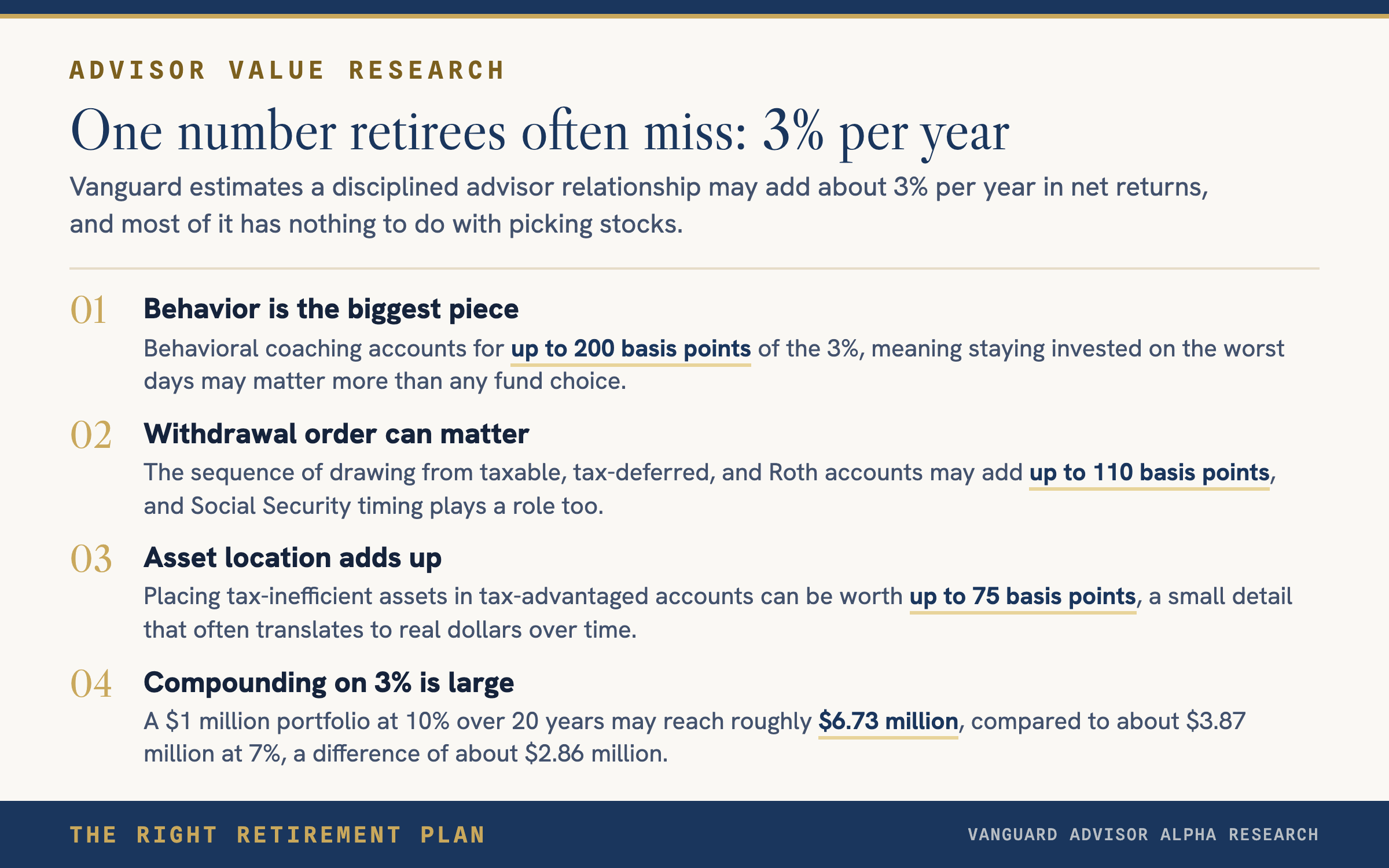
Here is a number more people should know.
Vanguard, the largest direct-to-investor broker in the world, estimates that a disciplined advisor relationship adds about 3% per year in net returns for the typical client. Every dollar a client moves to an advisor is a dollar that leaves Vanguard's platform, so they have no incentive to inflate the figure. They published it anyway, and they have been updating the math for more than a decade.
Three percent does not sound like much in isolation. The compounding does.
What 3% actually means to your money
A $1 million portfolio earning 7% over twenty years grows to roughly $3.87 million.
The same portfolio earning 10% (so 7% plus 3% in advisor value) over twenty years grows to roughly $6.73 million.
The difference is about $2.86 million. That is the kind of number that funds a grandchild's education, a second home, or the freedom to retire two years sooner without changing how you live.
Where Vanguard says the 3% comes from
Vanguard broke the three percent into seven specific behaviors. The numbers below are their estimates, and they are situational, meaning some retirees get more value from one piece and less from another.
- Behavioral coaching: up to 200 basis points. This is the biggest piece by far. It is the value of not selling in March of 2020. Not chasing tech in late 2021. Not piling into cash at 5% yields just before the curve normalizes. It is the value of an advisor who picks up the phone on the worst Tuesday of the year.
- Spending strategy in retirement: up to 110 basis points. The order you draw from taxable, tax-deferred, and Roth accounts matters more than most people realize. So does the timing of Social Security.
- Asset location: up to 75 basis points. Putting the tax-inefficient assets in the tax-advantaged accounts. Putting the long-duration growth in the Roth. Small details, real dollars.
- Cost-effective implementation: up to 30 basis points. Lower expense ratios, smarter share class selection, fewer hidden frictions.
- Rebalancing: up to 35 basis points. Selling what went up, buying what went down, on a schedule, without flinching.
- Suitable asset allocation and total-return investing. Harder to put a single number on, but real, and especially valuable when income needs are high and yields are not.
The catch: the 3% is available, not guaranteed
The Vanguard number is not automatic. The 3% is available. It is not guaranteed. It shows up for retirees who actually use the relationship. retirees who call before they trade. retirees who let the advisor pull the tax projection before December. retirees who say something when something at home changed, so the plan can be updated before it is overdue.
It does not show up for retirees who hire an advisor, ignore them, and only call when the market is already down 15%.
What to look for in a fiduciary advisor
This is also why the kind of advisor matters. A fee-only fiduciary is paid by you, the client, with no hidden commissions on any specific product. Their incentive to be worth their fee three times over is exactly aligned with the seven categories Vanguard quantified. A commission-based broker has no comparable structural reason to focus on behavioral coaching, because their pay does not depend on it.
Specific things to confirm when interviewing an advisor:
- They are a registered investment advisor (firm) or a CFP held to a fiduciary standard year-round, not just when selling certain products.
- They are fee-only (not "fee-based," which can include commissions).
- They publish their full fee schedule in writing before you sign anything.
- They will walk you through the seven Vanguard categories specifically and tell you how their process delivers each.
Read the original research
The full paper, including the methodology behind each component, is published openly by Vanguard's institutional research team: Putting a Value on Your Value: Quantifying Vanguard Advisor's Alpha. Worth bookmarking.
Frequently asked questions
Does a 1% advisor fee really pay for itself if Vanguard says 3% added?
Vanguard's number is net of typical advisor fees. So a 1% fee structure that delivers the full 3% in gross behavioral and tax value still nets to a 2% benefit per year for the client. The math works for retirees who use the relationship. It does not work for retirees who do not.
Is the 3% guaranteed?
No. Vanguard's estimate is an average across a population of disciplined relationships. Individual results vary based on how complicated the client's tax situation is, how disciplined they are about following the plan, and how much value the advisor can actually deliver in behavioral coaching during volatility.
What is the single biggest piece of the 3%?
Behavioral coaching, at up to 2% of the 3% total. The other six categories together account for the remaining ~1%.
When does an advisor add the most value?
At market extremes (both fear and euphoria) and at major life transitions (retirement, inheritance, business sale, divorce, death of a spouse). These are the moments when small decisions compound into large dollar outcomes for decades.