Tax Loss Harvesting In Retirement, When It Helps And When It Hurts
Tax loss harvesting sounds like a free lunch. You sell an investment at a loss, book the loss on your taxes, and buy something similar to keep your exposure. On paper you lower your tax bill while staying invested. In reality, it is one of the most misused strategies in retirement planning. Used right, it can add measurable after tax return every year. Used wrong, it creates phantom savings that disappear the moment you actually need the money.
What Tax Loss Harvesting Actually Does
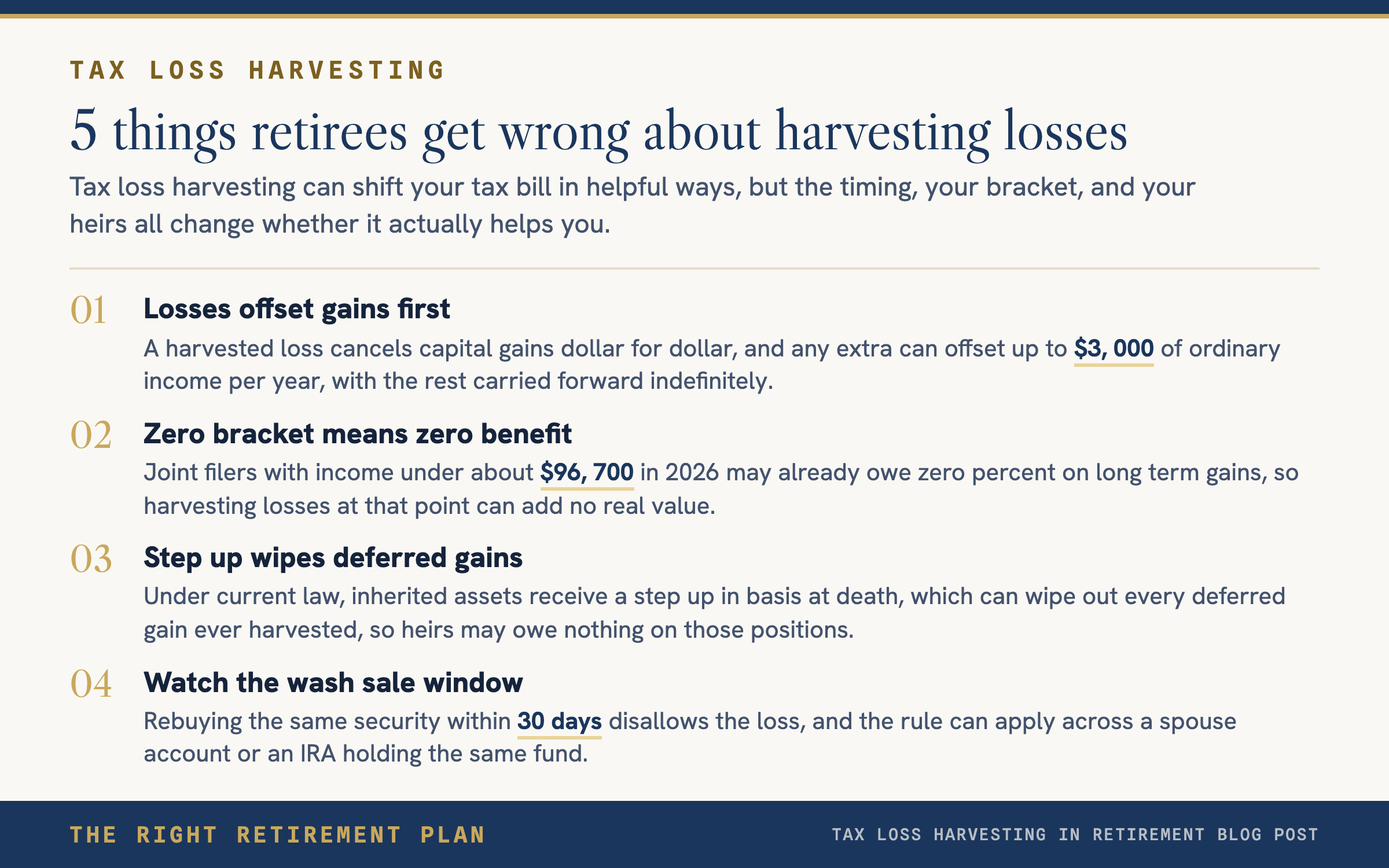
When you sell a taxable investment for less than you paid, the loss offsets capital gains dollar for dollar. If your losses exceed your gains, you can use up to $3,000 per year to offset ordinary income. Anything left over carries forward to future years with no expiration. In a volatile market this adds up quickly. A retiree with a diversified taxable account can often harvest tens of thousands of dollars in losses during a correction without changing their overall allocation.
The catch is the cost basis. Every loss you harvest lowers the cost basis of the replacement investment. When you eventually sell the replacement, that deferred gain comes back and shows up on a future return. Tax loss harvesting does not erase taxes. It shifts them. The question is whether the shift helps you.
When Harvesting Helps
Harvesting is most powerful when you are still working and in a high bracket. You save at 24 or 32 percent today and eventually pay back at 15 percent long term capital gains, or zero percent if your income drops enough in retirement. That spread is real and permanent.
It also helps when you plan to leave the replacement investment to your heirs. Under current law, inherited assets receive a step up in basis at death, which wipes out every deferred gain you ever harvested. In that case the tax you deferred is never paid by anyone.
Market volatility, like the pullbacks we saw during the recent war headlines and rate shocks, creates natural harvesting windows. A diversified portfolio will almost always have a few positions in the red even when the index is up, especially in international stocks, small caps, and longer duration bonds.
When Harvesting Hurts
The strategy turns on you in three common situations. First, if you are already in the zero percent long term capital gains bracket, which is income under about $96,700 for joint filers in 2026, you are harvesting losses at zero value. You would have paid no tax on the gain anyway. Second, if you trigger a wash sale by rebuying the same security within thirty days, the loss is disallowed and added back to your basis. Many robo advisors avoid this with paired funds, but it is easy to trip up if you also hold the same fund in an IRA or in a spouse account. Third, if you harvest aggressively in a taxable account while planning large Roth conversions, you can accidentally push yourself over an IRMAA cliff or into the 85 percent Social Security taxation threshold, which wipes out the savings.
If you are not sure whether your taxable account is being harvested intelligently, take our free Retire Ready Score. It will flag the portfolios where harvesting is adding real value, and the ones where it is quietly working against you.