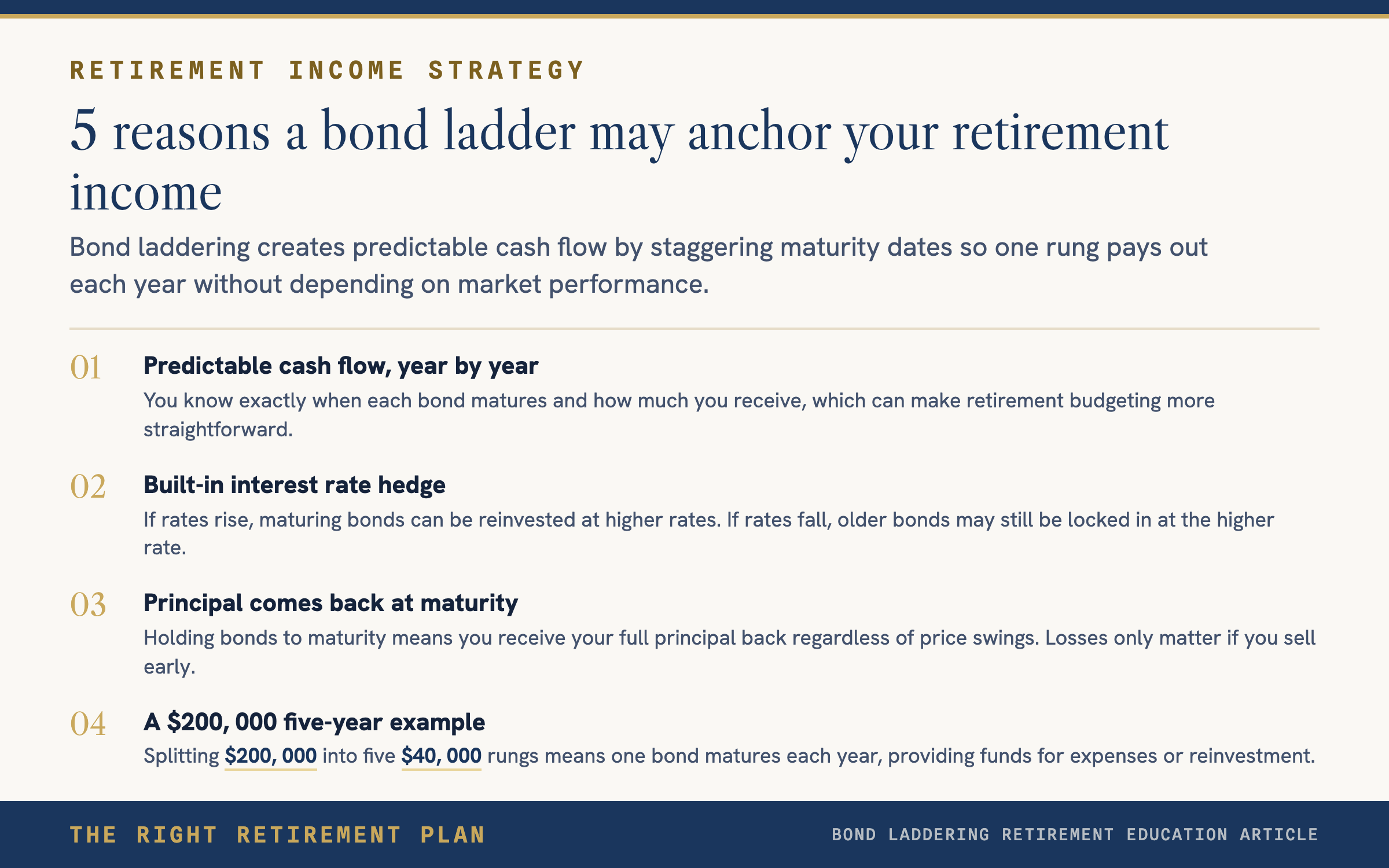
Bond Laddering: The Retirement Income Strategy Most People Overlook
When most people think about retirement income, they think about Social Security, pensions, or dividend stocks. But there is a time-tested strategy that creates reliable, predictable cash flow without depending on market performance: bond laddering.
Despite its simplicity and effectiveness, most pre-retirees have never considered it. That is a missed opportunity.
What Is a Bond Ladder?
A bond ladder is a portfolio of individual bonds with staggered maturity dates. Instead of buying one bond that matures in 10 years, you buy a series of bonds that mature in 1 year, 2 years, 3 years, and so on.
When each bond matures, you receive your principal back. You can either use that money for living expenses or reinvest it in a new bond at the longest rung of your ladder. This creates a rolling cycle of predictable income.
For example, with $200,000, you might build a 5 year ladder:
- $40,000 in a bond maturing in 1 year
- $40,000 in a bond maturing in 2 years
- $40,000 in a bond maturing in 3 years
- $40,000 in a bond maturing in 4 years
- $40,000 in a bond maturing in 5 years
Why It Works for Retirement Income
Bond laddering solves several problems that retirees face.
Predictable cash flow. You know exactly when each bond matures and how much you will receive. This makes budgeting straightforward.
Interest rate protection. If rates rise, your maturing bonds get reinvested at higher rates. If rates fall, you still have bonds locked in at the older, higher rates. This natural hedging smooths out the impact of rate changes.
No market timing required. You are not trying to guess where interest rates are headed. The ladder adjusts automatically as bonds mature and are reinvested.
Principal preservation. If you hold bonds to maturity, you receive your full principal back regardless of what bond prices do in the interim. Price fluctuations only matter if you sell early.
How to Structure a Bond Ladder
The right structure depends on your situation, but here are some general principles.
Choose your time horizon. Many retirees build 5 to 10 year ladders. Shorter ladders provide more liquidity. Longer ladders typically offer higher yields.
Select the bond type. Treasury bonds are the safest option and are exempt from state and local taxes. High quality corporate bonds offer slightly higher yields with modest additional risk. Municipal bonds can be attractive if you are in a higher tax bracket.
Space the maturities evenly. Annual maturities are most common, but you can use semi-annual intervals if you need more frequent income.
Reinvest or spend at maturity. Decide in advance which rungs you will use for income and which you will roll into new bonds. This keeps the strategy disciplined.
A bond ladder is not meant to compete with stocks for growth. It is meant to provide the stable income floor that allows the rest of your portfolio to stay invested in equities for growth. When you have two to five years of living expenses secured in a bond ladder, you can ride out stock market downturns without selling at a loss.
The real value of a bond ladder is not the yield. It is the peace of mind that lets you hold your stock positions through volatility. That behavioral benefit often adds more value than the interest payments themselves.
Take the Next Step
Curious how a bond ladder could fit into your retirement income plan? Take the free quiz at therightretirementplan.com/quiz to explore strategies matched to your timeline.
This content is for educational purposes only and should not be considered personalized investment advice. Consult a qualified financial professional before making investment decisions.