Ray Dalio's All Weather Portfolio: Does It Work for Retirees?
Ray Dalio, founder of Bridgewater Associates, developed the All Weather Portfolio to survive and grow in any economic season: inflation, deflation, rising growth, or declining growth. The idea is elegant. Instead of betting on one outcome, you build a portfolio that is prepared for all of them.
For retirees and pre-retirees who need consistency above all else, this concept deserves a closer look.
What Is the All Weather Portfolio?
The traditional version of Dalio's All Weather allocation looks something like this:
- 30% stocks
- 40% long-term bonds
- 15% intermediate-term bonds
- 7.5% gold
- 7.5% commodities
Historically, this approach has delivered solid risk-adjusted returns with significantly smaller drawdowns than a traditional stock-heavy portfolio.
Why It Appeals to Retirees
The biggest fear for most retirees is not missing out on gains. It is suffering a catastrophic loss at the wrong time. The All Weather Portfolio is built to minimize exactly that.
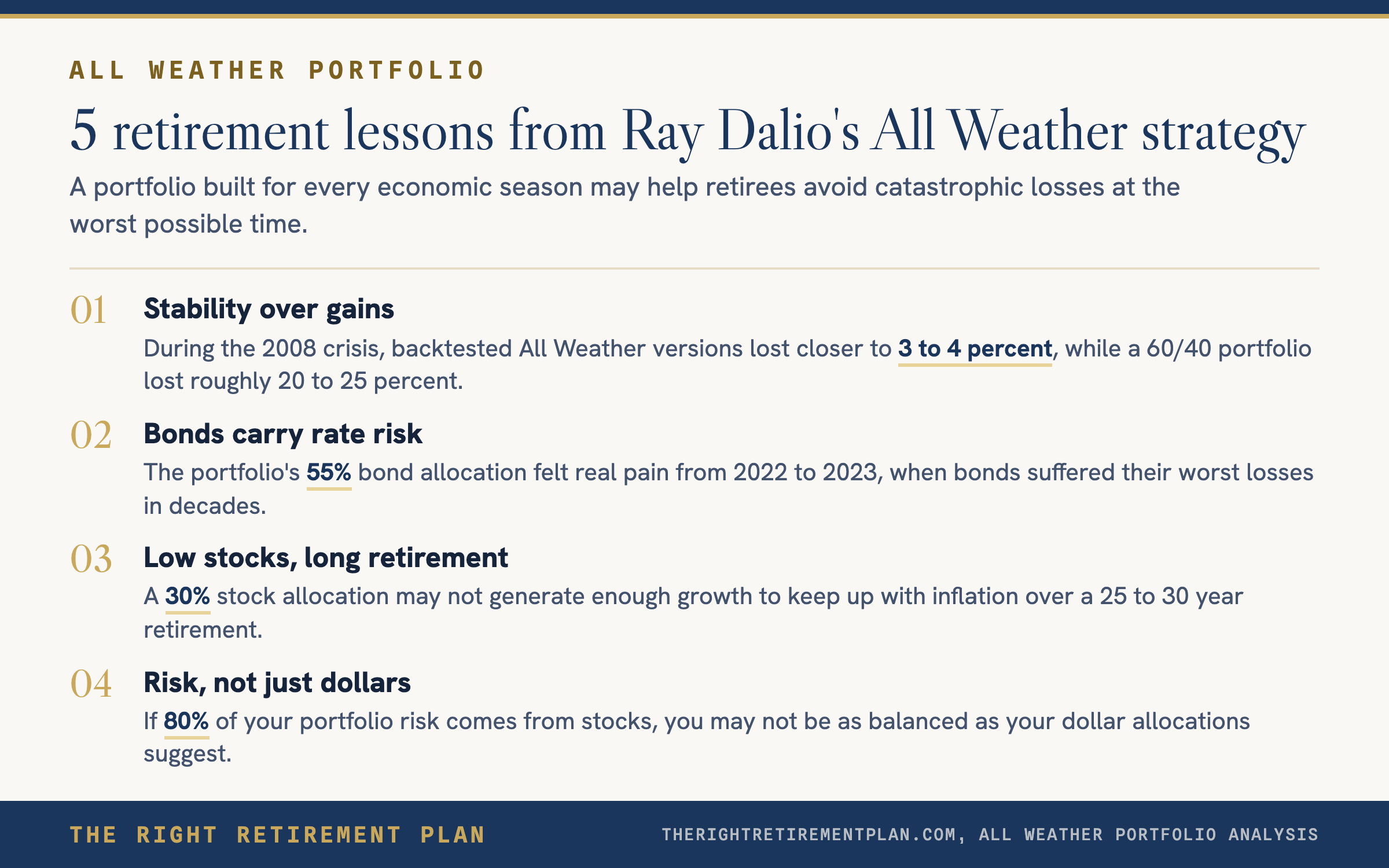
During the 2008 financial crisis, while a traditional 60/40 portfolio lost roughly 20 to 25 percent, backtested versions of the All Weather Portfolio lost closer to 3 to 4 percent. That kind of stability can mean the difference between a comfortable retirement and a crisis.
The approach also reduces the need to constantly monitor and adjust your portfolio. You are not trying to predict what the economy will do next. You are simply prepared for all outcomes.
Where It Falls Short
The All Weather Portfolio is not perfect, especially for retirees.
First, the heavy bond allocation (55%) becomes a problem when interest rates are rising. From 2022 to 2023, bonds suffered their worst losses in decades, and the All Weather Portfolio felt the pain. While it recovered, the experience reminded investors that no strategy is truly immune to losses.
Second, the relatively low stock allocation (30%) means you may not generate enough growth to keep up with inflation over a 25 to 30 year retirement. Longevity risk is real, and a portfolio that is too conservative can be just as dangerous as one that is too aggressive.
Third, gold and commodities add complexity. Many retirees are better served by simpler portfolios that are easier to manage and rebalance.
How to Apply the Principles Without Copying the Exact Portfolio
You do not need to replicate Dalio's exact allocation to benefit from his thinking. Here is what you can take away:
Diversify across truly different asset classes. Owning five stock funds is not diversification. Make sure your portfolio includes assets that behave differently in different environments.
Think about risk, not just dollars. If 80% of your portfolio risk comes from stocks, you are not as balanced as you think.
Prepare for multiple economic scenarios. Have some inflation protection (like TIPS or real assets), some deflation protection (like high quality bonds), and growth assets (like equities).
For retirees, the most valuable version of this principle is simple: never put yourself in a position where one bad year forces you to change your lifestyle. Build in buffers, diversify genuinely, and prioritize resilience over returns.
Take the Next Step
Curious how diversified your retirement portfolio actually is? Explore the free planning tools at therightretirementplan.com/tools to evaluate your current allocation.
This content is for educational purposes only and should not be considered personalized investment advice. Consult a qualified financial professional before making investment decisions.