Why International Diversification Matters Even in Retirement
If you are like most American investors, the overwhelming majority of your stock holdings are in U.S. companies. You are not alone. Studies consistently show that American investors allocate 70 to 80% of their equity portfolios domestically, even though the U.S. represents only about 60% of global stock market value.
This tendency, known as home country bias, is understandable. U.S. stocks have performed exceptionally well over the past decade. You know these companies. You use their products. But comfort and familiarity are not the same as sound diversification.
The Problem With Going All In on America
The U.S. stock market has been the world's best performer since roughly 2010. But that has not always been the case, and there is no guarantee it will continue.
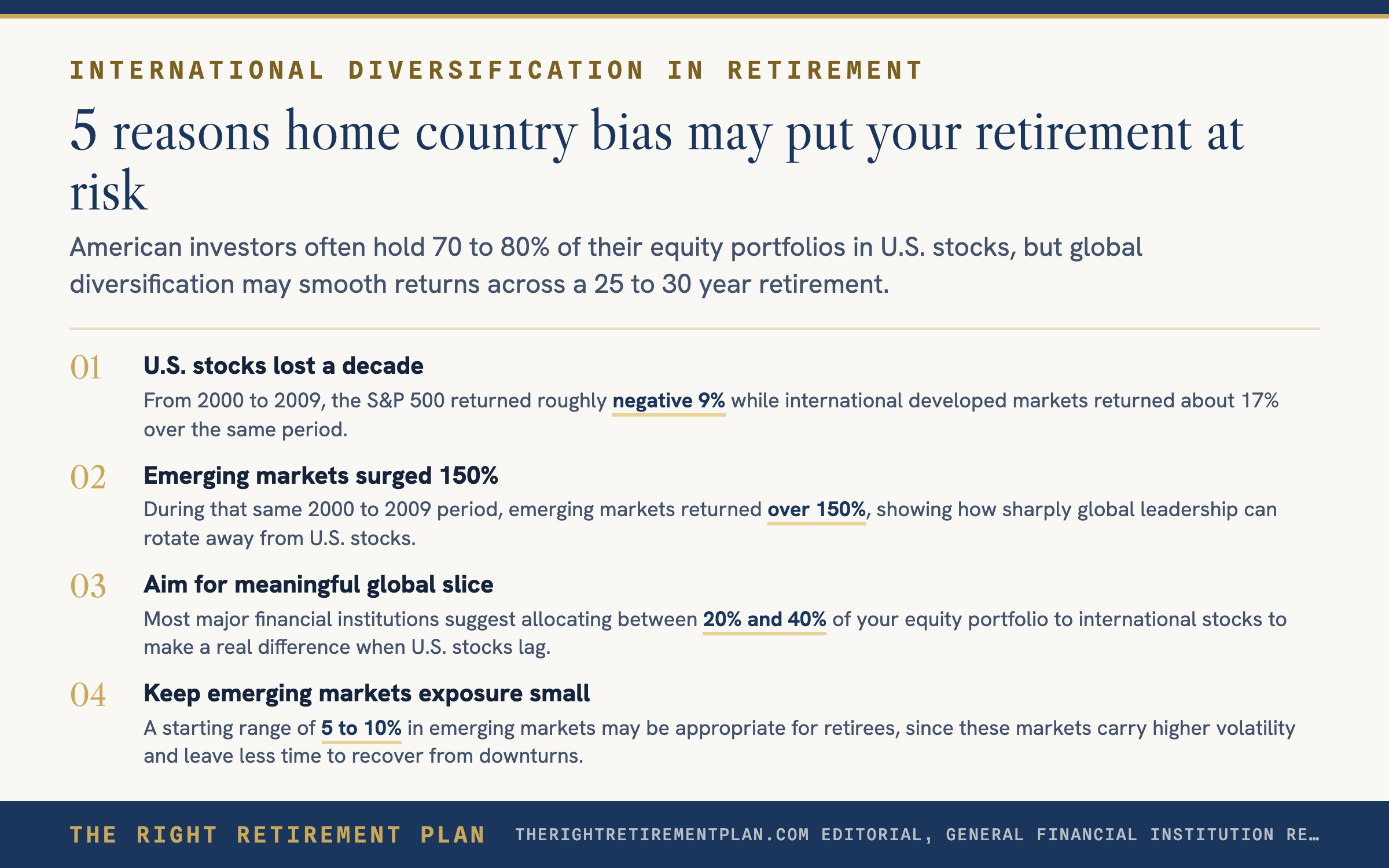
From 2000 to 2009, the S&P 500 delivered a total return of approximately negative 9% for the entire decade. During that same period, international developed markets returned roughly 17%, and emerging markets returned over 150%. An investor who was 100% in U.S. stocks lost money over an entire decade while global investors earned solid returns.
From the early 1970s through the late 1980s, Japanese stocks dramatically outperformed U.S. stocks. Then from 2003 through 2007, emerging markets led the world. Market leadership rotates, and it is impossible to predict when the rotation will happen.
For a retiree who needs consistent returns to fund 25 to 30 years of spending, betting entirely on one country's continued dominance is a significant gamble.
How International Diversification Helps
Reduced volatility through low correlation. U.S. and international stocks do not move in lockstep. Combining them produces a smoother return path, which is especially valuable when you are withdrawing money regularly.
Access to global growth. Many of the world's fastest growing economies are outside the United States. Emerging markets represent billions of consumers entering the middle class. Excluding them means missing significant global economic growth.
Currency diversification. Holding international investments provides natural protection against a declining U.S. dollar. If the dollar weakens, your foreign holdings become worth more in dollar terms.
Valuation opportunities. International stocks have recently traded at significantly lower valuations than U.S. stocks. Lower starting valuations have historically been associated with higher future returns.
How Much International Exposure Is Appropriate?
There is no single correct answer, but most major financial institutions suggest that U.S. investors allocate between 20% and 40% of their equity portfolio to international stocks.
Vanguard's research suggests that a 40% international allocation provides the best diversification benefit. Other firms recommend 20 to 30%. The exact percentage matters less than having a meaningful allocation that can actually make a difference during periods when U.S. stocks lag.
For retirees, a reasonable starting point might be:
- 60 to 75% U.S. stocks within your equity allocation
- 15 to 30% international developed markets (Europe, Japan, Australia)
- 5 to 10% emerging markets
Diversification means always having something in your portfolio that you wish you did not own. That is not a flaw. That is the point. The asset that disappoints you today may be the one that saves your retirement tomorrow.
The purpose of international diversification is not to maximize returns in any given year. It is to ensure that no single country's bear market can derail your entire retirement.
Take the Next Step
Want to check whether your portfolio has dangerous blind spots? Explore the free retirement planning tools at therightretirementplan.com/tools to evaluate your diversification.
This content is for educational purposes only and should not be considered personalized investment advice. Consult a qualified financial professional before making investment decisions.