The 60/40 Portfolio Is Not Dead: Why Balanced Investing Still Works
If you followed financial news in 2022, you probably saw the obituaries. "The 60/40 portfolio is dead," analysts declared. Stocks fell. Bonds fell alongside them. The traditional balanced approach that had worked for decades seemed broken.
But reports of its death have been greatly exaggerated. For pre-retirees looking for a reliable framework, the 60/40 portfolio still deserves your attention.
What Is the 60/40 Portfolio?
The concept is straightforward. You invest 60% of your portfolio in stocks for growth and 40% in bonds for stability and income. When stocks drop, bonds typically hold steady or rise, cushioning the blow. When stocks surge, the equity allocation drives growth.
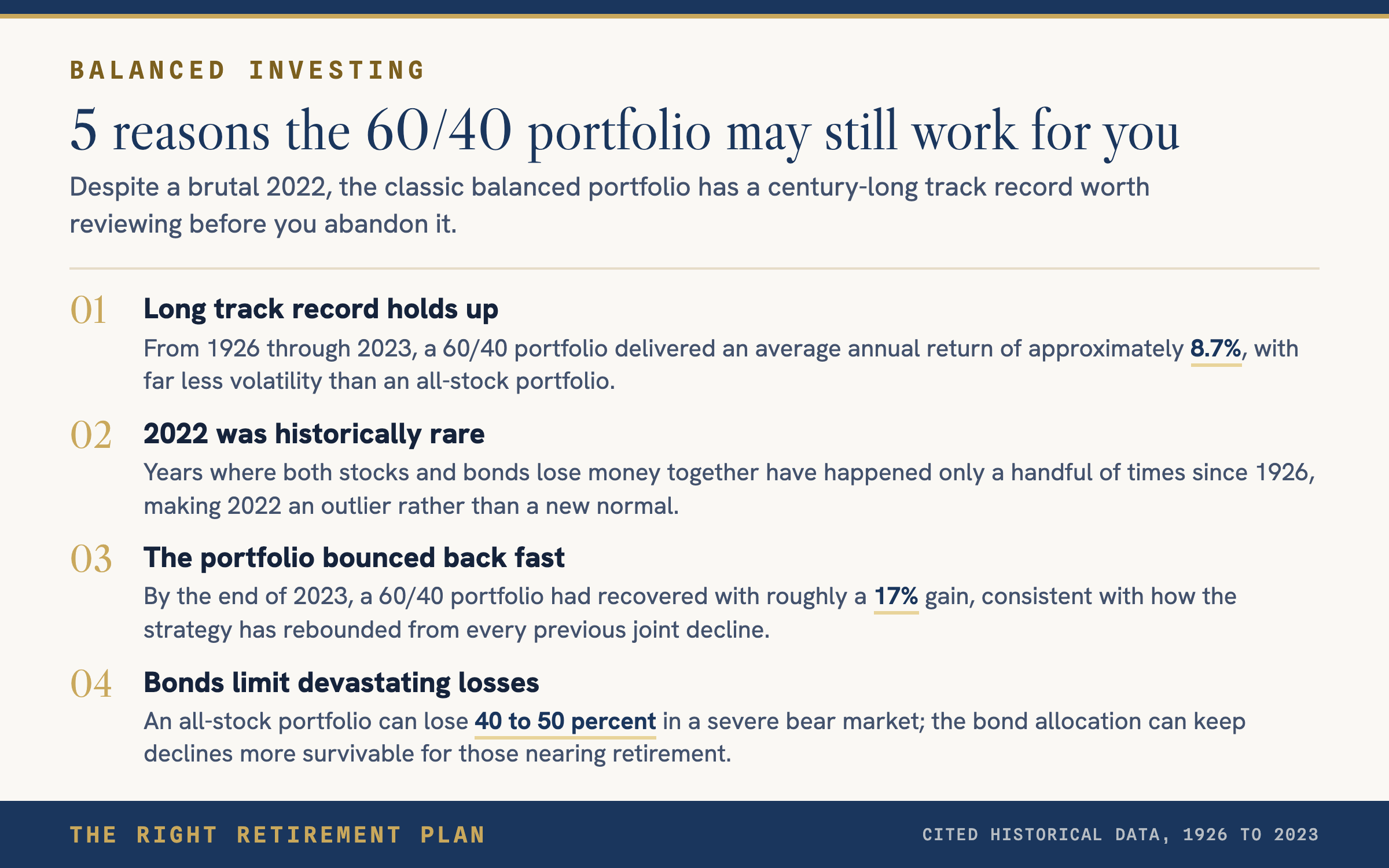
This approach has been the backbone of retirement investing for more than half a century. From 1926 through 2023, a 60/40 portfolio delivered an average annual return of approximately 8.7%, with far less volatility than an all stock portfolio.
Why 2022 Was an Outlier, Not the New Normal
In 2022, both stocks and bonds declined simultaneously. The S&P 500 fell roughly 18%, and the Bloomberg Aggregate Bond Index dropped about 13%. A 60/40 portfolio lost approximately 16%, its worst calendar year in decades.
What caused this? The Federal Reserve raised interest rates at the fastest pace in 40 years to fight inflation. Rising rates push bond prices down, and the speed of the increase was historically unusual.
Here is the critical context: years where both stocks and bonds lose money are exceptionally rare. Going back to 1926, it has happened only a handful of times. And in every previous instance, the 60/40 portfolio recovered within one to two years.
By the end of 2023, a 60/40 portfolio had bounced back with roughly a 17% gain. That is exactly how the strategy is supposed to work over time.
Why It Still Makes Sense for Pre-Retirees
The 60/40 portfolio is not designed to beat the market every year. It is designed to deliver solid long-term returns while keeping losses manageable. For someone 5 to 10 years from retirement, that trade-off is exactly right.
Here is why:
You cannot afford a 50% drawdown. An all stock portfolio can and does lose 40 to 50 percent in severe bear markets. If that happens right before or after you retire, the damage to your income plan can be permanent.
You still need growth. A retirement that lasts 25 to 30 years requires your money to keep working. Bonds alone will not outpace inflation. The 60% equity allocation provides the growth engine.
Simplicity reduces mistakes. Complex strategies with many moving parts create more opportunities to make emotional decisions. The 60/40 framework is easy to understand, easy to maintain, and hard to mess up.
Modern Variations Worth Considering
The classic 60/40 split is a starting point, not a rigid rule. Some planners adjust the bond allocation to include TIPS for inflation defense. Others add international stocks for broader diversification. Some pre-retirees use a glide path, starting at 60/40 and shifting toward 50/50 as they enter retirement.
The exact numbers matter less than the principle: maintain a meaningful allocation to both growth and stability.
What most people miss is that the 60/40 portfolio's strength is not in avoiding all losses. It is in keeping losses survivable. A 16% decline is unpleasant. A 40% decline can be devastating. The difference between those two outcomes is what the bond allocation buys you.
The real risk for pre-retirees is not owning a "boring" balanced portfolio. It is abandoning a sound strategy after one bad year and chasing something that looks better in hindsight.
Take the Next Step
Wondering if a balanced approach fits your retirement timeline? Take the free quiz at therightretirementplan.com/quiz to see where you stand.
This content is for educational purposes only and should not be considered personalized investment advice. Consult a qualified financial professional before making investment decisions.