The Pattern Is Boring On Purpose
The person walking into their first big paycheck and the person drawing income from a portfolio at 70 are the same human, separated by decisions. The retirees who finish well almost never tell a story about a winning stock. They tell a story about a structure that survived their own moods.
Get the structure right and the journey is uneventful. Get it wrong and most of retirement is spent repairing what should have already been built.
The Seven Habits That Show Up Every Time
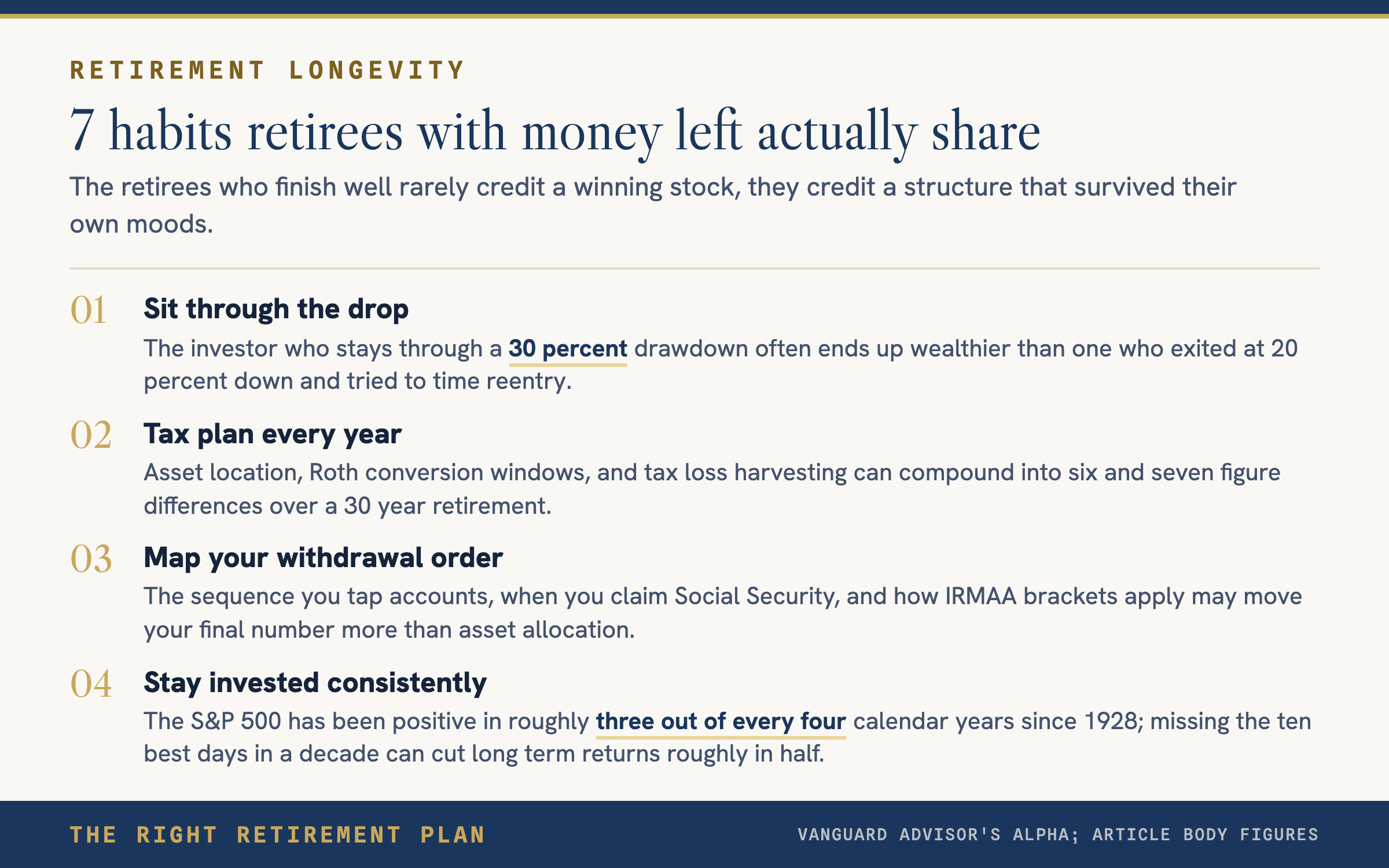
- Discipline over brilliance. The portfolio that wins over 30 years is rarely the cleverest. It is the one the household sat through. The investor who stays seated through a 30 percent drawdown ends up wealthier than the one who got out at 20 percent down and tried to time getting back in.
- A written plan that ties investments to income needs. Not a stock pick. A plan that names what comes from where, in which year, and what triggers a change.
- Stay invested. The S&P 500 has been positive in roughly three out of every four calendar years going back to 1928. Missing the ten best days in any decade cuts the long term return roughly in half. Those days cluster near the worst days.
- Let the holdings hold. Trading is a tax on the impatient. Every transaction is a chance to be wrong twice, once on the way out and once on the way back in.
- Tax planning every single year. Asset location, capital gain budgeting, tax loss harvesting, Roth conversion windows, charitable timing. The household that pays attention to taxes annually ends up with a meaningfully larger pile, not because the return was higher but because the leakage was lower.
- A withdrawal map. The order accounts are tapped, when Social Security is claimed, and how Medicare and IRMAA brackets shape the next decade can move the final number more than asset allocation.
- A real annual review. Tax law moves. Goals move. Allocations drift. Once a year, sit down, mark up the plan, decide what changed, and adjust.
What This Looks Like In Numbers
A dollar invested at 7 percent for 20 years becomes about 3.87 dollars. A dollar at 10 percent for the same window becomes about 6.73 dollars. That is a 74 percent larger pile in dollar terms on the same starting capital, on the same timeline. Stretch it to 30 years and the gap roughly doubles again. The 3 percent gap is not a bonus paid at the end. It is wealth that compounds in perpetuity, year after year, and keeps widening every decade.
The goal is not to find a 3 percent edge through investment selection. The goal is to leave the easy 1 to 2 percent on the table that most households leave through panic selling, missed Roth windows, ignored tax loss harvesting, and a withdrawal sequence built by accident.
Frequently Asked Questions
Do I really need a written retirement plan?
Yes. The household with a written plan adjusts at the margins. The household without one adjusts under stress, which is the most expensive time to make a decision.
How much does behavioral coaching actually save?
Vanguard's Advisor's Alpha research, updated regularly since 2001, attributes roughly 1.5 percent a year to behavioral coaching alone. Compounded over a 30 year retirement that is not a small number.
What is the right withdrawal order in retirement?
There is no single right order. Common patterns start with taxable accounts, then traditional retirement accounts, then Roth, with Social Security and Roth conversions used to smooth the brackets. The right order depends on RMD projections, IRMAA tiers, and legacy goals.
Should I rebalance during a market drop?
Usually yes. Rebalancing buys low and sells high in slow motion. The discipline matters more than the timing.
What does an annual review actually cover?
Tax position, withdrawal pace, asset allocation drift, Social Security claiming readiness, beneficiary designations, IRMAA bracket projection, and any planned conversions or harvests for the year. A 60 to 90 minute review catches most of what would otherwise become a problem.