The Quiet Tax on Emotional Decisions
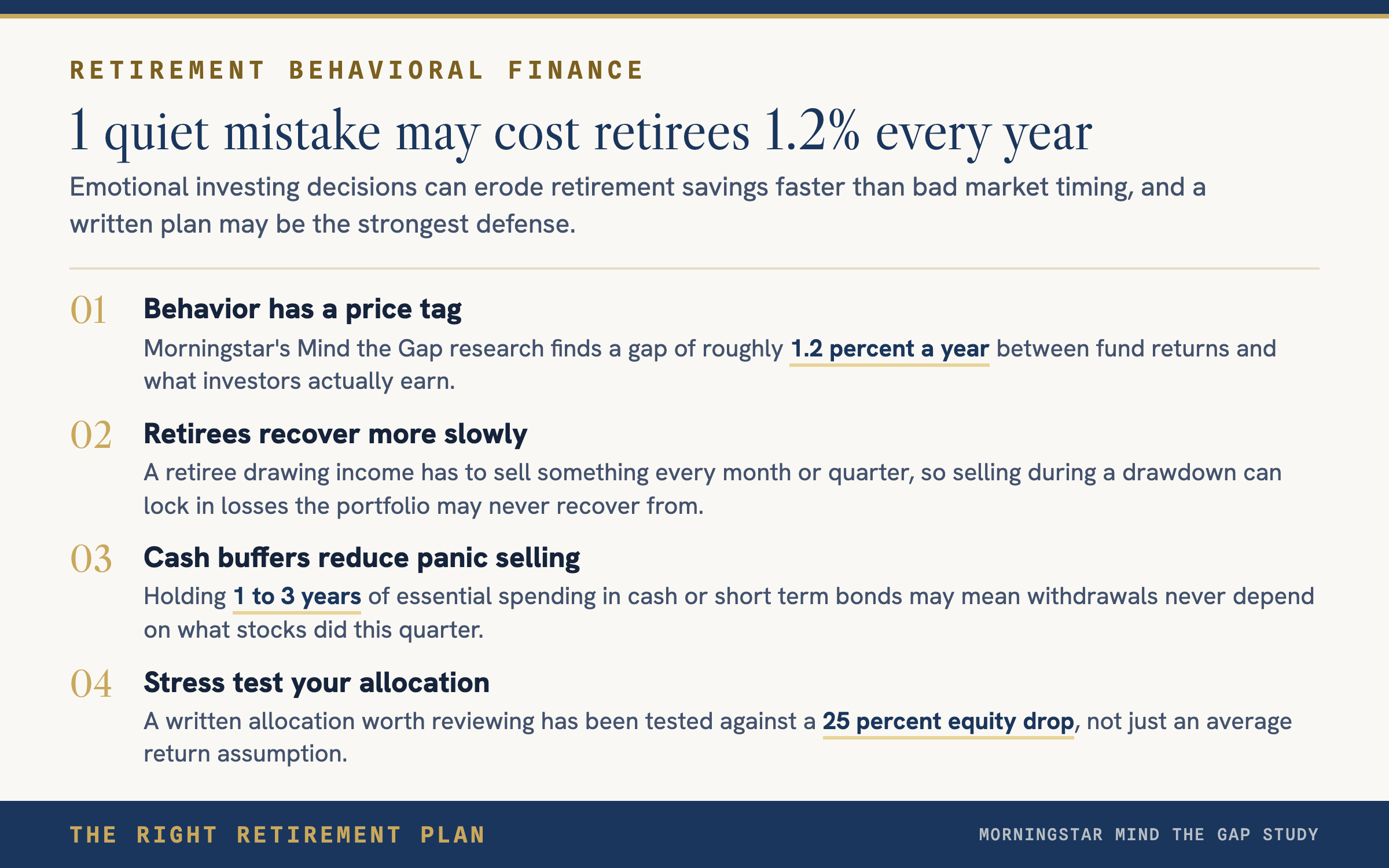
Morningstar research has tracked the gap between what funds return and what investors actually earn for almost two decades. The number keeps landing in the same place. Behavior costs the average investor roughly 1.2 percent a year, mostly through panic selling, performance chasing, and trying to time the market.
For a worker in their 30s, that gap is annoying. For a retiree drawing income, it is structural. There are fewer years left to recover, and any sale during a downturn is a permanent loss of compounding.
The S&P 500 has returned roughly 28 percent over the past year and 71 percent over the past five years through multiple geopolitical shocks. Retirees who sold in early 2025 or late March 2026 when the VIX spiked above 30 locked in the worst of those years and missed the rebound.
A Plan Is Not a Forecast
The goal of a retirement plan is not to predict markets. It is to make sure a 2 percent down day, or a 20 percent down year, never forces a panicked decision. That requires three things on paper before the next bad headline.
- Cash and short term reserves covering 1 to 3 years of essential spending, so withdrawals never have to come from stocks during a drawdown.
- A written allocation that has been stress tested against a 25 percent equity drop, not just an average return assumption.
- An income map that names which account each dollar comes from in which year, so the question is already answered when fear shows up.
Frequently Asked Questions
What is behavioral finance in the context of retirement?
Behavioral finance is the study of how emotions and cognitive biases drive investment decisions. In retirement, the most expensive biases are loss aversion, which leads to panic selling at lows, and recency bias, which leads to chasing whatever just performed well.
How much do behavioral mistakes really cost?
Morningstar's Mind the Gap research has consistently found a gap of roughly 1.2 percent a year between fund returns and investor returns. Over a 30 year retirement, that drag can compound into hundreds of thousands of dollars.
Why are retirees more exposed than younger investors?
A working investor can dollar cost average through a downturn. A retiree drawing income has to sell something every month or quarter. Selling stocks during a drawdown locks in losses that the portfolio cannot recover from.
What is the simplest way to reduce panic selling?
Hold 1 to 3 years of essential spending in cash or short term bonds, so withdrawals never depend on what stocks did this quarter. The buffer turns a market headline into a non event.
Does a financial advisor actually help with behavior?
Vanguard, Russell, and Morningstar have all tried to quantify advisor alpha and behavioral coaching consistently shows up as the largest contributor, often estimated at 1 to 2 percent a year, mostly because a written plan stops emotional decisions before they happen.
Take The Next Step
If you want a quick read on how your current setup would handle the next bad market, take the free Retire Ready Score. It is a short assessment built around the five pillars of a complete retirement plan, with no pitch on the other side.