The Real Cost of Confusing Activity With Progress

Most investors lose three to four percent a year to themselves, not the market. The cause is mistaking trading activity for smart management. Here is what the data says, and what we do about it.

The Real Cost of Confusing Activity With Progress

There is a quiet number that almost nobody talks about in financial media, and it explains more about long-term outcomes than any market call you will read this year.

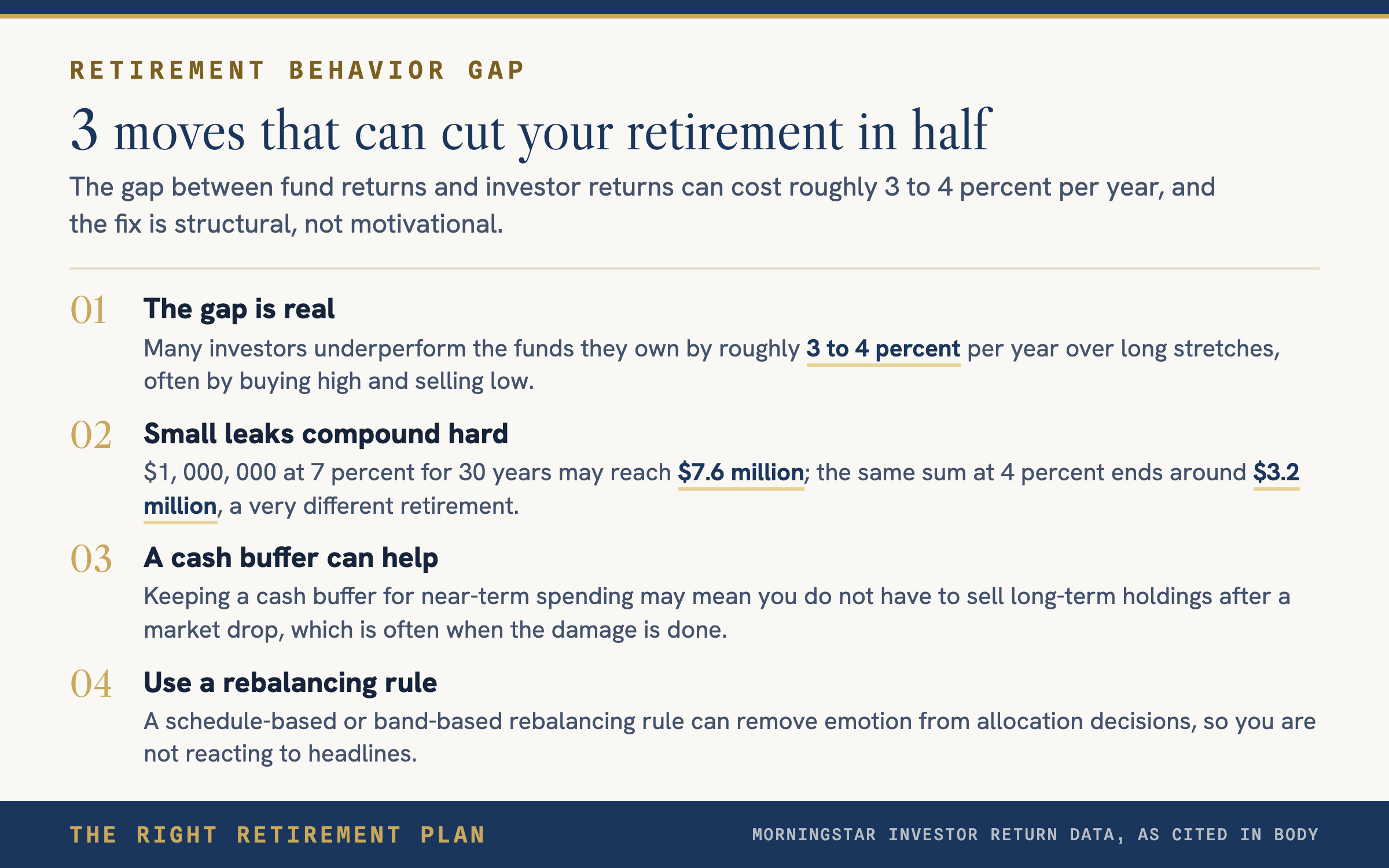
The average investor underperforms the funds they themselves own by roughly three to four percent per year over long stretches. Morningstar publishes the study every year. DALBAR has published its own version for decades. Different methodologies, same finding. The gap between the fund's published return and the dollar-weighted return of the people who held it is real, it is persistent, and it is bigger than most fees you will ever pay.

The market did not cost those investors the return. They cost themselves the return.

The mechanism is almost always the same. People buy in after a strong run, sell out during a drawdown, and miss the recovery. They chase last year's winner. They abandon last year's loser right before it turns. They confuse motion with management.

We see it in real time at the kitchen table. It usually does not sound like panic. It sounds reasonable.

"I am not selling. I am just moving to cash for a few months until things settle down."

"I am not market timing. I am being tactical."

"I just want to be safe right now."

In isolation, every one of those sentences sounds like prudence. In aggregate, across thousands of investors and twenty-five years of data, they are the most expensive sentences in personal finance.

Why activity feels like progress

The human brain is wired to associate doing something with making progress. In almost every other area of life, that wiring is correct. If your house is on fire, doing something is better than doing nothing. If your business is bleeding cash, doing something is better than doing nothing. If your kid is sick, doing something is better than doing nothing.

The stock market is one of the few places in life where the rule inverts. Doing nothing, on most days, is the right answer. Doing nothing during a 20% drawdown is the hardest and most valuable thing a long-term investor will ever do.

That is wildly unintuitive. And it is the entire game.

The portfolio that wins over thirty years is almost never the cleverest one. It is the one that survived its owner.

The math is brutal because it compounds

A three percent annual gap does not sound dramatic when you say it out loud. Compound it.

One million dollars invested at seven percent for thirty years grows to roughly 7.6 million. The same one million dollars invested at four percent over the same thirty years grows to roughly 3.2 million. Same starting capital. Same timeline. More than twice the result, on a single behavioral edge.

The number is even worse than it looks, because the people losing the three percent are usually also paying more in taxes, more in spreads, and more in transaction costs along the way. Activity does not just steal compounding. It usually drags everything else with it.

That is why we are so unromantic about it. The job is to keep the compounding intact. Most of the value an advisor adds, by far, is not from picking better investments. Vanguard's Advisor's Alpha research, updated regularly since 2001, puts the typical value of disciplined advice at about three percent per year, net of fees. Most of that comes from behavioral coaching, rebalancing discipline, tax management, and getting the withdrawal sequence right when income starts.

Three percent. The same three percent the average investor leaks.

That is not a coincidence.

What activity actually looks like inside a portfolio

The surface story you hear from a busy investor is rarely that they are panic selling. The surface story is more honest than that, and more subtle.

They are checking the account every morning. They are reading three new newsletters. They have opinions on the Fed. They are quietly trimming a winner and adding to a loser because the news cycle changed direction. They are buying a small position in something an acquaintance mentioned at dinner. They are watching one stock in their portfolio more than the other forty combined. They are nudging the allocation every quarter because the headlines moved.

None of those things, on any single day, look reckless. Over a decade, they add up to a portfolio that has been quietly traded into a much smaller pile.

The person across the table is not foolish. They are reacting to information their nervous system did not evolve to receive. Markets did not exist for most of human history. Cable news, push notifications, group chats, and real-time portfolio apps did not exist for any of it. The instinct to act is doing its job. The job is just wrong for this domain.

What we actually do about it

The answer is not motivation. It is structure.

We build the plan once, in writing. We document the assumptions. We agree in advance on the conditions that would change it and the conditions that would not. We rebalance on a schedule, not on a feeling. We tax-loss harvest mechanically when the opportunity appears, not when the headlines arrive. We sit through drawdowns with you, because that is the only time the entire plan is being tested at once.

When the urge to do something hits, and it will, the structure does the work. We have a planned conversation. We compare the current facts to the written plan. If something material changed, we adjust. If nothing material changed, we do not.

That is not glamorous. It does not generate content. It is also the difference, over a thirty-year career as an investor, between retiring well and not.

The honest test

If you have made more than two or three meaningful changes to your portfolio in the last twelve months, and none of them were tied to a planned rebalance or a documented life event, the odds are good that you are paying the behavioral tax in real time.

That is not a moral failure. It is a structural one. And it is fixable.

The simplest thing we can do for someone who is leaking returns to themselves is to put the plan back on paper, define the rules, and put someone between the urge and the order. That is most of the job. That is also where most of the value lives.

Progress in a portfolio is almost always invisible day to day. Activity is the thing that feels like progress when no real progress is being made.

The people who retire well learn the difference early. The rest learn it late.

We would rather you learn it early.

Compound Advisory LLC is a registered investment adviser. This material is for informational and educational purposes only and does not constitute personalized investment, legal, or tax advice. Past performance is not indicative of future results. Studies referenced (Morningstar Mind the Gap, DALBAR QAIB, Vanguard Advisor's Alpha) report industry averages and may not reflect any individual investor's experience. All investments involve risk, including the possible loss of principal.

ShareX / TwitterFacebook

Have questions about your specific situation? Take the free Retire Ready Score →

Want personalized guidance?

Our content gives you the knowledge. A qualified advisor can help you act on it.

Take the Free Assessment