What Every Pre-Retiree Should Know About Sequence of Returns Risk
Imagine two retirees. Both earn an average 7% annual return over 20 years. Both start with $1 million and withdraw $50,000 per year. One ends up with over $1.2 million. The other runs out of money in year 18.
How is that possible? Sequence of returns risk. And if you are within 10 years of retirement, it is the most important concept you need to understand.
What Is Sequence of Returns Risk?
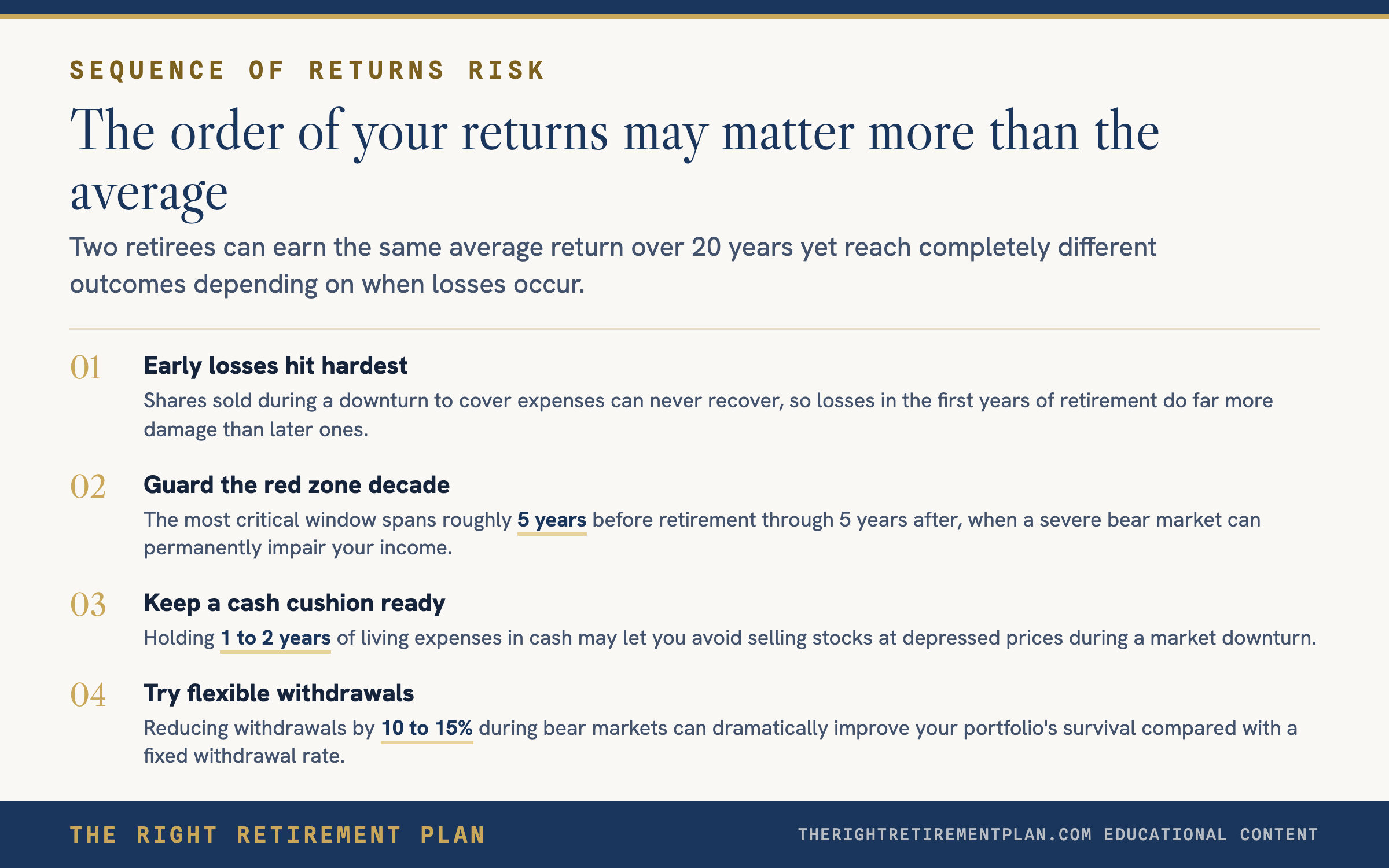
Sequence of returns risk is the danger that the order of your investment returns, not just the average, will determine your financial outcome. When you are withdrawing money from a portfolio, early losses do far more damage than later ones because you are selling shares at depressed prices to fund your living expenses.
Those sold shares can never participate in the eventual recovery. Every share you sell at a loss is permanently removed from your portfolio's growth engine.
During the accumulation phase, when you are adding money, bad early returns actually help you. You buy more shares at lower prices. But once you flip to withdrawals, the math reverses completely.
A Real World Example
Consider someone who retired on January 1, 2000, with $1 million in an S&P 500 index fund, withdrawing $50,000 per year adjusted for inflation. The first three years brought returns of roughly negative 9%, negative 12%, and negative 22%. The combination of losses and withdrawals reduced the portfolio so severely that even the 2003 to 2007 bull market could not repair the damage.
Now consider someone who retired in 1990 with the same setup. Strong early returns built a buffer, so by the time the 2000 to 2002 downturn arrived, the portfolio was large enough to absorb the losses.
Same average returns over 30 years. Drastically different outcomes based solely on the sequence.
The Danger Zone: 5 Years Before and After Retirement
Research shows that the most critical period for sequence risk spans roughly 5 years before retirement through 5 years after. During this window, a severe bear market can permanently impair your retirement income.
This is why many financial planners call it the "retirement red zone." The decisions you make during this decade may matter more than everything you did in the previous 30 years of saving.
How to Protect Yourself
You cannot control market returns, but you can reduce your vulnerability to bad sequences.
Build a cash reserve. Having 1 to 2 years of living expenses in cash means you do not need to sell stocks during a downturn.
Use the bucket strategy. Organize your portfolio into short-term (cash for years 1 through 3), medium-term (bonds for years 4 through 7), and long-term (stocks for year 8 and beyond). This insulates near-term spending from market volatility.
Consider flexible withdrawals. Reducing withdrawals by 10 to 15% during bear markets can dramatically improve your portfolio's survival. Fixed withdrawal rates are the most vulnerable to sequence risk.
Reduce equity exposure gradually. A common approach is to reduce your stock allocation by 1 to 2 percentage points per year in the decade before retirement.
The part most people miss is that retirement planning is not about optimizing for the best case. It is about surviving the worst case. Your retirement plan should be stress-tested against bad sequences, not just run with average assumptions.
If your plan only works when markets cooperate, it is not really a plan. It is a hope.
Take the Next Step
Is your retirement plan stress-tested against sequence of returns risk? Explore the free tools at therightretirementplan.com/tools to evaluate your readiness for every market scenario.
This content is for educational purposes only and should not be considered personalized investment advice. Consult a qualified financial professional before making investment decisions.