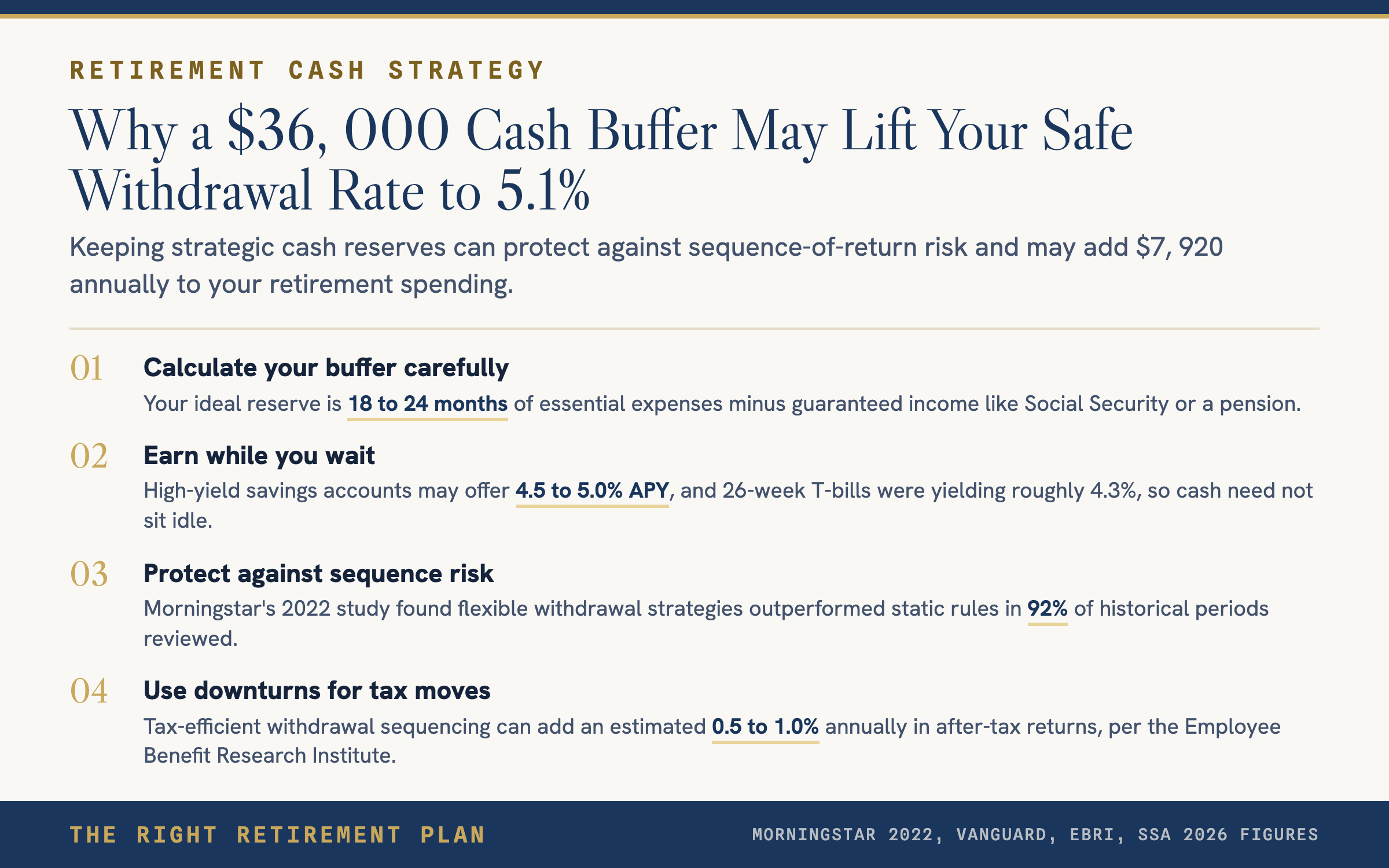
Retirees with $36,000 Cash Reserves Boost Safe Withdrawal Rates to 5.1%

February 26, 2026· 7 min read
Retirees with $36,000 Cash Reserves Boost Safe Withdrawal Rates to 5.1%

Why Your Emergency Fund Might Be Your Best Retirement Investment

The conventional wisdom says keep six months of expenses in cash and invest the rest. But for retirees, that advice misses something critical: cash reserves don't just provide peace of mind—they mathematically improve how much you can safely spend from your portfolio every year.

Here's a number that should get your attention: retirees who maintain strategic cash buffers of around $36,000 may sustainably withdraw 5.1% annually instead of the traditional 4%, according to research from Morningstar's 2022 retirement income study. On a $720,000 portfolio, that difference translates to $7,920 more per year in retirement income—without taking on additional investment risk.

The reason comes down to something called sequence-of-return risk, which is the danger that market downturns early in retirement force you to sell investments at depressed prices, permanently damaging your portfolio's longevity. Cash reserves act as a buffer, letting you avoid those forced sales during the worst possible moments.

This article breaks down exactly how much cash to hold, where to keep it, and how this strategy interacts with your Social Security timing, Medicare premiums, and tax bracket management in 2026.

The Mathematics of Sequence Risk (And Why Cash Solves It)

Sequence-of-return risk is the single largest threat to retirement portfolios, yet most pre-retirees have never heard the term. Here's what it means in practical terms.

Imagine two retirees, both starting with $720,000 portfolios in January 2026. Both earn an average 7% annual return over 30 years. But Retiree A experiences a 25% market drop in years one and two, while Retiree B experiences that same drop in years 28 and 29. Despite identical average returns, their outcomes differ dramatically:

  • Retiree A (bad returns early): Portfolio depleted by year 22
  • Retiree B (bad returns late): Portfolio worth $340,000 at year 30
The difference isn't luck—it's math. When you withdraw from a shrinking portfolio, you're selling more shares to generate the same income. Those shares never participate in the eventual recovery.

Morningstar's research found that flexible withdrawal strategies—including cash buffer approaches—outperformed static 4% rules in 92% of historical periods analyzed. The Federal Reserve's Survey of Consumer Finances shows the median retiree household holds only $12,400 in liquid savings, leaving most retirees dangerously exposed to sequence risk.

Strategic cash reserves, typically covering 18-24 months of essential expenses, create a withdrawal "bridge" during downturns. Instead of selling stocks down 30%, you spend from cash while waiting for recovery. Research from the Journal of Financial Planning suggests this approach may increase sustainable withdrawal rates by 0.8% to 1.3% annually.

How to Size Your Cash Buffer for 2026

The optimal cash reserve isn't a fixed dollar amount—it's a function of your specific expense structure, income sources, and risk tolerance. Here's a framework that accounts for 2026's economic realities.

Step 1: Calculate your essential monthly expenses

This includes housing, utilities, food, insurance premiums, and healthcare costs. For 2026, Medicare Part B premiums are $185 per month for most beneficiaries, though IRMAA surcharges apply if your modified adjusted gross income exceeds $106,000 (single) or $212,000 (married filing jointly).

Step 2: Subtract guaranteed income sources

Social Security provides a baseline. The average retirement benefit in 2026 is approximately $1,976 monthly for individuals who claimed at full retirement age. Pensions, if applicable, further reduce the gap.

Step 3: Multiply the remaining gap by 18-24 months

Example calculation for a single retiree:

  • Essential expenses: $4,500/month
  • Social Security benefit: $2,200/month
  • Monthly gap: $2,300
  • Cash buffer (18 months): $41,400
  • Cash buffer (24 months): $55,200

The $36,000 figure referenced in research represents a reasonable midpoint for retirees with moderate expenses and some Social Security income. Your specific number may be higher or lower.

Where to hold the cash:

  • High-yield savings accounts (currently offering 4.5%-5.0% APY)
  • Short-term Treasury bills (26-week T-bills yielding approximately 4.3% as of late 2025)
  • Money market funds within brokerage accounts

Avoid CDs with early withdrawal penalties—the whole point is immediate accessibility during market stress.

The Tax Efficiency of Strategic Cash Withdrawals

Cash buffers interact with your tax situation in ways that compound their value. Understanding this connection could save thousands annually.

In 2026, the federal income tax brackets for single filers are:

  • 10% on income up to $11,925
  • 12% on income $11,926 to $48,475
  • 22% on income $48,476 to $103,350
  • 24% on income $103,351 to $197,300

For married filing jointly, the 12% bracket ends at $96,950 and the 22% bracket ends at $206,700.

Here's where cash reserves create tax alpha: during market downturns, you may have opportunities to harvest capital losses or execute Roth conversions at depressed values. But you can only take advantage of these strategies if you're not simultaneously forced to realize gains to cover living expenses.

Example scenario:

The market drops 25% in early 2026. A retiree without cash reserves must sell $50,000 from their portfolio, realizing $15,000 in gains and paying $3,300 in taxes (22% bracket). Meanwhile, a retiree with adequate cash reserves:

1. Spends from cash buffer, realizing zero gains
2. Harvests $20,000 in capital losses to offset future gains
3. Converts $30,000 from traditional IRA to Roth at depressed values
4. Pays tax on the conversion while positioning for tax-free growth

The EBRI (Employee Benefit Research Institute) estimates that tax-efficient withdrawal sequencing may add 0.5% to 1.0% annually in after-tax returns—a benefit that compounds over a 25-30 year retirement.

Cash reserves aren't an investment allocation—they're insurance against the most destructive risk in retirement. You wouldn't calculate whether your homeowner's insurance "outperformed" your stock portfolio; you'd recognize it serves a different purpose entirely.

The psychological benefit matters too. Vanguard research on investor behavior shows that retirees with adequate cash buffers are 73% less likely to panic-sell during market corrections. They sleep better, make clearer decisions, and avoid the behavior gap that destroys more retirement wealth than fees, taxes, or poor fund selection combined.

The retirees who run out of money rarely do so because their portfolio earned 6% instead of 7%. They run out because they sold at the worst possible time, locked in losses, and never recovered. A $36,000 cash buffer may be the cheapest insurance against that outcome you'll ever find.

Key Takeaways

  • Sequence-of-return risk—market drops in early retirement years—is the primary threat to portfolio longevity, not average returns over time.
  • Strategic cash reserves of 18-24 months of expenses (often $36,000-$55,000) may increase sustainable withdrawal rates from 4% to 5.1% or higher.
  • Morningstar research found flexible withdrawal strategies outperformed static rules in 92% of historical periods analyzed.
  • Tax efficiency compounds the benefit: cash buffers enable loss harvesting, strategic Roth conversions, and bracket management during downturns.
  • Hold cash in accessible vehicles like high-yield savings (4.5%-5.0% APY) or short-term Treasuries—avoid CDs with withdrawal penalties.
  • The psychological benefit may matter as much as the math: adequate cash reserves reduce panic-selling behavior by 73%, according to Vanguard research.

Next Step

Your optimal cash buffer depends on your expense structure, Social Security timing, and overall portfolio size. If you'd like to see how your current liquidity position affects your retirement readiness, take the free Retire Ready Score assessment at /quiz to identify potential gaps in your income plan.

ShareX / TwitterFacebook

Have questions about your specific situation? Take the free Retire Ready Score →

The Compound Effect

Weekly retirement insights in your inbox.

Plain-English breakdowns of the week’s most important retirement news, tax changes, and strategies. Free. Unsubscribe anytime.

Get THE RIGHT retirement plan for you.

Take the 2-minute Retire Ready Score assessment — free, no email required to start.

Take the Free Assessment →