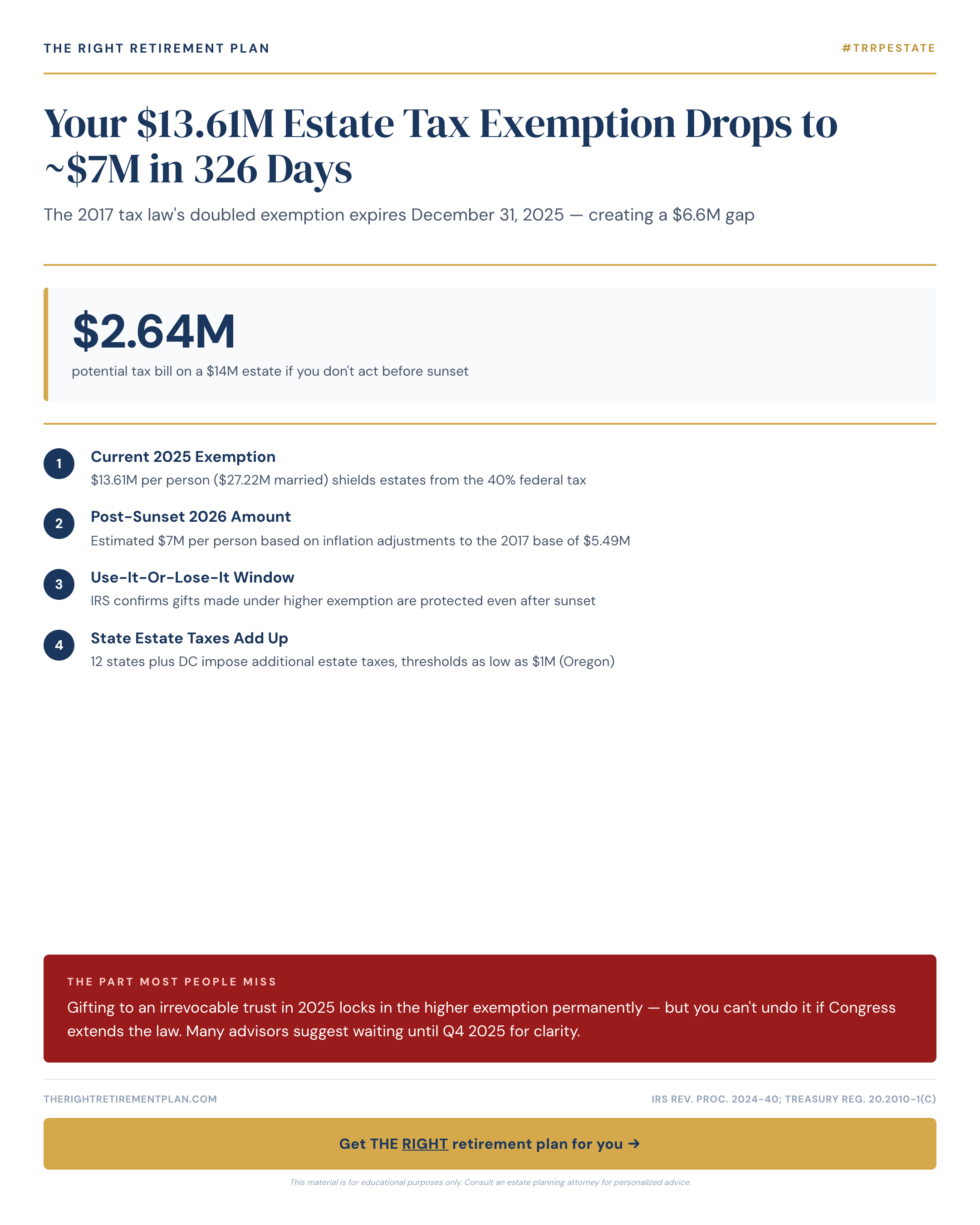
You have less than a year to make one of the most important wealth transfer decisions of your lifetime. The federal estate tax exemption, currently $13.61 million per person, drops to approximately $7 million on January 1, 2026, unless Congress intervenes.
This isn't speculation. It's built into the Tax Cuts and Jobs Act sunset provisions, creating a $6.6 million gap that could trigger massive tax bills for families who don't plan ahead.
Understanding the $6.6 Million Impact
The federal estate tax applies to everything you own at death: real estate, retirement accounts, life insurance benefits, business interests, and investments. Anything above the exemption threshold faces a 40% tax rate.
For married couples, today's $27.22 million combined exemption drops to roughly $14 million in 2026. The math is sobering:
- Current exemption (married): $27.22 million
- 2026 projected exemption: ~$14 million
- Additional taxable estate: ~$13 million
- Potential extra tax at 40%: ~$5.2 million
Single individuals face similar proportional exposure. Someone with a $13 million estate pays zero federal estate tax if they die in 2025, but their heirs could owe roughly $2.4 million in 2026.
Currently, only 0.2% of estates owe federal estate tax. That percentage will jump significantly when the exemption drops, pulling estates between $7-13.61 million into taxable territory for the first time.
Remember: these are federal figures only. States like Maryland impose separate estate taxes with much lower thresholds, just $5 million in Maryland's case.
Your Estate Is Probably Larger Than You Think
Many retirees underestimate their estate size by focusing only on liquid assets. Your taxable estate includes:
- Retirement accounts at full balance (not after-tax value)
- Real estate at current market value
- Life insurance death benefits you own
- Business interests at appraised value
- All investments and bank accounts
A Maryland couple with a $1.2 million Annapolis home, $3 million in retirement savings, $2 million in investments, $1 million life insurance, and a $1.8 million business has a $9 million estate. Under current law: no tax. In 2026: potentially $800,000 owed.
Federal Reserve data shows households aged 65-74 have median net worth of $410,000 but mean net worth of $1.79 million. If you're reading this, you may be closer to the higher end.
The Irrevocable Trust Strategy
The primary solution involves transferring assets to irrevocable trusts before December 31, 2025. The IRS confirmed through Treasury Regulation 20.2010-1(c) that gifts made under the higher exemption won't be "clawed back" when exemptions drop.
Gift $10 million to an irrevocable trust in 2025, and it stays protected even after the exemption falls to $7 million.
But irrevocable trusts come with serious trade-offs:
- Permanent loss of control over transferred assets
- No stepped-up basis for heirs, creating potential capital gains issues
- High setup costs ($5,000-$15,000+ for proper structures)
- Complex income tax implications
Many advisors recommend preparing trust documents mid-2025 while monitoring Congressional action, then executing transfers in Q4 if the exemption reduction appears certain.
If you've lost a spouse recently and didn't file Form 706, consult an estate planning attorney immediately about late portability elections.
The estate tax exemption reduction creates urgency for wealthy families, but the optimal strategy depends on your specific situation, Congressional actions, and risk tolerance. If you want to see how estate planning fits with your broader retirement picture, consider taking our Retire Ready Score for personalized guidance.
If you want help building a retirement plan that actually makes sense for your situation, our team at Compound Advisory does this work every day. You can schedule a complimentary review at https://compoundadvisory.co/free-assessment.