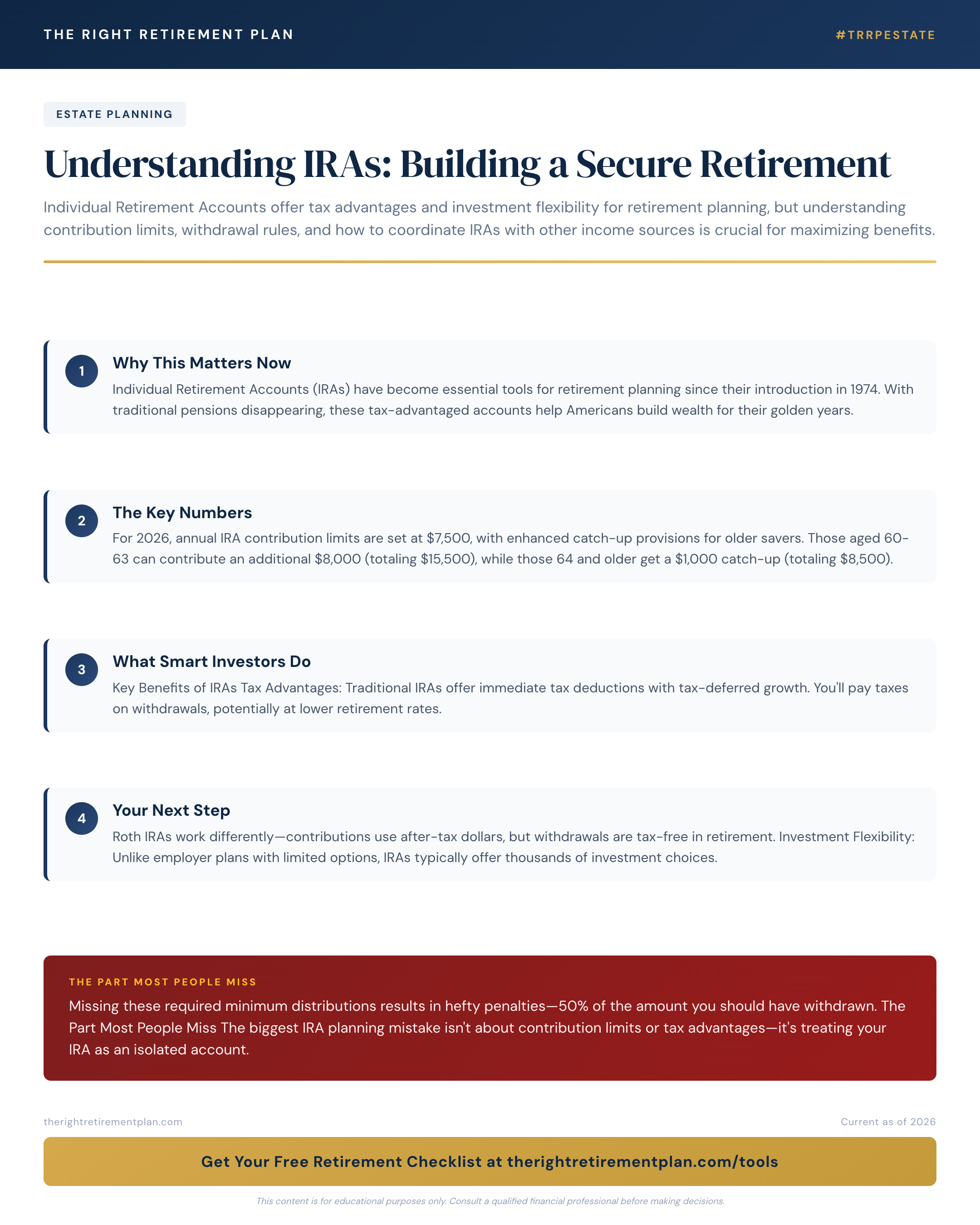
Individual Retirement Accounts (IRAs) have become essential tools for retirement planning since their introduction in 1974. With traditional pensions disappearing, these tax-advantaged accounts help Americans build wealth for their golden years.
For 2026, annual IRA contribution limits are set at $7,500, with enhanced catch-up provisions for older savers. Those aged 60-63 can contribute an additional $8,000 (totaling $15,500), while those 64 and older get a $1,000 catch-up (totaling $8,500).
Key Benefits of IRAs
Tax Advantages: Traditional IRAs offer immediate tax deductions with tax-deferred growth. You'll pay taxes on withdrawals, potentially at lower retirement rates. Roth IRAs work differently, contributions use after-tax dollars, but withdrawals are tax-free in retirement.
Investment Flexibility: Unlike employer plans with limited options, IRAs typically offer thousands of investment choices. You can build a diversified portfolio with stocks, bonds, mutual funds, and other assets tailored to your goals and risk tolerance.
Broad Accessibility: IRAs are available to anyone with earned income, including:
- Self-employed individuals
- Part-time workers
- Those without employer retirement plans
- Non-working spouses through spousal IRAs
Common IRA Pitfalls
Income Restrictions: High earners face contribution limitations. For 2026, traditional IRA deductions phase out for single filers earning $77,000-$87,000 (or $123,000-$143,000 married filing jointly) when covered by an employer plan.
Early Withdrawal Penalties: Accessing funds before age 59½ typically triggers a 10% penalty plus income taxes. While Roth IRA contributions can be withdrawn anytime penalty-free, earnings face the same restrictions.
Required Distributions: Traditional IRAs mandate withdrawals starting at age 73. Missing these required minimum distributions results in hefty penalties, 50% of the amount you should have withdrawn.
Maximizing Your IRA Strategy
Professional guidance helps navigate IRA complexities and coordinate them with your complete retirement picture. A qualified financial advisor can help you:
- Choose between traditional and Roth IRAs based on current and projected tax brackets
- Develop age-appropriate investment strategies
- Plan withdrawal sequences to minimize taxes
- Execute Roth conversion strategies during lower-income years
- Coordinate with Social Security benefits optimization
The key is viewing your IRA as part of a comprehensive retirement plan, not a standalone solution.
If you want personalized guidance on optimizing your IRA strategy within your complete retirement plan, consider taking our Retire Ready Score assessment.