Estates Under $13.99M May Not Need a Living Trust in 2026

February 19, 2026· 7 min read
Estates Under $13.99M May Not Need a Living Trust in 2026

You've probably seen the ads: "Protect your family with a living trust!" Maybe an attorney quoted you $2,500 to $5,000 for a trust package. Or a well-meaning friend insisted that without a trust, your heirs will spend years in probate court fighting over your assets.

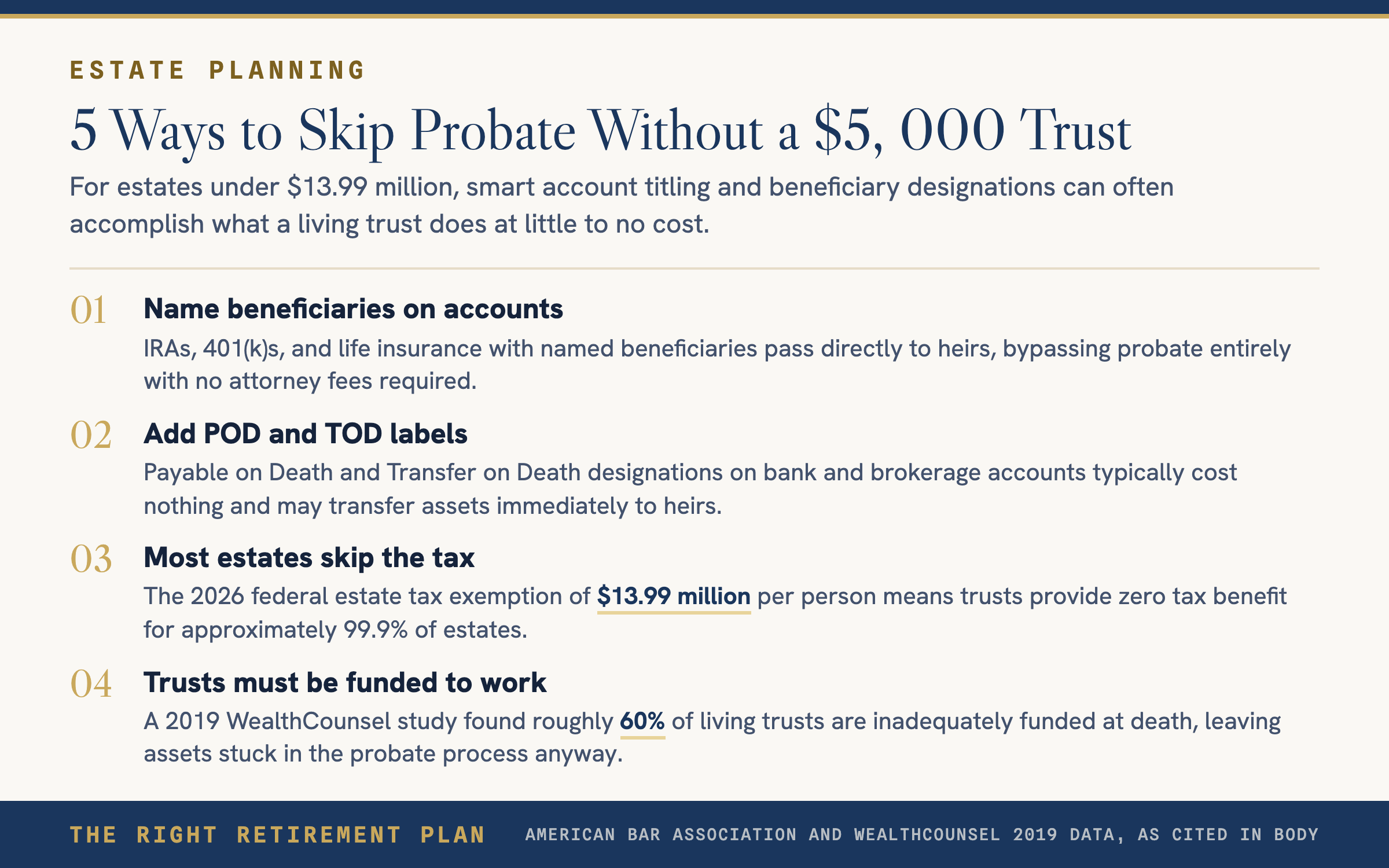
Here's what those ads don't tell you: for estates under the 2026 federal exemption of $13.99 million, a properly structured will combined with smart account titling can accomplish nearly everything a living trust does—often at a fraction of the cost. According to the American Bar Association, roughly 95% of American households fall below this threshold, yet the trust industry continues to market these products as essential for everyone.

This doesn't mean trusts are useless. For certain situations—blended families, special needs dependents, significant real estate in multiple states—they remain valuable tools. But for the typical retiree with a straightforward estate, the math often doesn't support the expense. Let's break down when you actually need a trust, when you don't, and the zero-cost strategies that achieve 90% of what trusts promise.

What Living Trusts Actually Do (and Don't Do)

A revocable living trust is essentially a legal container for your assets. You transfer ownership of your property into the trust during your lifetime, name yourself as trustee, and designate who receives the assets after your death. The primary benefit? Assets held in the trust bypass probate—the court-supervised process of validating a will and distributing assets.

But here's what the marketing materials gloss over: trusts don't reduce estate taxes for most people. The 2026 federal estate tax exemption of $13.99 million per person (or $27.98 million for married couples, according to the IRS) means only about 0.1% of estates owe any federal estate tax. If your estate falls below this threshold—and statistically, it almost certainly does—a trust provides zero tax advantage.

Trusts also don't protect assets from creditors during your lifetime, don't automatically avoid state estate taxes, and don't eliminate the need for other estate planning documents like powers of attorney and healthcare directives.

What trusts genuinely accomplish:

  • Probate avoidance for assets titled in the trust's name
  • Privacy, since trusts don't become public record like wills
  • Continuity of management if you become incapacitated
  • Control over distribution timing (for example, staggered payouts to young beneficiaries)
The question isn't whether these benefits have value—they do. The question is whether you can achieve most of them through simpler, cheaper means.

The Zero-Cost Probate Avoidance Strategy

Most retirees can avoid probate on 90% or more of their assets without spending a dime on a trust. The secret lies in understanding which assets actually go through probate—and which don't.

Assets that bypass probate automatically with proper titling:

  • Retirement accounts (IRAs, 401(k)s, 403(b)s) with named beneficiaries pass directly to those beneficiaries. According to the Employee Benefit Research Institute, retirement accounts represent the largest single asset for most American households.
  • Life insurance policies with named beneficiaries pay directly to those individuals.
  • Bank accounts with Payable on Death (POD) designations transfer immediately to named beneficiaries.
  • Brokerage accounts with Transfer on Death (TOD) designations work the same way.
  • Jointly titled property with rights of survivorship passes automatically to the surviving owner.
Adding POD or TOD designations typically costs nothing—just a form from your financial institution. Yet these simple designations accomplish exactly what a trust does for those assets: immediate transfer to heirs without court involvement.

What actually goes through probate:

  • Real estate titled solely in your name (without TOD deed where available)
  • Vehicles in your name alone
  • Personal property without designated beneficiaries
  • Bank and investment accounts without POD/TOD designations
For many retirees, properly titled accounts mean the only assets requiring probate are a car, household items, and perhaps a home. Many states have simplified probate procedures for small estates—California, for instance, allows estates under $184,500 (as of 2024, adjusted periodically) to use a streamlined affidavit process that avoids formal probate entirely.

When a Trust Actually Makes Sense

Despite the effectiveness of beneficiary designations, certain situations genuinely warrant the expense of a living trust. Understanding these scenarios helps you make an informed decision rather than simply following generic advice.

Real estate in multiple states creates the strongest case for a trust. Without one, your heirs may face separate probate proceedings in each state where you own property—a process called ancillary probate. If you own a vacation home in Florida and your primary residence in New York, your estate could face two parallel court processes with separate attorneys and filing fees. A trust holding both properties allows everything to pass in a single proceeding.

Blended families with complex inheritance wishes often benefit from trust provisions. If you want your current spouse to have use of your home during their lifetime but ultimately want the property to pass to children from a previous marriage, a trust can accomplish this more reliably than a will.

Beneficiaries with special circumstances may need trust protection:

  • Adult children with spending problems or creditor issues
  • Beneficiaries receiving means-tested government benefits (a special needs trust can preserve eligibility)
  • Minor children who can't legally inherit directly
  • Beneficiaries struggling with addiction
Privacy concerns in certain professions or situations make the public nature of probate problematic. Wills become public record; trusts typically don't.

Anticipated incapacity concerns—perhaps due to family history of dementia—make trusts valuable for management continuity. While a durable power of attorney can accomplish similar goals, some financial institutions more readily accept trust documents.

If none of these situations apply to you, a simple will combined with proper beneficiary designations likely accomplishes your goals at far lower cost.

The Real Math: Trust Costs vs. Probate Costs

The trust industry often emphasizes probate costs while downplaying trust expenses. Let's examine actual numbers.

Typical living trust costs:

  • Attorney fees for trust creation: $2,500–$7,500 depending on complexity and location
  • Funding the trust (retitling assets): additional time and sometimes fees
  • Ongoing maintenance: periodic reviews and amendments, potentially $500–$1,500
  • Real estate transfer: recording fees, potential title insurance updates
Typical probate costs:

Probate expenses vary dramatically by state. According to the American Association of Retired Persons (AARP), probate typically costs 3–7% of the estate's probatable value—but remember, properly titled assets aren't part of that calculation.

Consider this example: A retiree has $800,000 in total assets—$600,000 in IRAs and life insurance (with beneficiaries), $150,000 in a home, and $50,000 in other assets. With proper beneficiary designations, only the home and miscellaneous assets ($200,000) go through probate. At 5%, that's $10,000 in probate costs versus $4,000+ for a trust—but the trust requires upfront payment while probate costs come from the estate after death.

Moreover, many states have reformed probate procedures. Independent administration, available in most states, allows executors to handle most matters without court approval, significantly reducing costs and delays. The horror stories about years-long probate battles typically involve contested wills or unusual circumstances—not routine estate administration.

A 2019 study by WealthCounsel found that roughly 60% of living trusts are inadequately funded at the grantor's death. That beautiful $5,000 trust document? It's essentially decorative if you never transferred your assets into it. Those assets still pass through probate—exactly what you paid to avoid.

Conversely, the simple beneficiary designation on your IRA requires no ongoing maintenance. Once you've named your beneficiaries (and reviewed them after major life changes), the account passes directly to them regardless of what your will or trust says. This simplicity is a feature, not a bug.

Key Takeaways

  • The 2026 federal estate tax exemption of $13.99 million means trusts provide zero tax benefit for approximately 99.9% of estates.
  • Beneficiary designations on retirement accounts, life insurance, and POD/TOD registrations on bank and brokerage accounts bypass probate at no cost.
  • Living trusts make genuine sense for multi-state real estate, blended families, special needs beneficiaries, and privacy concerns.
  • Probate costs apply only to assets without beneficiary designations or survivorship provisions—often a small fraction of total estate value.
  • An unfunded trust provides no probate protection; simple beneficiary designations require minimal maintenance.
  • Review all beneficiary designations annually and after major life events like marriage, divorce, or the death of a named beneficiary.

Next Step

Wondering whether your current estate setup has gaps that could cost your heirs? The free Retire Ready Score at /quiz can help you identify areas where a quick review might prevent expensive complications.

ShareX / TwitterFacebook

Have questions about your specific situation? Take the free Retire Ready Score →

The Compound Effect

Weekly retirement insights in your inbox.

Plain-English breakdowns of the week’s most important retirement news, tax changes, and strategies. Free. Unsubscribe anytime.

Get THE RIGHT retirement plan for you.

Take the 2-minute Retire Ready Score assessment — free, no email required to start.

Take the Free Assessment →