Medicare Advantage $0 Premium vs Medigap Plan G $185/Month

March 24, 2026· 7 min read
Medicare Advantage $0 Premium vs Medigap Plan G $185/Month

That $0 premium Medicare Advantage plan looks like free money. No monthly cost, often includes dental and vision, maybe even a gym membership. Meanwhile, Medigap Plan G wants $185 every month—$2,220 annually—just for supplemental coverage.

The math seems obvious until you end up in the hospital.

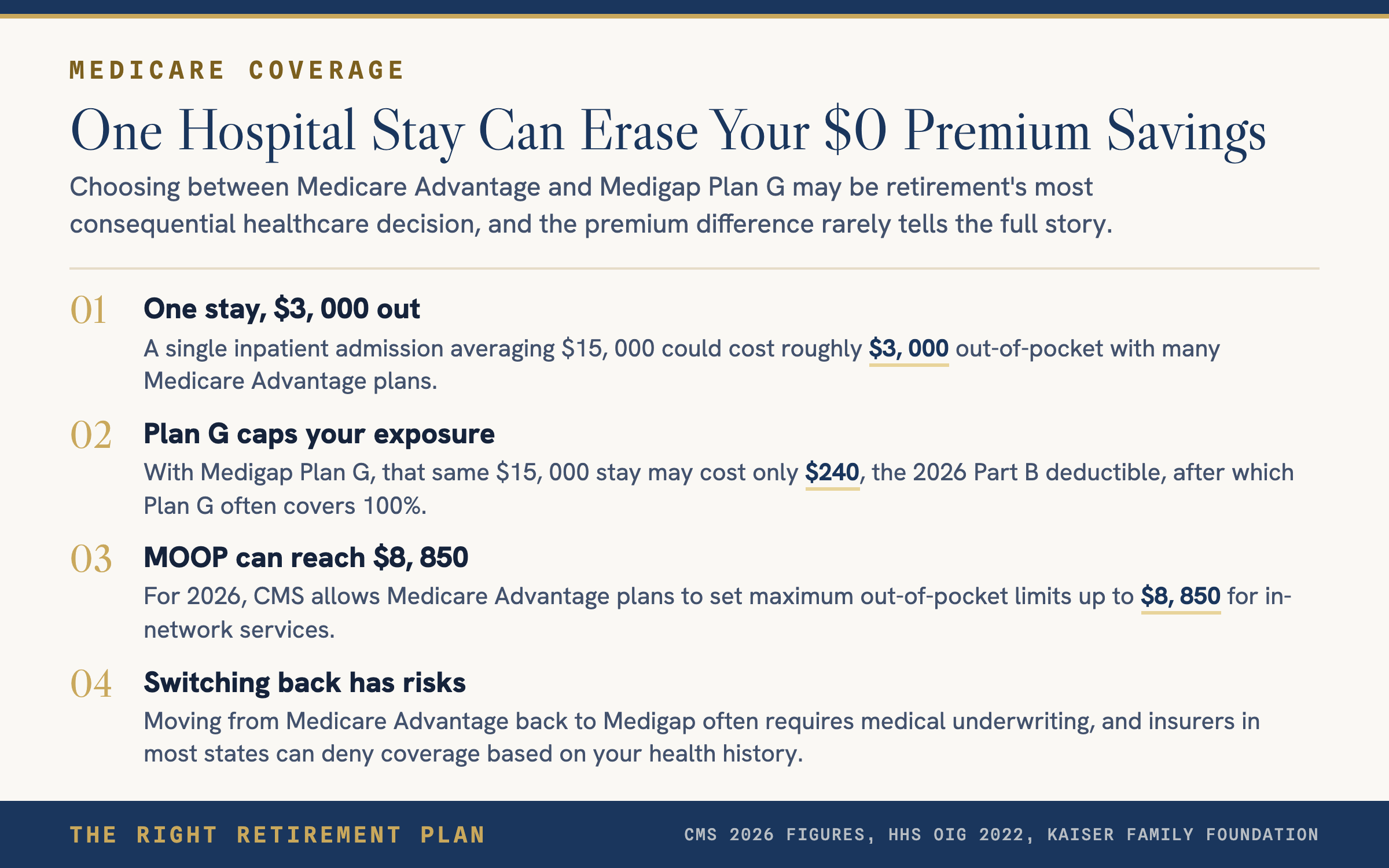
A single inpatient admission averaging $15,000 could cost you roughly $3,000 out-of-pocket with many Medicare Advantage plans. That same stay with Medigap Plan G? Approximately $240—just the Part B deductible for 2026. The premium you thought you were saving vanishes in a single health event, potentially with thousands more following it out the door.

For the 65 million Americans on Medicare, this choice represents one of the most consequential healthcare decisions of retirement. According to the Kaiser Family Foundation, roughly 51% of Medicare beneficiaries now choose Medicare Advantage, up from 19% in 2007. But enrollment popularity doesn't necessarily mean it's the right choice for your situation. Understanding the true cost structure of each option—beyond the premium—could mean the difference between predictable healthcare expenses and financial uncertainty when you're most vulnerable.

How the Two Coverage Models Actually Work

Medicare Advantage (Part C) and Medigap (Medicare Supplement) represent fundamentally different approaches to covering what Original Medicare leaves behind. Original Medicare pays approximately 80% of approved costs after deductibles, leaving beneficiaries responsible for the remaining 20% with no annual cap.

Medicare Advantage replaces Original Medicare entirely. Private insurers contract with CMS (Centers for Medicare & Medicaid Services) to provide at least the same benefits as Parts A and B, typically adding prescription drug coverage and extras like dental or vision. The trade-off: you generally must use network providers, may need referrals for specialists, and face cost-sharing through copays, coinsurance, and deductibles up to an annual maximum out-of-pocket limit.

For 2026, CMS allows Medicare Advantage plans to set maximum out-of-pocket limits up to $8,850 for in-network services. Many plans set lower limits, but the national average hovers around $5,000–$6,000 according to Kaiser Family Foundation data.

Medigap works differently. You keep Original Medicare as your primary coverage and add a standardized supplement policy to cover some or all of the gaps. Plan G—the most popular option since Plan F closed to new enrollees in 2020—covers:

  • Part A hospital coinsurance and costs up to 365 additional days after Medicare benefits end
  • Part B coinsurance (the 20% you'd otherwise owe)
  • Blood (first 3 pints)
  • Part A hospice care coinsurance
  • Skilled nursing facility coinsurance
  • Part A deductible ($1,676 for 2026)
  • 80% of foreign travel emergency coverage
The only gap remaining: the annual Part B deductible, set at $240 for 2026 according to CMS projections. After that, Plan G typically covers everything Original Medicare approves at 100%.

The Real Math Behind a Hospital Stay

Let's follow the money through an actual scenario: a 68-year-old retiree admitted for pneumonia requiring five days of hospitalization. The Medicare-approved charges total $15,000.

With Original Medicare alone (no supplement), the patient owes the Part A deductible of $1,676 for the hospital stay, plus 20% of any Part B services—potentially several thousand more depending on physician charges, imaging, and other services billed under Part B.

With a typical Medicare Advantage plan, the structure varies significantly by plan. However, common cost-sharing might include:

  • Hospital copay: $350–$500 per day for days 1–5 (potentially $1,750–$2,500)
  • Physician services copay or coinsurance during stay
  • Various ancillary service copays
Many plans would result in $2,500–$4,000 out-of-pocket for this single admission, according to analysis from the Medicare Payment Advisory Commission (MedPAC). Some plans with richer benefits may cost less; others with higher cost-sharing could approach $5,000.

With Medigap Plan G, the patient pays only the $240 Part B deductible if not already met for the year. Plan G covers the Part A deductible, all hospital coinsurance, and the 20% Part B coinsurance. A $15,000 hospital stay results in $240 maximum additional cost.

The $2,220 annual premium for Plan G suddenly looks different when one moderate health event could cost $3,000+ with Medicare Advantage. Two such events in a year—not uncommon for retirees managing chronic conditions—could mean $6,000+ in out-of-pocket costs that the Medigap policyholder avoided entirely.

Beyond Premiums: The Factors Most Comparisons Miss

Premium and hospital cost-sharing represent only part of the equation. Several other factors could significantly impact total retirement healthcare costs.

Network restrictions and provider access. Medicare Advantage plans typically require using in-network providers, with some exceptions for emergencies. Original Medicare with Medigap allows you to see any provider nationwide who accepts Medicare—approximately 93% of non-pediatric physicians according to CMS data. For retirees who travel, split time between states, or want maximum provider choice, this flexibility may prove valuable.

Prior authorization requirements. Many Medicare Advantage plans require prior authorization for certain procedures, specialist visits, or medical equipment. A 2022 HHS Office of Inspector General report found that 13% of prior authorization denials in Medicare Advantage plans were for services that actually met Medicare coverage rules. While appeals often succeed, the process creates delays and administrative burden during health crises.

Premium trajectory over time. Medicare Advantage premiums can change annually, with plans sometimes increasing cost-sharing or reducing benefits year to year. Medigap premiums also increase, but policyholders own their policy and cannot be dropped for health reasons. AHIP (America's Health Insurance Plans) data suggests Medigap premiums typically increase 3–8% annually depending on the insurer and state.

Prescription drug coverage. Medicare Advantage often bundles Part D drug coverage. Medigap requires purchasing a separate Part D plan, adding $15–$100+ monthly depending on the plan and medications. This partially offsets Medigap's cost advantage, though it also allows selecting drug coverage optimized for your specific prescriptions.

The extras question. Medicare Advantage dental, vision, hearing, and fitness benefits appeal to many enrollees. However, these benefits typically come with significant limitations—$1,000–$1,500 annual dental maximums, for example, may not cover major work. Retirees should calculate whether purchasing separate coverage might sometimes provide better value.

If you enroll in Medicare Advantage at 65, develop health conditions over the following years, then decide at 72 that you'd prefer Medigap's predictability, insurers in most states can deny coverage or charge significantly higher premiums based on your health history. Only four states—Connecticut, Maine, Massachusetts, and New York—guarantee issue rights for Medigap regardless of when you apply.

This creates an asymmetric decision. Choosing Medigap preserves optionality; choosing Medicare Advantage may limit future flexibility. According to AHIP, fewer than 2% of Medigap policyholders switch to Medicare Advantage annually, while roughly 10% of Medicare Advantage enrollees return to Original Medicare within three years—some discovering they cannot obtain Medigap coverage at standard rates.

Key Takeaways

  • Premium isn't cost. A $0 Medicare Advantage premium could result in $5,000+ annual out-of-pocket expenses during health events; Medigap Plan G's $185/month premium often provides more predictable total costs.
  • One hospital stay changes the math. A $15,000 hospitalization might cost $3,000+ with Medicare Advantage versus $240 with Plan G.
  • Network flexibility matters. Original Medicare with Medigap works with 93% of physicians nationwide; Medicare Advantage typically restricts you to plan networks.
  • The switching trap is real. Moving from Medigap to Medicare Advantage is generally easy; reversing that decision may require medical underwriting that prices you out or denies coverage.
  • Don't ignore Part D. Medigap requires separate prescription drug coverage, typically adding $15–$100+ monthly to your costs.
  • Extras need scrutiny. Medicare Advantage dental and vision benefits often have tight annual limits that may not cover significant needs.

Next Step

Your healthcare needs, budget, and risk tolerance make this decision highly personal. If you're curious how your current Medicare approach fits into your broader retirement picture, the Retire Ready Score provides a quick assessment across income, taxes, healthcare, and protection—helping you spot potential gaps before they become costly surprises.

ShareX / TwitterFacebook

Have questions about your specific situation? Take the free Retire Ready Score →

The Compound Effect

Weekly retirement insights in your inbox.

Plain-English breakdowns of the week’s most important retirement news, tax changes, and strategies. Free. Unsubscribe anytime.

Get THE RIGHT retirement plan for you.

Take the 2-minute Retire Ready Score assessment — free, no email required to start.

Take the Free Assessment →