$2,040 Penalty Trap: Medicare's 6-Month Lookback Can Trigger HSA Violations

March 22, 2026· 7 min read
$2,040 Penalty Trap: Medicare's 6-Month Lookback Can Trigger HSA Violations

Introduction

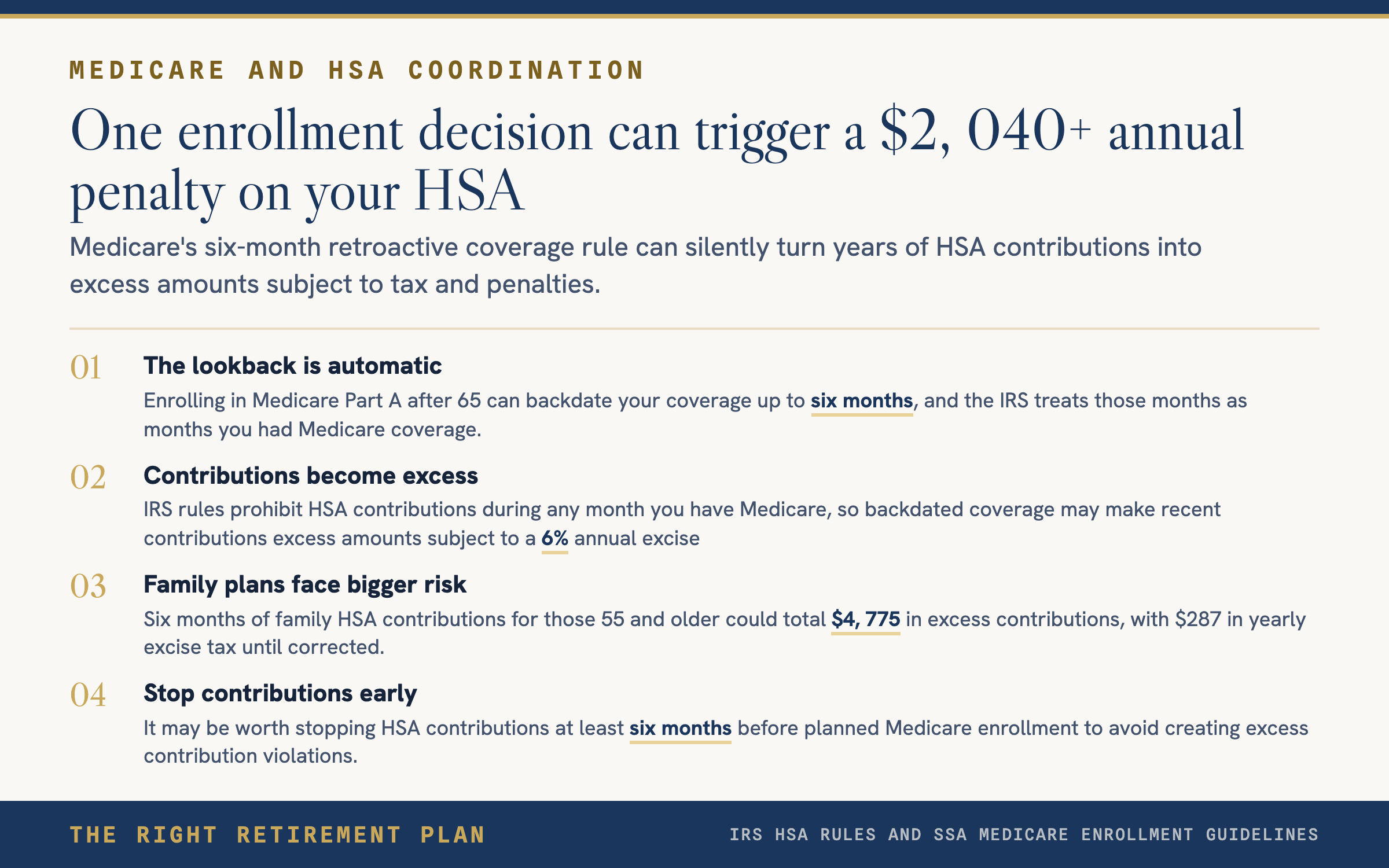
You've been diligently contributing to your Health Savings Account for years, building a tax-advantaged nest egg for healthcare costs in retirement. Then you turn 65, delay Medicare enrollment because you're still working, and continue making HSA contributions—completely unaware that a single enrollment decision could trigger a $2,040 penalty and potentially disqualify your entire account.

The culprit? Medicare's six-month retroactive coverage rule, which the IRS treats as establishing coverage months before you actually signed up. According to IRS Publication 969, you cannot contribute to an HSA for any month you're enrolled in Medicare—including months you didn't know you were covered. For 2026, the maximum HSA contribution for those 55 and older with family coverage is $9,550. Six months of ineligible contributions could mean $4,775 in excess contributions subject to a 6% excise tax annually until corrected, plus potential income tax on the withdrawn amount.

This article explains exactly how Medicare's retroactive enrollment works, when it applies to you, and the specific steps to protect your HSA from unexpected penalties.

How Medicare's Retroactive Enrollment Creates HSA Problems

When you enroll in Medicare Part A after age 65, the Social Security Administration automatically backdates your coverage up to six months—but no earlier than the month you turned 65. This isn't optional. According to the Centers for Medicare & Medicaid Services (CMS), this retroactive coverage is a standard feature of delayed Part A enrollment designed to protect beneficiaries from gaps in coverage.

Here's where the conflict emerges: IRS rules state you cannot contribute to an HSA for any month in which you have Medicare coverage. The IRS doesn't care that you didn't know you were covered. The moment your Medicare Part A becomes effective—even retroactively—every HSA contribution made during that lookback period becomes an excess contribution.

Consider this example:

  • Susan turns 65 in March 2026 but continues working with employer coverage
  • She keeps contributing to her HSA through September 2026
  • She enrolls in Medicare Part A in October 2026
  • Medicare backdates her Part A coverage to April 2026 (six months back, but not before her 65th birthday month)
  • Her HSA contributions from April through September—six months—are now excess contributions
For 2026, the IRS catch-up contribution for those 55+ is $1,000, on top of the base limit of $4,300 for individual coverage or $8,550 for family coverage. If Susan was contributing the maximum for family coverage with catch-up ($9,550 annually, or roughly $796 per month), her six months of ineligible contributions total approximately $4,775 in excess contributions.

The penalty structure compounds quickly:

  • 6% excise tax on excess contributions for each year they remain in the account
  • Potential income tax if you withdraw the excess without proper correction
  • Loss of the tax deduction for those contributions

Three Scenarios Where This Trap Is Most Likely to Strike

Not everyone faces equal risk. Understanding which situations create the highest exposure helps you plan accordingly.

Scenario 1: The Working-Past-65 Professional

You're 67, still employed with group health insurance, and have been maximizing HSA contributions. When you retire and enroll in Medicare, the six-month lookback could invalidate half a year of contributions. According to the Employee Benefit Research Institute (EBRI), approximately 19% of workers aged 65+ continue in jobs with employer-sponsored health coverage—putting them squarely in this risk category.

Scenario 2: The Delayed Social Security Claimer

If you're not receiving Social Security benefits, you won't be automatically enrolled in Medicare at 65. This creates a window where you might assume you're Medicare-free while making HSA contributions. The moment you claim Social Security benefits after 65, Medicare Part A enrollment typically follows—with retroactive coverage attached.

Scenario 3: The Premium-Free Part A Qualifier

Most people qualify for premium-free Medicare Part A based on work history. Because Part A costs nothing, there's strong incentive to enroll. But that "free" coverage comes with the six-month lookback, potentially making it far more expensive than expected if you've been contributing to an HSA.

Calculating Your Actual Exposure and Correction Options

If you've already made excess contributions, the IRS provides a correction path—but timing matters significantly.

To calculate your excess contribution:

1. Identify the month your Medicare Part A became effective (including retroactive date)
2. Total all HSA contributions made on or after that effective date
3. Include both your contributions and any employer contributions

For 2026, here's what the math typically looks like:

| Coverage Type | Monthly Max (with catch-up, age 55+) | 6-Month Excess |
|---------------|--------------------------------------|----------------|
| Individual | $442 | $2,650 |
| Family | $796 | $4,775 |

Correction options include:

  • Withdraw excess before tax filing deadline (including extensions): You can remove excess contributions plus any earnings attributable to them. The earnings are taxable, but you avoid the 6% excise tax on the excess amount.
  • Apply excess to future years: If you have years where you contributed less than the maximum, excess contributions can theoretically carry forward—but this doesn't apply if you're now on Medicare permanently.
  • Pay the 6% excise tax: If you miss the correction deadline, you'll owe 6% of the excess amount for each year it remains. On $4,775, that's $287 annually until corrected.
The IRS requires you to file Form 5329 to report excess contributions and any excise tax owed. According to IRS guidance, the excise tax continues to apply each year until the excess is fully distributed or absorbed.

However, this strategy has significant limitations. According to Medicare.gov, if you're receiving Social Security benefits, you'll be automatically enrolled in both Part A and Part B. You can decline Part B, but Part A enrollment is automatic and cannot be refused if you're collecting Social Security.

The actionable insight: if you're planning to work past 65 and want to continue HSA contributions, delay both Medicare enrollment AND Social Security benefits. The moment you claim Social Security after 65, Medicare Part A follows with its six-month lookback attached. This interconnection between Social Security timing and HSA eligibility is the planning element most pre-retirees overlook entirely.

Key Takeaways

  • Medicare Part A enrollment after 65 triggers automatic six-month retroactive coverage—you cannot opt out of this lookback period
  • HSA contributions made during retroactive Medicare coverage become excess contributions, subject to 6% annual excise tax until corrected
  • Maximum 2026 exposure for those 55+ with family coverage could exceed $4,775 in excess contributions if the full six-month lookback applies
  • Claiming Social Security benefits after 65 automatically enrolls you in Medicare Part A, triggering the lookback even if you didn't intend to enroll
  • Correction is possible if you act before your tax filing deadline (including extensions)—withdraw excess contributions plus earnings to avoid ongoing penalties
  • Stop HSA contributions at least six months before your planned Medicare enrollment date to create a buffer against retroactive coverage

Next Step

The interaction between Medicare enrollment timing, Social Security claiming decisions, and HSA contribution rules represents just one of several coordination challenges in retirement planning. If you're curious how these pieces fit together in your situation, the free Retire Ready Score assessment identifies potential gaps across taxes, healthcare, and income planning in about two minutes.

ShareX / TwitterFacebook

Have questions about your specific situation? Take the free Retire Ready Score →

The Compound Effect

Weekly retirement insights in your inbox.

Plain-English breakdowns of the week’s most important retirement news, tax changes, and strategies. Free. Unsubscribe anytime.

Get THE RIGHT retirement plan for you.

Take the 2-minute Retire Ready Score assessment — free, no email required to start.

Take the Free Assessment →