Convert $29,200 to Roth Annually Without Crossing Into 24% Tax

March 7, 2026· 7 min read
Convert $29,200 to Roth Annually Without Crossing Into 24% Tax

Introduction

The difference between the 22% and 24% federal tax brackets might seem minor—just two percentage points. But for retirees executing Roth conversions, that gap represents real money. Cross the line by even one dollar, and you'll pay 24 cents on every dollar above the threshold instead of 22 cents.

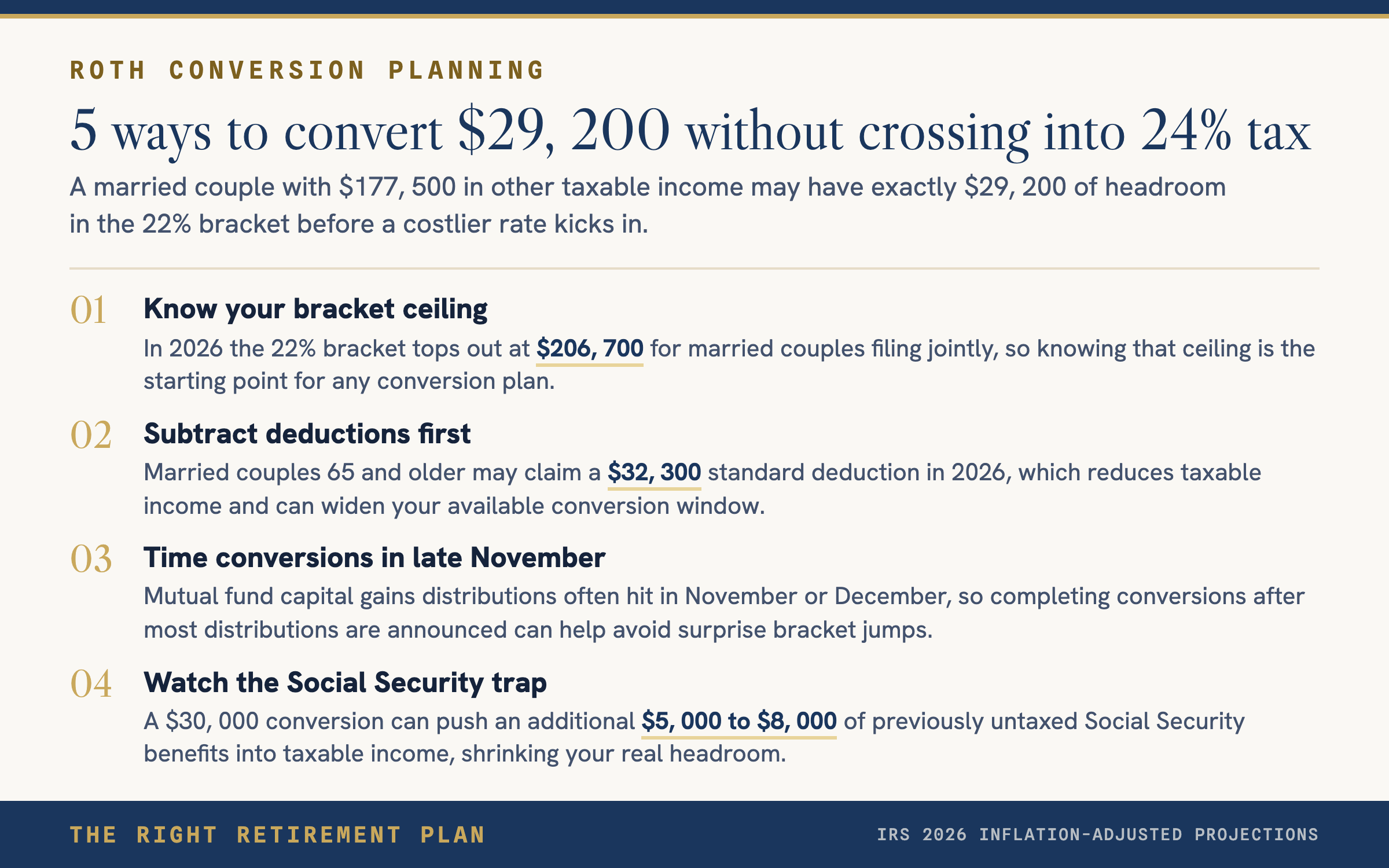
In 2026, the 22% bracket extends to $103,350 for single filers and $206,700 for married couples filing jointly, according to IRS inflation-adjusted projections. For a married couple with $177,500 in other taxable income, that leaves exactly $29,200 of "headroom" before hitting 24%—a window that could allow tax-efficient Roth conversions for years.

The math sounds simple, but execution trips up even experienced planners. Provisional income calculations, the timing of Social Security, and year-end surprises like capital gains distributions can push you over when you weren't expecting it. This article breaks down how to calculate your precise conversion capacity, avoid the most common bracket-busting mistakes, and build a multi-year strategy that could save tens of thousands in lifetime taxes.

How the 22% Bracket Actually Works in 2026

Tax brackets apply to taxable income—not gross income, not adjusted gross income, but the number after subtracting your standard or itemized deductions. Understanding this distinction is essential for precise Roth conversion planning.

For 2026, the IRS projects these thresholds for the 22% bracket:

  • Single filers: $48,476 to $103,350
  • Married filing jointly: $96,951 to $206,700
  • Head of household: $64,851 to $103,350
Here's a critical detail most tax software overlooks: the IRS rounds down at bracket edges. Converting to exactly $103,349 (not $103,350) for a single filer keeps every dollar in the 22% bracket. That one-dollar difference could save approximately $220 on a $1,000 conversion that would otherwise spill into 24%.

Calculating Your Conversion Capacity

To find your available headroom, work backward from the bracket ceiling:

Step 1: Start with the bracket top ($206,700 for married filers).

Step 2: Subtract your standard deduction ($32,300 for married couples 65+ in 2026, based on IRS projections including the additional deduction for seniors).

Step 3: Subtract all other income: wages, pensions, taxable Social Security, interest, dividends, rental income, and required minimum distributions.

Example: A married couple, both 68, has:

  • Pension income: $45,000
  • Social Security (85% taxable): $34,000
  • Investment income: $18,500
  • RMDs: $22,000
  • Total other income: $119,500

Their calculation: $206,700 – $32,300 – $119,500 = $54,900 of Roth conversion capacity while staying in the 22% bracket.

The $29,200 Strategy: A Worked Example

Let's examine a specific scenario that illustrates the $29,200 annual conversion opportunity mentioned in the headline—and why precision matters.

The Hendersons (hypothetical married couple, ages 66 and 64):

  • Combined Social Security: $52,000 annually
  • Pension: $48,000
  • Traditional IRA balance: $780,000
  • No current RMDs (neither has reached 73)

Income breakdown:
  • Pension: $48,000
  • Taxable Social Security: approximately $44,200 (85% of $52,000, typical at their income level)
  • Interest and dividends: $8,800
  • Adjusted gross income before conversion: $101,000
  • Minus standard deduction ($32,300): $68,700 taxable income

Available headroom: $206,700 – $68,700 = $138,000

Wait—that's far more than $29,200. So where does that specific number come from?

The $29,200 figure applies to couples with higher base income. Consider a different scenario: a couple with $145,100 in taxable income before conversions. Their headroom: $206,700 – $145,100 = $61,600. But if they're also managing IRMAA thresholds (more on this shortly), they might limit conversions to $29,200 to stay below Medicare premium increases.

Why Not Convert the Maximum?

Filling the bracket completely isn't always optimal. Contributing advisors at TRRP, drawing on over 240 combined years of retirement planning experience, frequently cite these reasons to convert less than your full headroom:

  • IRMAA cliffs: Medicare premiums jump at specific modified adjusted gross income thresholds ($212,000 for married couples in 2026, per CMS projections)
  • State tax considerations: Conversions count as income for state taxes, which may have different bracket structures
  • ACA premium impacts: If you're not yet 65, higher income reduces premium tax credit eligibility
  • Cash flow needs: You need funds to pay the conversion tax without raiding the converted amount

Timing Mistakes That Blow Up the Math

Even careful planners stumble on timing issues that push them unexpectedly into the 24% bracket.

The December Surprise

Mutual fund capital gains distributions typically occur in November or December. According to Morningstar research, the average equity fund distributed 4.2% of NAV in capital gains during 2023. If you've already executed your Roth conversion in September based on projected income, a surprise $8,000 distribution could push you over.

Solution: Complete conversions in late November or December after most fund distributions are announced, or use exchange-traded funds, which typically distribute fewer capital gains.

The Social Security Provisional Income Trap

Roth conversions increase your modified adjusted gross income, which can make more of your Social Security taxable—a circular calculation that confuses many planners.

Here's how it works: Up to 85% of Social Security benefits may become taxable based on "provisional income" (adjusted gross income plus tax-exempt interest plus half of Social Security). A $30,000 Roth conversion doesn't just add $30,000 to taxable income; it could also push an additional $5,000–$8,000 of previously untaxed Social Security into taxable territory.

Solution: Model the full impact using IRS Publication 915 worksheets or tax software that handles the iteration correctly.

The RMD Ordering Rule

You cannot convert your required minimum distribution. The first dollars withdrawn from your traditional IRA each year satisfy your RMD before any conversion can occur. This catches retirees who attempt to convert in January before "taking" their RMD—the IRS automatically treats those early withdrawals as RMD first.

Solution: Calculate and withdraw your full RMD before executing any Roth conversion, or plan conversion amounts knowing the RMD comes off the top.

Building a Multi-Year Conversion Ladder

Single-year thinking misses the bigger opportunity. Strategic Roth conversions typically work best as a multi-year project, especially during the "gap years" between retirement and age 73 (when RMDs begin) or age 65 (when Medicare starts).

The Prime Conversion Window

According to research from the Employee Benefit Research Institute (EBRI), retirees often have lower taxable income during ages 62–72 than they will after RMDs begin. This window may offer the best conversion opportunity.

Example timeline for someone retiring at 63:

  • Ages 63–64: Convert up to the top of the 22% bracket (no Medicare yet, so no IRMAA concerns)
  • Ages 65–72: Convert up to IRMAA thresholds, balancing tax brackets against Medicare premium increases
  • Age 73+: Conversion capacity shrinks as RMDs fill bracket space

The $1 Under Rule

When calculating your final conversion amount, stop $1 below the bracket threshold. As noted earlier, the IRS rounds down at bracket edges, but various income sources (bank interest, for example) may not report final amounts until January. Building in a small buffer—perhaps $100–$500—provides insurance against bracket creep.

Medicare's Income-Related Monthly Adjustment Amount creates cliffs, not slopes. At $212,000 of modified adjusted gross income (married filing jointly, 2026 projection per CMS), your Medicare Part B and Part D premiums jump by roughly $1,100 per person annually. That's a $2,200 penalty for exceeding the threshold by even one dollar—far more punishing than paying 24% instead of 22% on the same dollar.

The sophisticated approach considers both thresholds simultaneously. For some retirees, the optimal conversion stops at the IRMAA cliff even though significant 22% bracket room remains. For others, IRMAA impacts are irrelevant because their income is either well below or permanently above the thresholds.

Key Takeaways

  • The 22% federal bracket extends to $103,350 (single) or $206,700 (married filing jointly) in 2026, providing a ceiling for tax-efficient Roth conversions.
  • Calculate conversion capacity by subtracting your standard deduction and all other income from the bracket top—stop $1 below the edge.
  • Year-end capital gains distributions, the Social Security provisional income calculation, and RMD ordering rules commonly push retirees into higher brackets unexpectedly.
  • IRMAA thresholds often matter more than tax brackets—a single dollar over the cliff triggers $2,200+ in additional Medicare premiums for couples.
  • The years between retirement and age 73 typically offer the widest conversion window before RMDs consume bracket space.
  • Multi-year conversion strategies generally outperform single-year optimization by spreading the tax liability across lower-income years.

Next Step

Precise Roth conversion planning requires understanding how your income, healthcare costs, and tax situation interact over time. If you'd like to see where your current approach might leave money on the table, the free Retire Ready Score provides a quick assessment across these key retirement dimensions.

ShareX / TwitterFacebook

Have questions about your specific situation? Take the free Retire Ready Score →

The Compound Effect

Weekly retirement insights in your inbox.

Plain-English breakdowns of the week’s most important retirement news, tax changes, and strategies. Free. Unsubscribe anytime.

Get THE RIGHT retirement plan for you.

Take the 2-minute Retire Ready Score assessment — free, no email required to start.

Take the Free Assessment →