Sell at a $10,000 Loss but Buy Back in 29 Days? IRS Says You Owe Tax on $0 Deduction
The 61-day wash sale window catches investors harvesting losses for tax
When couples see they're in the "32% tax bracket," many assume nearly a third of their income disappears to federal taxes. That misunderstanding costs retirees real money every year—sometimes tens of thousands of dollars over a retirement—because it leads to poor timing decisions about when to take income, convert IRAs, or claim Social Security.
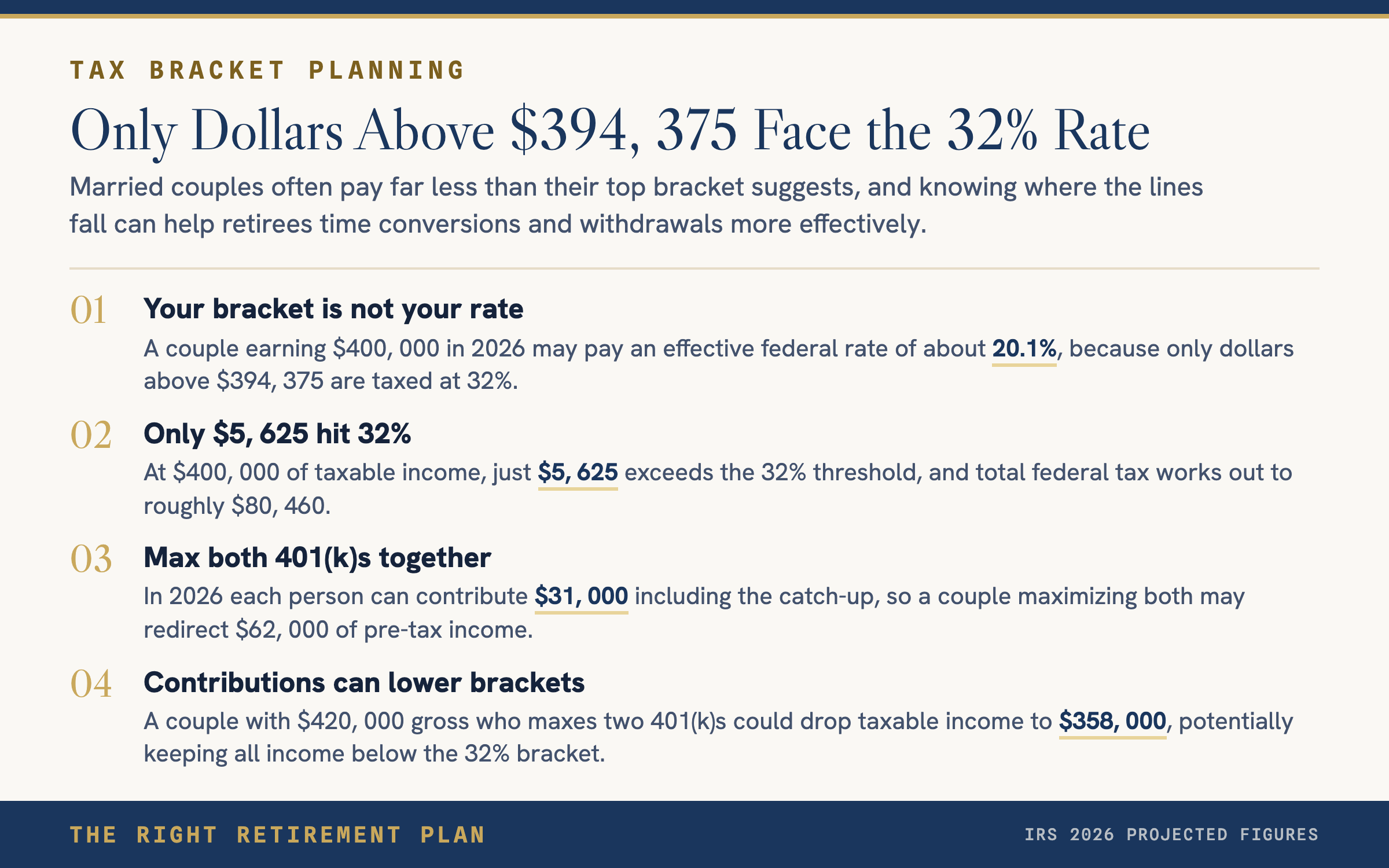
Here's the reality: a married couple earning $400,000 in 2026 pays an effective federal tax rate of approximately 20.1%, not 32%. The difference between those two numbers represents roughly $47,600 in annual tax savings that the progressive system already provides. Understanding exactly how this works—and where the planning opportunities hide—could help you keep significantly more of your retirement income.
According to IRS projections for 2026, married couples filing jointly hit the 32% bracket on taxable income above $394,375. But that 32% rate applies only to dollars above that threshold, not to your entire income. This article breaks down exactly how the math works and where strategic planning may create additional savings.
The federal income tax system is progressive, meaning different portions of your income get taxed at different rates. For married couples filing jointly in 2026, the IRS brackets are projected to be:
For a couple with $400,000 in taxable income, only $5,625 actually gets taxed at 32%—the amount exceeding the $394,375 threshold. The remaining $394,375 flows through the lower brackets at their respective rates.
The actual federal tax on $400,000 of taxable income works out to approximately $80,460, producing that 20.1% effective rate. The gap between 32% and 20.1% exists because the bulk of the income—nearly $207,000 of it—gets taxed at 22% or lower.
Understanding bracket mechanics reveals specific opportunities that may reduce lifetime tax liability. The key insight: every dollar you can shift from a higher bracket to a lower one saves the difference in rates.
For couples with income pushing into the 32% bracket, the spread between 24% and 32% represents an 8-percentage-point opportunity. That means every $10,000 moved from the 32% bracket to the 24% bracket could save $800 in federal taxes.
Retirement contribution strategies offer one approach. In 2026, the 401(k) contribution limit is projected to reach $23,500 per person, with an additional $7,500 catch-up contribution for those 50 and older. A couple where both spouses maximize their 401(k)s at $31,000 each could redirect $62,000 of pre-tax income—potentially pulling a significant portion out of higher brackets.
Consider a couple with $420,000 in gross income. Without any retirement contributions, roughly $25,625 sits in the 32% bracket. By maximizing two 401(k)s at $62,000 total, they could drop their taxable income to $358,000, keeping the entire amount below the 32% threshold. The tax savings on that $62,000 shift from 32% to 24%? Approximately $4,960 annually.
Timing of income recognition creates similar opportunities. Retirees often have more control over income timing than workers—choosing when to take IRA distributions, when to realize capital gains, or when to convert traditional IRA funds to Roth accounts.
The years between retirement and age 73 (when required minimum distributions typically begin) often create a temporary low-income window. During these years, strategic Roth conversions may allow couples to "fill up" lower brackets with converted income.
Here's how this could work: A couple retires at 62 with $2 million in traditional IRAs and modest pension income of $60,000. Before Social Security kicks in, their taxable income might be relatively low. By converting portions of their traditional IRA to Roth during these years, they could pay taxes at the 12% or 22% brackets on money that might otherwise be distributed at 24% or higher once RMDs, Social Security, and other income sources stack up.
The math on conversion planning involves comparing current bracket rates against projected future rates—factoring in the 2026 sunset of current tax rates, which according to the Tax Cuts and Jobs Act provisions, could push brackets higher in 2027 unless Congress acts.
A note on Medicare premiums: High-income retirees face Income-Related Monthly Adjustment Amounts (IRMAA) that increase Medicare Part B and Part D premiums. For 2026, couples with modified adjusted gross income above $212,000 (based on 2024 income) may pay surcharges ranging from $74 to $419 per person per month on Part B alone, according to CMS projections. Roth conversions, while reducing future RMDs, could temporarily spike income and trigger IRMAA—a factor that requires careful year-by-year analysis.
Federal brackets tell only part of the story. Couples in high-tax states face combined marginal rates that may significantly exceed federal rates alone.
California's top rate of 13.3% applies to income over $1,398,962 for joint filers, though the 9.3% rate kicks in at just $136,742. New York City residents face combined state and city rates approaching 13% on high incomes. Meanwhile, nine states—including Florida, Texas, Nevada, and Tennessee—impose no state income tax on ordinary income.
For retirees with flexibility about where to establish residency, the state tax differential on $400,000 of income could exceed $40,000 annually. That's not a small consideration when projecting 20 or 30 years of retirement income.
Even within high-tax states, understanding the interaction between state and federal brackets matters. State taxes are deductible on federal returns, but the $10,000 SALT cap limits this benefit for most high-income couples. This cap is currently scheduled to remain through 2025 under current law, with potential changes depending on legislative action.
A dollar saved in the 32% bracket today might cost $1.50 in the 37% bracket ten years from now if RMDs push income higher. Conversely, paying taxes now at 24% to do a Roth conversion could save money if future rates increase or if your income rises in retirement.
Research from the Employee Benefit Research Institute suggests that many retirees actually see their tax rates increase during retirement, contrary to the common assumption that retirement means lower brackets. This happens when required distributions, Social Security benefits, and accumulated assets combine to create higher taxable income than during working years.
If you're curious how bracket planning might apply to your specific situation, the free Retire Ready Score at /quiz offers a two-minute assessment covering income, taxes, and healthcare—showing where your current approach may have gaps worth examining.
Have questions about your specific situation? Take the free Retire Ready Score →

The 61-day wash sale window catches investors harvesting losses for tax

Alternative Minimum Tax exemptions phase out quickly, catching high earners by

The annual gift exclusion lets you transfer wealth without using your lifetime