Convert $100,000 to Roth at 59? You Can't Touch It Tax-Free Until Age 64

February 10, 2026· 7 min read
Convert $100,000 to Roth at 59? You Can't Touch It Tax-Free Until Age 64

The Conversion Clock Nobody Explains at Signing

You've done the math. You've read the articles. You're convinced that converting some of your traditional IRA to a Roth before Required Minimum Distributions kick in makes sense. So you convert $100,000 at age 59, pay the taxes, and assume you now have $100,000 in a tax-free account ready whenever you need it.

Then you learn about the 5-year rule—and realize you can't touch those converted dollars without a 10% penalty until you turn 64.

This timing trap catches thousands of pre-retirees every year, according to data from tax preparation firms. The IRS collected over $23 billion in early withdrawal penalties and taxes in 2023, and a meaningful portion came from retirees who misunderstood Roth conversion timing rules.

The stakes are significant. Convert $500,000 at age 60, and you could face a 5-year liquidity crisis where accessing your own money costs you 10% plus whatever you paid in conversion taxes. That's potentially $50,000 in penalties on top of the $100,000+ you already paid to convert.

This article breaks down exactly how the 5-year conversion rule works, when it applies, and how to structure conversions so you don't accidentally lock yourself out of your retirement funds during the years you may need them most.

How the 5-Year Conversion Rule Actually Works

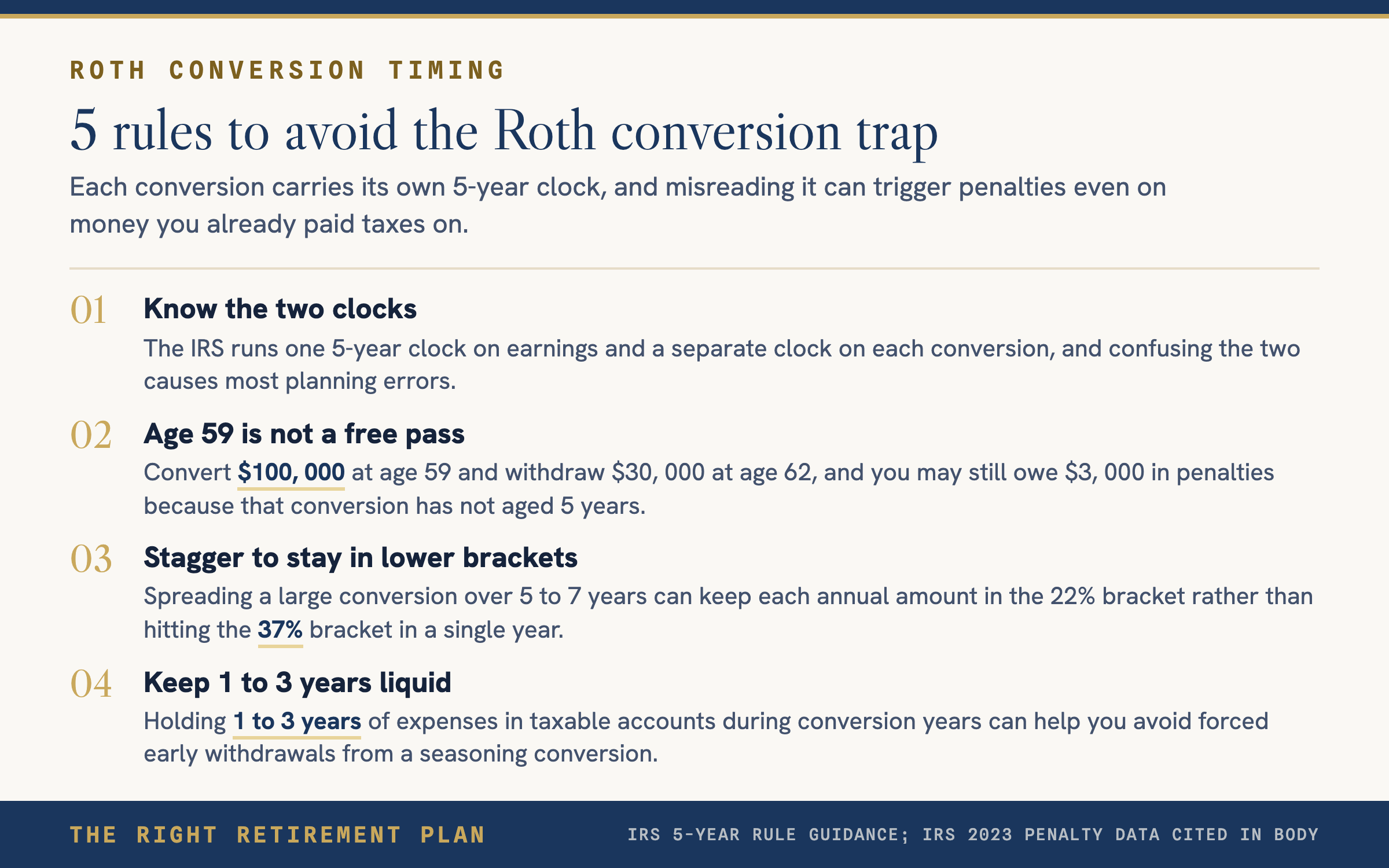
The IRS maintains two separate 5-year clocks for Roth IRAs, and confusing them is where most planning errors occur.

The first clock governs when earnings become tax-free. This starts when you make your first Roth contribution (or conversion) and determines when the growth in your account can be withdrawn without taxes. This clock only needs to start once in your lifetime.

The second clock—the one that trips up pre-retirees—applies separately to each conversion. Under IRS rules, every Roth conversion has its own 5-year holding period before you can withdraw those specific converted dollars penalty-free. This clock resets with each conversion you make.

Here's the critical distinction: if you're under age 59½ when you want to withdraw converted funds, you must wait 5 years from the conversion date or pay a 10% early withdrawal penalty on the converted amount.

The ordering rules matter enormously:

  • First out: Your direct contributions (always tax and penalty-free)
  • Second out: Converted amounts (in order of conversion, oldest first)
  • Last out: Earnings (subject to both 5-year rules and age requirements)
So if you convert $100,000 at age 59 and need $30,000 at age 62, you'll owe a 10% penalty ($3,000) because that specific conversion hasn't aged 5 years yet—even though you already paid income tax on the full conversion.

The calendar-year rule provides one small advantage: conversions done anytime in 2026 are considered to have started their clock on January 1, 2026. A December 2026 conversion and a January 2026 conversion reach their 5-year mark on the same date: January 1, 2031.

The Age 59½ Exception (And Why It Doesn't Always Save You)

Many retirees assume the 5-year conversion rule becomes irrelevant once they pass age 59½. This is partially true—but the timing matters more than most realize.

Once you reach age 59½, the 10% early withdrawal penalty no longer applies to Roth distributions. This means conversions you made before turning 59½ can be accessed penalty-free once you cross that birthday threshold, regardless of whether the 5-year period has elapsed.

However, here's where it gets complicated:

  • Convert at age 58, withdraw at age 60: No penalty (you're over 59½)
  • Convert at age 60, withdraw at age 62: 10% penalty applies (conversion hasn't aged 5 years, and you're accessing converted principal before its clock runs out)
Wait—that second scenario seems backward. If you're over 59½, shouldn't you be penalty-free?

The answer reveals a nuance many advisors gloss over: the 5-year rule on conversions specifically applies to converted amounts when withdrawn before the 5-year period ends, regardless of age at withdrawal. The age 59½ exception eliminates penalties on earnings and contributions, but converted amounts follow their own timeline.

According to IRS Publication 590-B, if you withdraw converted amounts within 5 years, the 10% additional tax may apply to the portion attributable to conversion—even after age 59½—if you were under 59½ at the time of conversion.

This creates a planning window: conversions made after age 59½ are only subject to the 5-year earnings rule, not the conversion penalty rule. Convert at 60, and you can access those converted dollars at 61 without penalty—you just can't access the earnings on those dollars tax-free until the 5-year clock runs.

Strategic Conversion Timing: A Practical Framework

Given these overlapping rules, how should pre-retirees approach Roth conversions without creating liquidity problems?

Start conversions early if possible. Every year you delay starting conversions is another year the 5-year clock isn't running. A retiree who begins modest conversions at age 55 has their first batch fully accessible by 60—right when many retirement transitions occur.

Stagger conversions across multiple years. Rather than converting $500,000 in one year (which would push you into the 35% or 37% federal bracket for 2026), consider spreading conversions across 5-7 years. This accomplishes two goals:

  • Keeps each year's conversion in a lower tax bracket
  • Creates a rolling schedule where some converted funds become accessible each year
Example conversion schedule:

| Age | Amount Converted | Penalty-Free Access Date | Tax Bracket (2026, MFJ) |
|-----|------------------|--------------------------|-------------------------|
| 58 | $80,000 | Age 63 | 22% |
| 59 | $80,000 | Age 64 | 22% |
| 60 | $80,000 | Age 65 | 22% |
| 61 | $80,000 | Age 66 | 22% |
| 62 | $80,000 | Age 67 | 22% |

Maintain separate liquidity. The 5-year rule primarily creates problems when retirees have no other accessible funds. Financial planning research from Vanguard suggests maintaining 1-3 years of expenses in taxable accounts or other accessible sources during the conversion years.

Consider the Medicare IRMAA impact. Large conversions can temporarily push income above the 2026 IRMAA thresholds ($206,000 for married filing jointly), increasing Medicare Part B and D premiums two years later. Spreading conversions helps manage this secondary cost.

Most retirees focus on avoiding the conversion penalty by waiting 5 years to touch converted funds. But if you wait too long to start any Roth account, you may face the opposite problem: you can access your converted principal fine, but the earnings on those conversions won't be tax-free until 5 years after your first Roth contribution.

The overlooked move? Make a small Roth IRA contribution (or conversion) in your early 50s—even $1,000—just to start the earnings clock. According to Fidelity research, roughly 40% of workers aged 50-54 with traditional IRAs have never made any Roth contribution. They're starting both clocks simultaneously when they could have started one a decade earlier.

One contribution today could mean tax-free earnings five years sooner on everything you convert later.

Key Takeaways

  • Each Roth conversion starts its own 5-year clock for penalty-free access to that specific converted amount—this is separate from the earnings clock.
  • Converting under age 59½ creates penalty exposure on withdrawals of converted amounts until that conversion ages 5 years, even if you're over 59½ when you withdraw.
  • Conversions made after age 59½ avoid the conversion penalty but still require a 5-year wait for tax-free earnings access.
  • Staggering conversions across multiple years provides both tax bracket management and rolling access to funds.
  • Starting any Roth account early begins the earnings clock that governs when growth becomes tax-free—even a small contribution counts.
  • Maintain accessible liquidity outside your Roth during conversion years to avoid forced early withdrawals.

Next Step

Understanding how conversion timing interacts with your specific retirement age, income, and liquidity needs requires looking at your complete picture. The free Retire Ready Score at /quiz helps you identify whether Roth conversion timing could create gaps in your current retirement plan.

ShareX / TwitterFacebook

Have questions about your specific situation? Take the free Retire Ready Score →

The Compound Effect

Weekly retirement insights in your inbox.

Plain-English breakdowns of the week’s most important retirement news, tax changes, and strategies. Free. Unsubscribe anytime.

Get THE RIGHT retirement plan for you.

Take the 2-minute Retire Ready Score assessment — free, no email required to start.

Take the Free Assessment →