The $70,500 Annual Roth Conversion Most High Earners Miss

March 28, 2026· 7 min read
The $70,500 Annual Roth Conversion Most High Earners Miss

Introduction

If you earn too much for direct Roth IRA contributions, you probably know about the backdoor Roth strategy. But that move is capped at $7,000 for 2026 — a rounding error for high earners trying to build meaningful tax-free retirement wealth.

What most people don't realize is that there's another door. A much bigger one.

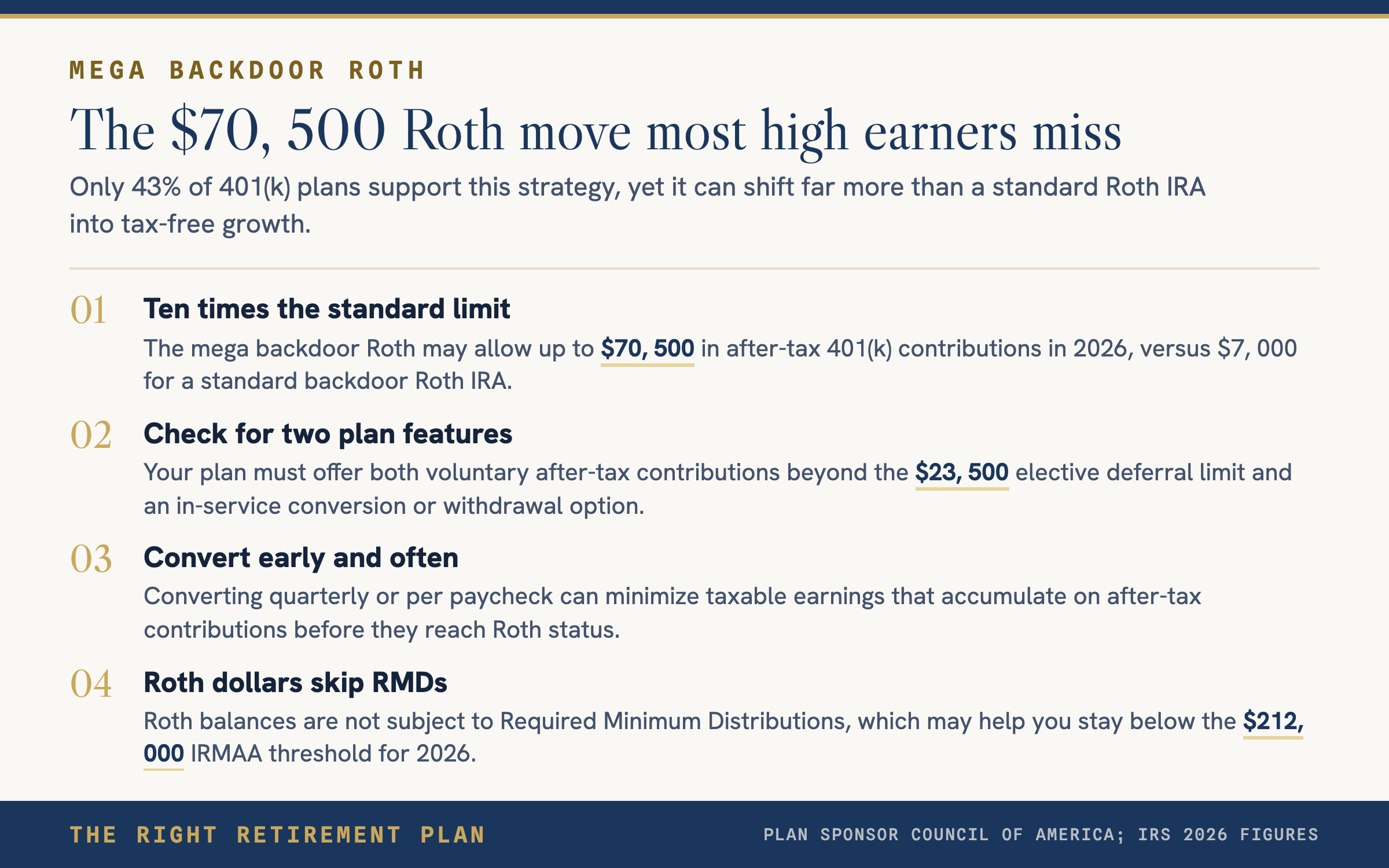
The mega backdoor Roth allows eligible savers to convert up to $70,500 in additional after-tax dollars into Roth accounts in a single year. That's ten times the standard backdoor limit. Over a decade, that's potentially $705,000 shifted into tax-free territory — plus all future growth.

The catch? Only 43% of employer 401(k) plans allow the specific provisions that make this strategy work, according to a 2024 Plan Sponsor Council of America survey. And even among those who have access, most never use it because they don't know it exists.

This article breaks down exactly how the mega backdoor Roth works, who qualifies, how to calculate your maximum contribution, and the critical plan features you need to check before making a move.

Understanding the 401(k) Contribution Tiers

Most retirement savers think of 401(k) contributions as a single bucket. In reality, the IRS creates three distinct tiers, each with different tax treatment:

Tier 1: Employee Elective Deferrals
For 2026, you can contribute up to $23,500 in pre-tax or Roth elective deferrals ($31,000 if you're 50 or older due to catch-up provisions). This is the number most people focus on.

Tier 2: Employer Contributions
Your employer's matching contributions and profit-sharing add to your account but don't count against your personal limit. These contributions are always pre-tax.

Tier 3: After-Tax Employee Contributions
Here's where the mega backdoor lives. The IRS allows total annual additions to a 401(k) of $70,000 for 2026 ($77,500 with catch-up contributions). After you max out Tier 1 and receive your employer match, the remaining space can potentially be filled with after-tax contributions.

Let's run the math for a 52-year-old earning $350,000 with a 4% employer match:

  • Employee elective deferrals: $31,000 (including catch-up)
  • Employer match (4% of salary): $14,000
  • Total annual addition limit: $77,500
  • Available after-tax space: $32,500
That $32,500 in after-tax contributions becomes the raw material for a mega backdoor Roth conversion. For someone without catch-up eligibility and a smaller match, the available space could exceed $40,000.

The Two Plan Features That Make It Work

Having after-tax contribution capacity means nothing without two critical plan provisions. According to Vanguard's 2024 How America Saves report, many plans offer one but not both — and you need both.

Feature 1: After-Tax Contribution Allowance

Your plan must explicitly permit voluntary after-tax contributions beyond your standard pre-tax or Roth elective deferrals. This is separate from Roth 401(k) contributions. Not all plans include this option, and some that do may cap the amount below the IRS maximum.

How to check: Request your Summary Plan Description (SPD) from HR or your plan administrator. Look for language about "voluntary after-tax contributions" or "non-Roth after-tax contributions."

Feature 2: In-Service Withdrawals or In-Plan Conversions

After-tax contributions sitting in your 401(k) aren't in a Roth account — they're in an after-tax account where earnings grow tax-deferred (not tax-free). To complete the mega backdoor strategy, you need one of these mechanisms:

  • In-service withdrawal to Roth IRA: Your plan allows you to roll after-tax contributions (and any earnings) to an external Roth IRA while still employed.
  • In-plan Roth conversion: Your plan permits converting after-tax contributions to the plan's Roth 401(k) bucket.
The PSCA survey found that while 86% of plans offering after-tax contributions also allow in-service withdrawals, the remaining 14% leave participants stranded — able to make after-tax contributions but unable to convert them until separation from service.

The earnings complication: When you convert, your after-tax contributions roll to Roth tax-free (you already paid tax on them). However, any earnings on those contributions are pre-tax and will be taxable upon conversion. This is why frequency matters — converting quarterly or even per-paycheck minimizes accumulated earnings and the associated tax bill.

Calculating Your Personal Mega Backdoor Capacity

Your mega backdoor opportunity depends on three variables: your compensation, your contribution rate, and your employer's generosity. Here's a framework for estimating your capacity:

Step 1: Determine Your Total Addition Limit

For 2026, the limit is $70,000 (or $77,500 with catch-up contributions for those 50+). However, employer contributions for highly compensated employees may be subject to additional testing that reduces this ceiling. Consult your plan administrator for your specific limit.

Step 2: Calculate Your Elective Deferral Maximum

This is $23,500 for 2026, plus $7,500 catch-up if eligible. Note: The SECURE 2.0 Act created a special catch-up provision for ages 60-63, allowing $11,250 in catch-up contributions for 2025-2028. This would reduce your after-tax space but increase your Roth 401(k) space.

Step 3: Estimate Employer Contributions

Add matching contributions and any profit-sharing. For highly compensated employees, IRS nondiscrimination testing may limit employer contributions received.

Step 4: Identify the Gap

After-Tax Capacity = Total Addition Limit − Elective Deferrals − Employer Contributions

Example scenarios for 2026:

| Scenario | Total Limit | Elective Deferrals | Employer Match | After-Tax Capacity |
|----------|-------------|-------------------|----------------|--------------------|
| Age 45, 6% match on $200K | $70,000 | $23,500 | $12,000 | $34,500 |
| Age 55, 3% match on $400K | $77,500 | $31,000 | $12,000 | $34,500 |
| Age 62, 4% match on $300K | $81,250 | $34,750 | $12,000 | $34,500 |

*Reflects enhanced catch-up under SECURE 2.0 for ages 60-63.

Conventional wisdom says pre-tax contributions are better if you'll be in a lower bracket later. But high earners with substantial pre-tax 401(k) balances, pensions, or deferred compensation often face Required Minimum Distributions that push them into higher brackets than expected — potentially triggering IRMAA surcharges on Medicare premiums or taxation of Social Security benefits.

The mega backdoor Roth lets you diversify your tax exposure. Those Roth dollars won't count toward RMDs, won't increase your provisional income for Social Security taxation, and won't push you into higher IRMAA brackets. For married couples in 2026, IRMAA surcharges begin at modified adjusted gross income above $212,000, per CMS projections — a threshold many retirees with substantial pre-tax accounts inadvertently cross.

This isn't about predicting future tax rates. It's about creating optionality.

Key Takeaways

  • The mega backdoor Roth allows up to $70,500 in after-tax 401(k) contributions converted to Roth status in 2026 ($77,500+ with catch-up provisions).
  • Only 43% of 401(k) plans permit the necessary combination of after-tax contributions and in-service withdrawals or conversions.
  • Your available after-tax space equals the total addition limit minus your elective deferrals and employer contributions.
  • Converting frequently (quarterly or per-paycheck) minimizes taxable earnings accumulated before conversion.
  • Roth assets provide tax diversification and may help manage RMDs, IRMAA thresholds, and Social Security taxation in retirement.
  • Request your Summary Plan Description to verify whether your plan supports this strategy before making changes.

Next Step

Your mega backdoor Roth capacity depends on factors unique to your situation — income, plan provisions, existing account balances, and retirement timeline. The free Retire Ready Score can help you see where tax-efficient contribution strategies fit within your broader retirement picture.

ShareX / TwitterFacebook

Have questions about your specific situation? Take the free Retire Ready Score →

The Compound Effect

Weekly retirement insights in your inbox.

Plain-English breakdowns of the week’s most important retirement news, tax changes, and strategies. Free. Unsubscribe anytime.

Get THE RIGHT retirement plan for you.

Take the 2-minute Retire Ready Score assessment — free, no email required to start.

Take the Free Assessment →