A -20% Year 1 Drop Costs Retirees $426,000 Over 30 Years

February 14, 2026· 7 min read
A -20% Year 1 Drop Costs Retirees $426,000 Over 30 Years

Why Your First Five Years Could Make or Break Your Retirement

You've saved diligently for decades. You've hit your number. You've filed for Social Security, picked a Medicare plan, and maybe even celebrated with a trip to celebrate this new chapter.

Then the market drops 20% in your first year of retirement.

That single year—not your lifetime average return, not your asset allocation, not even how much you saved—could determine whether your portfolio lasts 30 years or runs dry at 22. According to research from the Center for Retirement Research at Boston College, retirees who experience a significant market decline in their first few years face dramatically different outcomes than those who experience the same decline later.

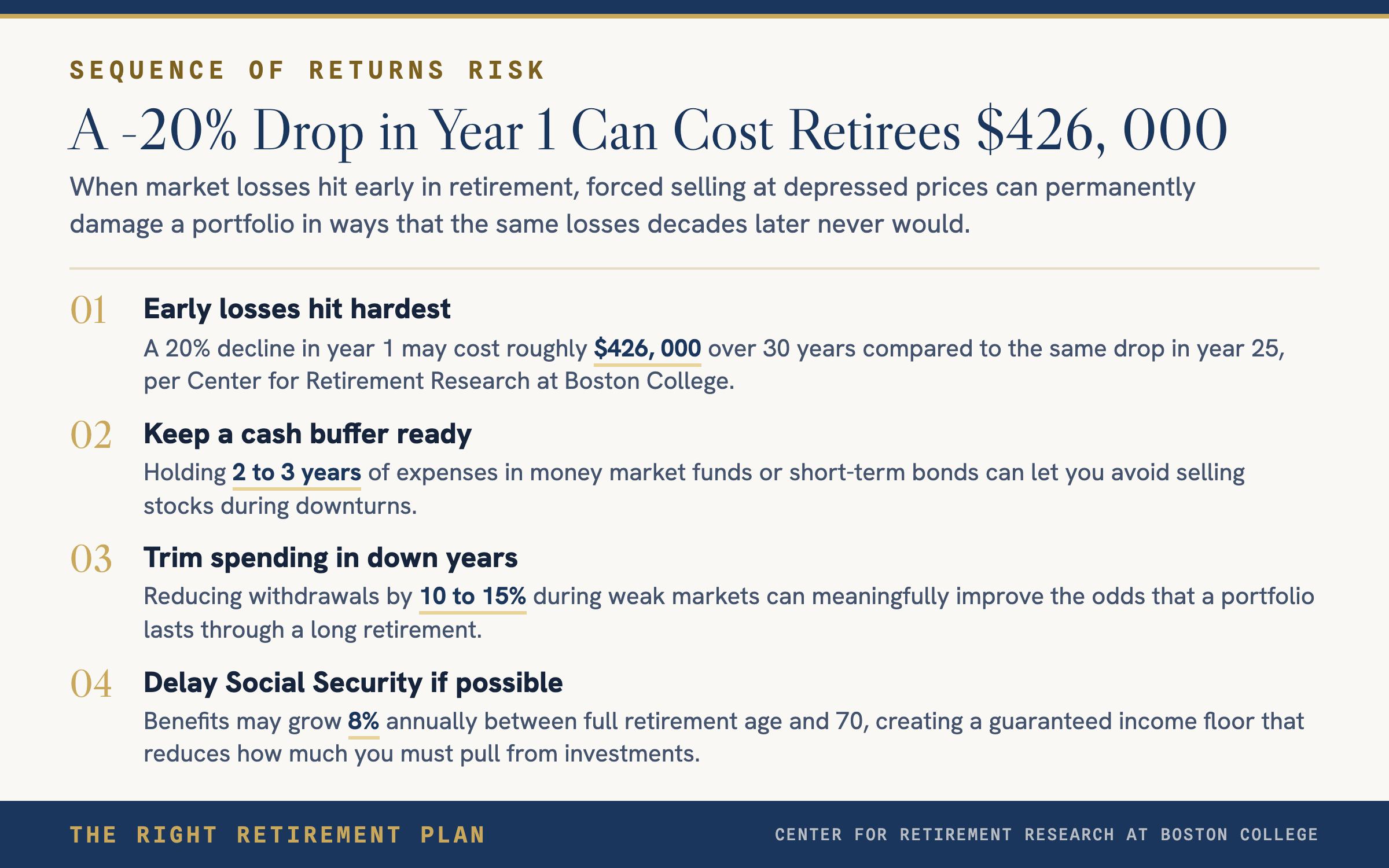
How dramatic? A -20% drop in year one, combined with normal 4% annual withdrawals, can cost retirees approximately $426,000 over a 30-year retirement compared to experiencing that same drop in year 25. Same total returns. Same withdrawal rate. Completely different ending balances.

This phenomenon—called sequence of returns risk—is one of the most misunderstood and underestimated threats to retirement security. And understanding it could fundamentally change how you think about your first five years after leaving work.

The Math That Explains Why Timing Matters More Than Averages

Most retirement planning conversations focus on average returns. "Historically, a 60/40 portfolio returns about 7% annually," you might hear. But averages hide a dangerous truth: the order of those returns matters enormously when you're withdrawing money.

Here's why. When you're accumulating wealth, a bad year early on hurts—but you have decades of contributions and compounding ahead to recover. When you're withdrawing, a bad year early forces you to sell more shares at depressed prices just to cover living expenses. Those shares are gone. They can't participate in the eventual recovery.

Consider two hypothetical retirees, both starting with $1 million and withdrawing $40,000 annually (a 4% initial withdrawal rate, adjusted for inflation):

  • Retiree A experiences returns of -20%, -15%, and -5% in years 1-3, then averages 8% for years 4-30
  • Retiree B experiences the same -20%, -15%, and -5% returns—but in years 28-30, with 8% returns in years 1-27
Both portfolios have identical 30-year average returns of approximately 6.2%. Yet Retiree A's portfolio is depleted by year 22, while Retiree B finishes with over $2.1 million.

The difference isn't luck or skill. It's pure mathematics. When Retiree A withdraws $40,000 from a portfolio that just dropped to $800,000, they're selling 5% of their remaining assets. When Retiree B withdraws that same $40,000 from a portfolio that's grown to $3.2 million, they're selling just 1.25%.

The "Fragile Decade": Why Years One Through Five Demand Extra Protection

Retirement researchers, including those at Morningstar and the Employee Benefit Research Institute (EBRI), often refer to the first five to ten years of retirement as the "fragile decade" or "retirement red zone." During this window, your portfolio is most vulnerable to permanent damage from market declines.

The vulnerability comes from three compounding factors:

  • Largest portfolio balance: You're likely starting retirement with the most money you've ever had. A 20% drop on $1.2 million is $240,000—far more painful than the same percentage drop on the $400,000 you had at age 45.
  • Withdrawals accelerate losses: Every dollar you withdraw during a downturn is a dollar that can't recover when markets rebound.
  • Psychological pressure: Watching your nest egg shrink while simultaneously depending on it for income creates stress that often leads to poor decisions—like panic-selling at market bottoms.
Vanguard research suggests that retirees who experience a 20%+ market decline in their first two years of retirement are significantly more likely to either run out of money or be forced to dramatically reduce their spending later. The early damage simply can't be overcome, even with strong returns in subsequent years.

This doesn't mean you should avoid stocks entirely. Historically, according to Federal Reserve data, equities have been essential for maintaining purchasing power over 30-year retirements, especially as inflation erodes the value of fixed-income holdings. The goal isn't elimination of risk—it's strategic management of when you're exposed to it.

Strategies That May Help Protect Your First Five Years

Understanding sequence risk is step one. Preparing for it is step two. Here are approaches that retirement planning professionals often consider:

Build a Cash or Bond "Buffer"

Some retirees maintain two to three years of living expenses in cash equivalents or short-term bonds. During market downturns, they draw from this buffer instead of selling depreciated stocks. This approach—sometimes called a "bucket strategy"—may allow equity holdings time to recover before you need to tap them.

For 2026, even money market funds and Treasury bills are offering yields above 4%, according to Federal Reserve rate projections, making this buffer less costly to maintain than in the near-zero interest rate environment of the 2010s.

Consider a "Rising Equity Glidepath"

Counterintuitively, some research from retirement academics suggests starting retirement with a lower stock allocation and gradually increasing it over time. The logic: reduce equity exposure during the fragile early years, then increase it as sequence risk diminishes and longevity risk (outliving your money) becomes the greater threat.

This approach challenges conventional wisdom but has gained attention in academic circles.

Flexible Withdrawal Strategies

The rigid "4% rule" based on Trinity Study research assumed constant inflation-adjusted withdrawals regardless of market conditions. More adaptive approaches—reducing withdrawals by 10-15% during down markets, for example—may significantly improve portfolio survival rates. According to research from Morningstar, flexible spending strategies could allow higher initial withdrawal rates while maintaining similar success probabilities.

Delay Social Security When Possible

For 2026, Social Security benefits increase by 8% for each year you delay claiming between full retirement age and 70. That's a guaranteed, inflation-adjusted return that no market investment can match. Using portfolio withdrawals during your early 60s while delaying Social Security may create a larger "floor" of guaranteed income later—reducing how much you need to withdraw during market downturns.

This means the traditional focus on "beating the market" or maximizing returns may be misplaced for retirees. In accumulation, higher returns are almost always better. In decumulation, the timing and volatility of those returns matter just as much—sometimes more.

The retiree who earns 5% annually with low volatility may actually end up wealthier than one who earns 7% with wild swings, simply because the consistent returns don't force fire-sales during downturns. Stability has real, calculable value once you're depending on your portfolio for income.

Key Takeaways

  • A 20% market decline in year one of retirement could cost approximately $426,000 over 30 years compared to experiencing the same decline in year 25—even with identical average returns.
  • The first five years of retirement represent a "fragile decade" when your portfolio is most vulnerable to permanent damage from sequence of returns risk.
  • Withdrawing during market downturns forces you to sell more shares at lower prices, and those shares can't participate in eventual recoveries.
  • Strategies such as cash buffers, flexible withdrawal rules, and delayed Social Security may help mitigate sequence risk during the critical early years.
  • Average returns are misleading for retirees—the order of returns matters as much as the magnitude when you're withdrawing money.
  • Protecting against early losses may be more valuable than chasing higher average returns during retirement.

Next Step

Understanding how sequence risk applies to your specific timeline and portfolio mix could reveal vulnerabilities you hadn't considered. If you're curious where you stand, the free Retire Ready Score takes about two minutes and may highlight areas worth a closer look.

ShareX / TwitterFacebook

Have questions about your specific situation? Take the free Retire Ready Score →

The Compound Effect

Weekly retirement insights in your inbox.

Plain-English breakdowns of the week’s most important retirement news, tax changes, and strategies. Free. Unsubscribe anytime.

Get THE RIGHT retirement plan for you.

Take the 2-minute Retire Ready Score assessment — free, no email required to start.

Take the Free Assessment →