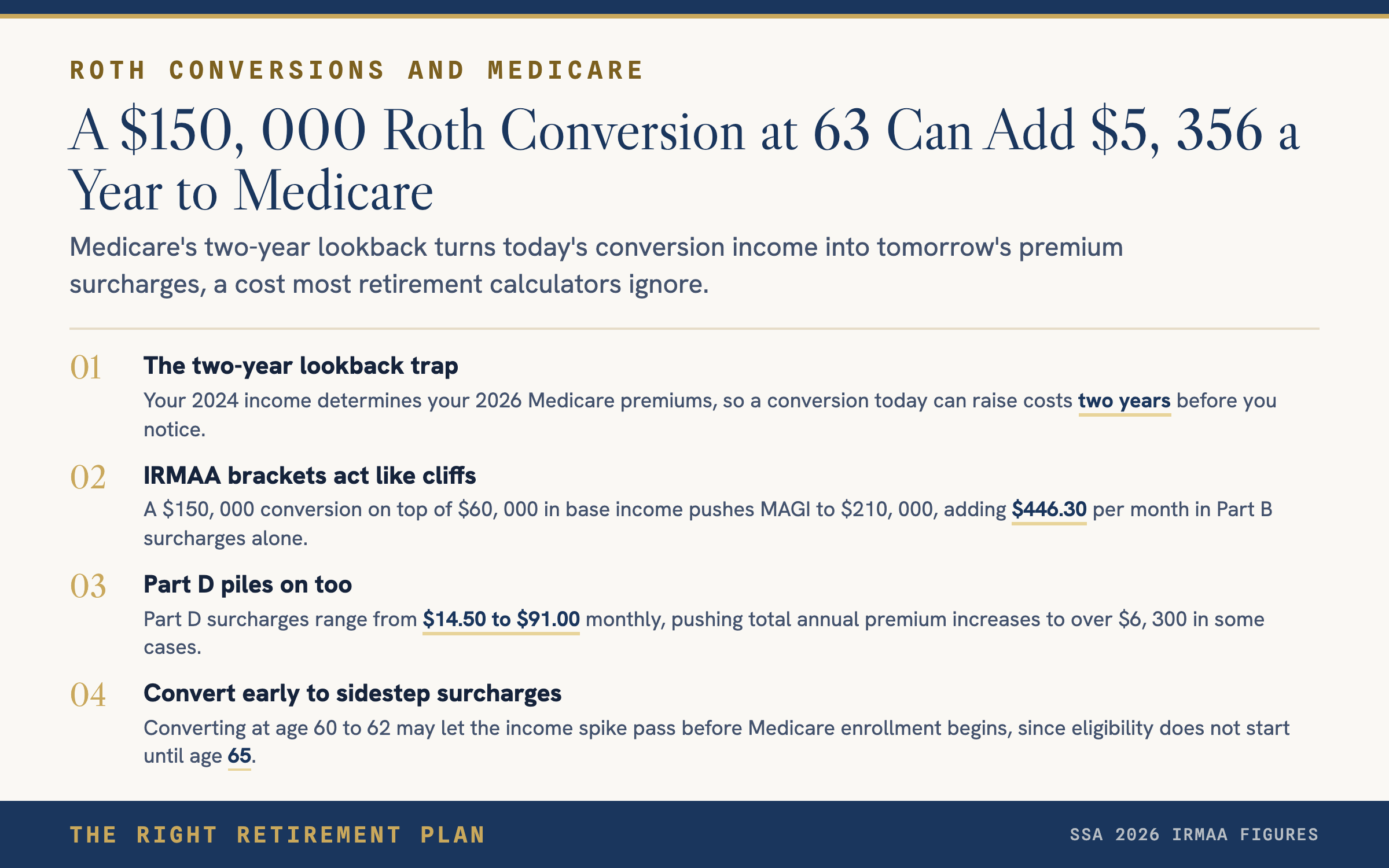
A $150,000 Roth Conversion at 63 Costs $3,432/Year Extra in Medicare at 65

March 6, 2026· 7 min read
A $150,000 Roth Conversion at 63 Costs $3,432/Year Extra in Medicare at 65

Why Your Roth Conversion Today Shows Up in Your Medicare Bill Two Years From Now

You've done the math on Roth conversions. You understand paying taxes now to get tax-free growth later. You've identified the "gap years" between retirement and required minimum distributions as your conversion window. But there's a hidden cost that catches even sophisticated planners off guard — and it arrives in your mailbox exactly when you're signing up for Medicare.

Here's the number that stops most people mid-conversion: a $150,000 Roth conversion executed at age 63 could add $3,432 per year in Medicare premiums when you turn 65, according to 2026 IRMAA thresholds published by the Centers for Medicare & Medicaid Services. That's real money subtracted from your conversion strategy's expected return — money that never shows up in the basic "pay taxes now vs. later" calculation.

The mechanism is Medicare's Income-Related Monthly Adjustment Amount, or IRMAA, which uses a two-year lookback to determine your premiums. What you earn in 2024 affects what you pay in 2026. This article breaks down exactly how the lookback works, where the income cliffs sit, and why the optimal conversion window may be narrower than you think.

How IRMAA's Two-Year Lookback Turns Conversion Income Into Premium Surcharges

Medicare Part B and Part D premiums aren't one-size-fits-all. The Social Security Administration determines your premium based on your Modified Adjusted Gross Income from two years prior. If you're paying premiums in 2026, the SSA looks at your 2024 tax return.

This creates a timing trap for Roth conversions. When you convert traditional IRA assets to a Roth, the entire converted amount counts as ordinary income for that tax year. A $150,000 conversion adds $150,000 to your MAGI — regardless of whether you "feel" richer or actually spent any of that money.

For 2026, the IRMAA thresholds for individuals work like this:

  • MAGI up to $106,000: Standard premium ($185/month for Part B)
  • $106,001 to $133,000: $259.40/month (+$74.40)
  • $133,001 to $167,000: $370.00/month (+$185.00)
  • $167,001 to $200,000: $480.60/month (+$295.60)
  • $200,001 to $500,000: $591.20/month (+$406.20)
  • Above $500,000: $628.90/month (+$443.90)
These figures come from CMS projections based on Medicare Trustees Report assumptions. Part D adds additional surcharges at each bracket, typically ranging from $13.70 to $85.80 per month.

Now the math becomes concrete. Suppose you're 63, retired, and living on $60,000 of combined Social Security and pension income. Without a conversion, your MAGI keeps you in the standard premium tier. Execute a $150,000 Roth conversion, and your MAGI jumps to $210,000 — pushing you into the $591.20/month Part B bracket.

The premium increase: $406.20 per month, or $4,874.40 per year for Part B alone. Add Part D surcharges of approximately $74.20 monthly, and your total IRMAA hit approaches $5,765 annually. For a married couple both on Medicare, double it.

The 60-62 Sweet Spot: Why Earlier Conversions May Dodge the Lookback Entirely

The two-year lookback creates a mathematical safe zone that many retirees overlook. If you convert at age 60, that income affects your 2026 Medicare premiums — except you're not on Medicare yet at 62. The lookback period passes before you ever enroll.

Consider this timeline for someone retiring at 60:

  • Age 60 (2024): Large Roth conversion of $150,000. MAGI spikes.
  • Age 62 (2026): If on Medicare, premiums would be elevated. But you're not on Medicare.
  • Age 63 (2027): Medicare premiums based on 2025 income. If you converted nothing in 2025, premiums return to standard.
  • Age 65 (2029): Medicare Part B enrollment. Premiums based on 2027 income.
This timing advantage may allow for more aggressive conversions earlier in retirement, when you have the most years of tax-free growth ahead. According to Vanguard research on retirement tax planning, each year of tax-free compounding in a Roth account adds approximately 1-2% in total retirement wealth for retirees in moderate tax brackets.

The strategy has limits. You need the cash to pay conversion taxes without raiding the converted funds. You need a clear understanding of your income trajectory through your early 60s. And you need to avoid triggering other income-based thresholds, including the net investment income tax at $200,000 ($250,000 married) and potential impacts on ACA premium subsidies if you're on marketplace insurance before Medicare.

Sizing Conversions to Stay Below IRMAA Cliffs: The Bracket-Aware Approach

If you're converting after age 63, IRMAA becomes unavoidable — but manageable. The key is treating IRMAA brackets like tax brackets: fill up to the threshold, then stop.

Suppose your base income (Social Security, pension, dividends) totals $80,000 annually. The first IRMAA threshold sits at $106,000. You have $26,000 of "room" before triggering any premium increase.

Converting exactly $26,000 keeps you in the standard premium tier while still moving money from tax-deferred to tax-free status. Yes, it's smaller than a $150,000 conversion. But consider the effective cost:

  • $26,000 conversion: Federal tax at 22% bracket = $5,720. No IRMAA. Total cost: $5,720.
  • $150,000 conversion: Federal tax at blended rate (22-32%) ≈ $33,000. Plus $5,765 IRMAA. Total cost: $38,765.
The larger conversion moves more money into the Roth, but at a significantly higher effective tax rate when you include the Medicare surcharge. For the $150,000 conversion, IRMAA adds roughly 3.8 percentage points to your effective conversion rate.

This bracket-aware approach typically works best when you have a long conversion runway — say, 10-15 years of smaller conversions rather than 2-3 years of large ones. The Employee Benefit Research Institute notes that retirees who begin systematic conversions at 60 may convert twice as much total over their lifetime as those who start at 65, simply because they have more years in lower brackets.

Undoing the Damage: Life-Changing Events and IRMAA Appeals

What if you've already made the conversion and the IRMAA notice arrives? The SSA does allow appeals based on qualifying life-changing events — but a Roth conversion isn't one of them.

Qualifying events include:

  • Marriage, divorce, or death of spouse
  • Work stoppage or reduction
  • Loss of income-producing property
  • Loss of pension income
  • Employer settlement payment
If one of these events occurred and explains why your current income differs from the lookback year, you may file SSA Form SSA-44 requesting a new determination. The SSA will then use your estimated current-year income instead of the two-year-old figure.

This creates a narrow planning opportunity. If you retired in 2024 and converted in the same year, your 2026 Medicare premiums will be based on your combined working income plus conversion income — potentially pushing you into the highest IRMAA brackets. But if your actual 2026 income has dropped to just Social Security and a small pension, you can appeal based on the work stoppage and potentially have your premiums reduced.

The appeal process typically takes 30-60 days, according to Medicare.gov guidance. Success requires documentation: a letter from your former employer confirming retirement date, your most recent tax return, and an estimate of current-year income.

The retiree who converts $150,000 at 63 and $150,000 at 64 may pay elevated premiums for four consecutive years: ages 65, 66, 67, and 68. At $5,765 per year, that's $23,060 in premium surcharges never captured by the basic conversion math. Suddenly the breakeven point on those conversions extends years further into the future — and for some retirees, beyond their life expectancy.

The planners with 240 combined years of experience contributing to TRRP consistently emphasize: Medicare premium impacts belong in every Roth conversion projection. Ignoring them doesn't make them disappear; it just means the surprise arrives in your mailbox.

Key Takeaways

  • IRMAA uses a two-year lookback: Your 2024 income determines your 2026 Medicare premiums, creating a hidden cost for poorly timed conversions.
  • A $150,000 conversion at 63 may add $3,432-$5,765 annually in Medicare premiums starting at age 65, depending on your base income and bracket.
  • The 60-62 window may offer IRMAA-free conversions: Income from these years affects Medicare premiums before you're enrolled, if you wait until 65 for Medicare.
  • Bracket-aware sizing limits damage: Converting up to the next IRMAA threshold — not over it — may optimize your after-premium effective tax rate.
  • Life-changing events enable appeals: Retirement, divorce, or spouse death may qualify you for recalculation based on current income instead of the lookback year.
  • Standard conversion calculators typically exclude IRMAA: Factor in 2-4 years of elevated premiums when evaluating conversion strategies after age 63.

Next Step

Understanding how Roth conversions interact with Medicare is one piece of a larger retirement puzzle. If you're curious how your current approach stacks up across income planning, tax efficiency, healthcare costs, and protection strategies, the free Retire Ready Score offers a quick two-minute assessment designed for pre-retirees navigating exactly these decisions.

ShareX / TwitterFacebook

Have questions about your specific situation? Take the free Retire Ready Score →

The Compound Effect

Weekly retirement insights in your inbox.

Plain-English breakdowns of the week’s most important retirement news, tax changes, and strategies. Free. Unsubscribe anytime.

Get THE RIGHT retirement plan for you.

Take the 2-minute Retire Ready Score assessment — free, no email required to start.

Take the Free Assessment →