$500,000 Pretax IRA Converts to $385,000 After-Tax Roth by Age 70

March 12, 2026· 7 min read
$500,000 Pretax IRA Converts to $385,000 After-Tax Roth by Age 70

Why the Decade Before 70 Matters More Than Any Other

There's a window in retirement planning that doesn't get nearly enough attention. It sits between the day you stop working and the day the IRS forces you to start withdrawing from your retirement accounts. For most people, that's roughly ages 60 to 73—and within that span, the years before 70 are particularly valuable.

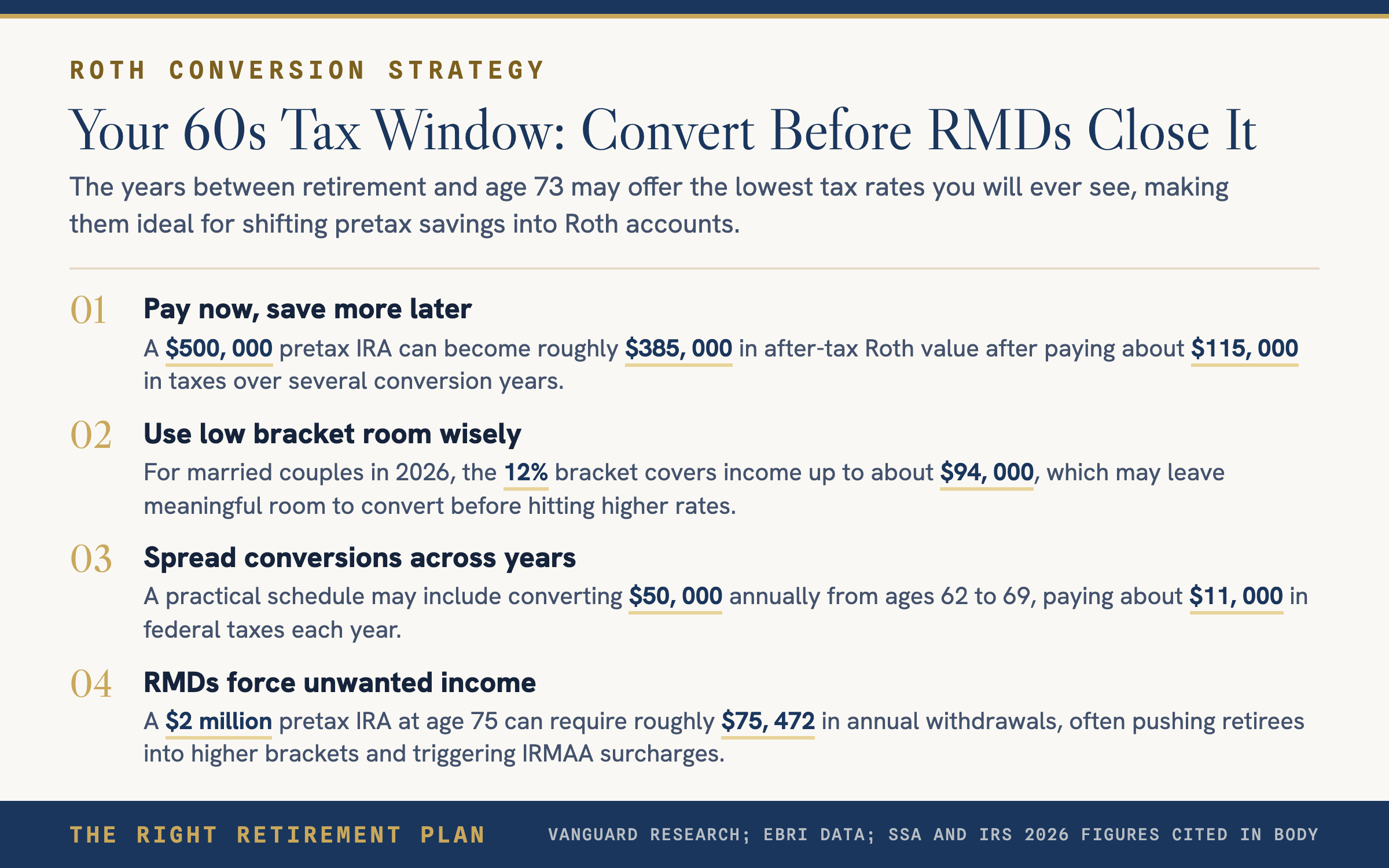
Here's a number that explains why: A $500,000 pretax IRA can become approximately $385,000 in after-tax Roth value by age 70 through strategic conversions. That's not a typo. You're voluntarily paying taxes now—roughly $115,000 over several years—to potentially save far more in taxes later.

The math seems counterintuitive until you understand what's actually happening. During these years, many retirees sit in artificially low tax brackets. They've stopped earning a salary but haven't yet started Social Security or Required Minimum Distributions. Their taxable income might be $30,000 when it used to be $150,000. That gap is an opportunity—one that closes permanently once RMDs begin.

This article breaks down the conversion strategy that could reduce your lifetime tax bill by $100,000 or more, depending on your situation. You'll learn the specific brackets to target in 2026, how to calculate your own conversion ceiling, and the often-overlooked consequence of doing nothing: the RMD spiral that can trap retirees in higher brackets for decades.

The Math Behind Strategic Roth Conversions

To understand why converting makes sense, you need to understand the 2026 federal tax brackets. Under current law, the Tax Cuts and Jobs Act provisions are scheduled to sunset after 2025, which would push many retirees into higher brackets. But let's work with what we know for 2026 planning.

For a married couple filing jointly in 2026, the projected brackets look approximately like this:

  • 10% on income up to roughly $23,000
  • 12% on income from $23,000 to approximately $94,000
  • 22% on income from $94,000 to approximately $201,000
  • 24% on income from $201,000 to approximately $383,000
Now imagine a retired couple with $40,000 in pension income and $28,000 in Social Security benefits (of which roughly 85% may be taxable, or about $23,800). Their baseline taxable income sits around $63,800 before any IRA withdrawals.

That leaves approximately $30,000 of room in the 12% bracket and another $107,000 in the 22% bracket before hitting the 24% threshold. This is what retirement planners call your "conversion ceiling"—the amount you can convert while staying within acceptable tax brackets.

A practical conversion schedule might look like this:

  • Age 62: Convert $50,000, pay approximately $11,000 in federal tax (22% bracket)
  • Age 63: Convert $50,000, pay approximately $11,000
  • Age 64: Convert $50,000, pay approximately $11,000
  • Age 65-69: Continue converting $50,000-$60,000 annually
Over eight years, you've moved $500,000 from pretax to Roth, paying roughly $115,000 in taxes along the way. Your Roth now holds $385,000 in after-tax money—plus whatever growth occurred during the conversion years.

According to research from Vanguard, systematic Roth conversions during low-income years can improve after-tax retirement income by 10-15% over a 30-year retirement, depending on future tax rates and investment returns.

The RMD Spiral Nobody Warns You About

Here's where the real damage of inaction becomes clear. Required Minimum Distributions begin at age 73 under current IRS rules, and they're calculated based on your account balance divided by a life expectancy factor.

For a $2,000,000 pretax IRA at age 75, the IRS requires you to withdraw approximately $75,472 that year (using the Uniform Lifetime Table divisor of 26.5). You have no choice. That money hits your tax return whether you need it or not.

But the spiral doesn't stop there:

  • Tax bracket creep: That $75,472 RMD, combined with Social Security and any pension income, could push a couple from the 22% bracket well into the 24% bracket—or higher
  • IRMAA surcharges: Medicare's Income-Related Monthly Adjustment Amount kicks in when Modified Adjusted Gross Income exceeds $206,000 for couples in 2024 (thresholds typically adjust annually). At that level, Medicare Part B premiums jump from the standard $174.70 to $244.60 per person per month—an extra $1,678 annually per spouse, according to CMS data
  • Social Security taxation: Higher income means up to 85% of Social Security benefits become taxable, creating a feedback loop
  • Net Investment Income Tax: Singles above $200,000 and couples above $250,000 may owe an additional 3.8% tax on investment income
The compounding effect is brutal. A retiree who does nothing might pay 24-32% effective rates on forced RMD withdrawals, plus IRMAA, plus higher Social Security taxation. Meanwhile, someone who converted strategically in their 60s pays 12-22% on the same money—and never faces RMDs on those Roth dollars again.

Research from the Employee Benefit Research Institute (EBRI) suggests that retirees who fail to plan for RMDs often underestimate their tax burden by 15-25% in later retirement years.

How to Calculate Your Personal Conversion Ceiling

Every situation is different, but the framework for finding your conversion ceiling follows the same logic:

Step 1: Estimate your baseline taxable income
Add up all income sources that will appear on your tax return: pension, Social Security (the taxable portion), rental income, dividends, and any part-time work. For 2026, remember that Social Security taxation thresholds haven't changed in decades—provisional income above $44,000 for couples typically means 85% of benefits are taxable.

Step 2: Identify your target bracket ceiling
Most advisors suggest staying within the 22% or 24% bracket for conversions. Going higher rarely makes mathematical sense unless you expect dramatically higher future rates. For 2026, that means keeping total taxable income below approximately $383,000 for married couples filing jointly.

Step 3: Calculate the gap
Subtract your baseline income from your target ceiling. That's your theoretical conversion room.

Step 4: Adjust for IRMAA thresholds
This is where many DIY planners stumble. IRMAA uses income from two years prior, so a large 2026 conversion affects your 2028 Medicare premiums. If you're already close to the first IRMAA threshold (projected around $212,000 for couples in 2026), you may want to convert just below that line to avoid the premium spike.

Step 5: Consider state taxes
Federal brackets are only part of the equation. States like California, New York, and New Jersey add 6-10% or more. States like Florida, Texas, and Nevada have no state income tax on retirement income. Your state dramatically affects whether conversions make sense and how much to convert.

A simplified example:

  • Baseline taxable income: $65,000
  • Target ceiling (top of 22% bracket): $201,000
  • IRMAA threshold concern: $212,000
  • Conversion ceiling: approximately $136,000 annually

That's theoretical maximum. Most people convert less to maintain flexibility and avoid large one-year tax bills.

Every dollar you convert to Roth is a dollar that will never generate an RMD. A $500,000 Roth IRA at age 75 requires exactly zero in mandatory withdrawals. That same $500,000 in a traditional IRA forces roughly $18,868 out the door annually—taxable income you may not need and definitely can't avoid.

The cascade effect means retirees with large pretax balances often face a cruel irony: the more they saved, the more the tax code penalizes them in later years. Strategic conversions in your 60s break that cycle before it starts.

Key Takeaways

  • The years between 60 and 70 often represent the lowest tax brackets you'll see in retirement—before RMDs, before full Social Security, and before the forced withdrawal spiral begins
  • Converting $500,000 over 8-10 years at 22% costs roughly $115,000 in taxes but may save $100,000+ in lifetime taxes compared to waiting for RMDs at higher brackets
  • A $2,000,000 pretax IRA at age 75 forces approximately $75,472 in annual RMDs—income that triggers bracket creep, IRMAA surcharges, and Social Security taxation
  • IRMAA thresholds create a hidden tax: crossing $206,000 in income (2024 figures) can add $1,678+ annually to Medicare premiums per person
  • Your conversion ceiling depends on baseline income, target bracket, IRMAA thresholds, and state tax rates—there's no universal number
  • Roth dollars never generate RMDs, breaking the forced-withdrawal cycle that traps many retirees in higher brackets for decades

Next Step

The conversion math depends entirely on your specific income sources, account balances, and state tax situation. If you'd like to see how these strategies might apply to your retirement, the free Retire Ready Score offers a quick way to identify where your current plan may have gaps worth addressing.

ShareX / TwitterFacebook

Have questions about your specific situation? Take the free Retire Ready Score →

The Compound Effect

Weekly retirement insights in your inbox.

Plain-English breakdowns of the week’s most important retirement news, tax changes, and strategies. Free. Unsubscribe anytime.

Get THE RIGHT retirement plan for you.

Take the 2-minute Retire Ready Score assessment — free, no email required to start.

Take the Free Assessment →