Waiting Past 67 Adds 8% Annually — Up to $4,194/Month at 70

January 24, 2026· 7 min read
Waiting Past 67 Adds 8% Annually — Up to $4,194/Month at 70

Why Those Extra Years Might Be Worth More Than You Think

Most pre-retirees know that waiting to claim Social Security increases their benefit. But few understand exactly how much — or that the math works differently than they assume.

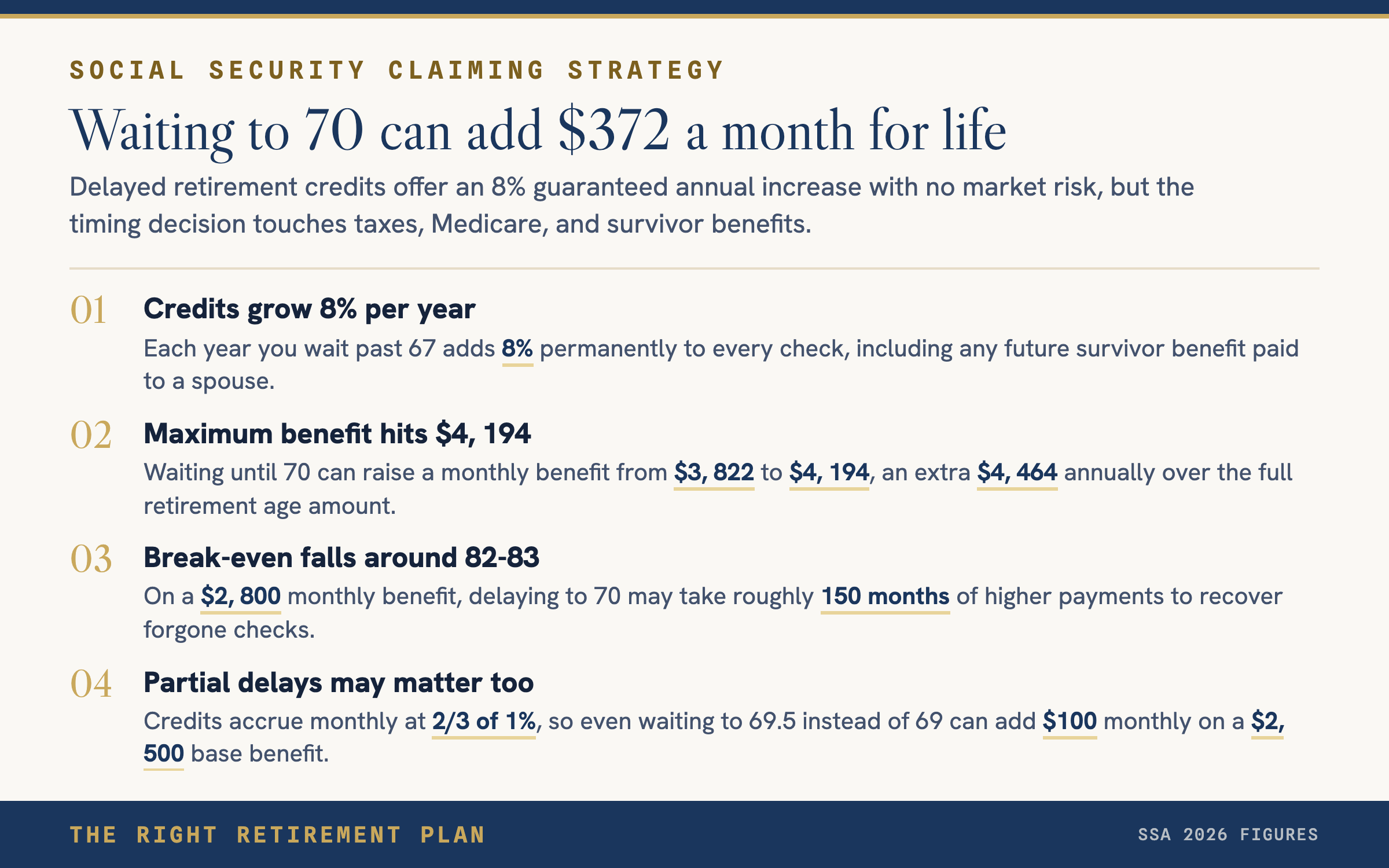
Here's the number that matters: for every year you delay claiming Social Security past your full retirement age of 67, your benefit grows by 8%. That's not a one-time bump. It's a permanent increase that compounds into every check you receive for the rest of your life, plus any survivor benefits your spouse may later collect.

According to the Social Security Administration, the maximum benefit at full retirement age in 2026 is $3,822 per month. But wait until 70, and that figure jumps to $4,194 — a difference of $372 every month, or $4,464 annually. Over a 20-year retirement, that's nearly $90,000 in additional income from the same work record.

Yet here's what makes this decision genuinely complex: delayed claiming isn't automatically the right choice. Your health, your spouse's age, your other income sources, and your tax situation all factor into the calculation. This article breaks down exactly how delayed retirement credits work, when they make mathematical sense, and the partial-year strategy most calculators miss entirely.

How Delayed Retirement Credits Actually Accumulate

The Social Security Administration awards delayed retirement credits (DRCs) to anyone who waits past their full retirement age to claim benefits. For those born in 1960 or later, full retirement age is 67. The credits stop accruing at age 70, giving you a three-year window to build your permanent benefit increase.

The growth rate is straightforward: 8% per year, or more precisely, 2/3 of 1% for each month you delay. This monthly calculation is where most people — and many online calculators — get the math wrong.

The partial-year advantage most people miss:

  • Delay until 68: 8% increase
  • Delay until 69: 16% increase
  • Delay until 69 and 6 months: 20% increase
  • Delay until 70: 24% increase
That 69.5 example matters more than it appears. If your full retirement age benefit is $2,500 per month, waiting until 69.5 rather than claiming at 69 adds another $100 monthly — $1,200 per year — for life. According to SSA actuarial tables, that could mean $24,000 or more over a typical retirement.

The credits are calculated automatically. You don't need to file paperwork or request them. Simply delay your claim, and the SSA applies the appropriate percentage when you eventually file. However, you must actively monitor your intended claiming date, because benefits don't increase past 70. There's no advantage to waiting beyond that birthday.

The Break-Even Math: When Waiting Pays Off

Every delayed claiming decision involves a trade-off: you give up benefits today in exchange for larger benefits later. The question is whether you'll live long enough to come out ahead.

The break-even calculation is simpler than most people realize. If you delay from 67 to 70, you forfeit three years of payments to gain a 24% permanent increase. For most benefit levels, the crossover point falls around age 82 to 83.

Example with 2026 numbers:

Assume a full retirement age benefit of $2,800 per month.

  • Claiming at 67: $2,800/month × 36 months = $100,800 received by age 70
  • Claiming at 70: $0 received by age 70, but $3,472/month thereafter (24% higher)
The monthly difference is $672. To recover the $100,800 you forwent, you need approximately 150 months of higher payments — roughly 12.5 years. That puts break-even at age 82.5.

According to Social Security Administration life expectancy tables, a 67-year-old man can expect to live to approximately 84.5, and a 67-year-old woman to roughly 87. For married couples where at least one spouse reaches 67, there's a 72% probability that one partner will live past 85, per Society of Actuaries research.

These averages suggest that waiting typically pays off mathematically. But averages don't account for your specific health situation, family history, or financial needs.

Factors that may favor delaying:

  • Excellent health and family longevity
  • A younger spouse who may rely on survivor benefits
  • Sufficient other income to cover the gap years
  • Desire to maximize guaranteed lifetime income
Factors that may favor claiming earlier:
  • Serious health concerns
  • No surviving spouse or dependents
  • Immediate need for income
  • Other assets that could grow faster than 8% annually

Tax Implications of Higher Benefits

A larger Social Security benefit sounds universally positive until you consider the tax consequences. Higher benefits can push more of your Social Security income into taxable territory and potentially trigger Medicare premium surcharges.

Under current IRS rules for 2026, Social Security benefits become partially taxable when your "combined income" exceeds certain thresholds. Combined income equals your adjusted gross income, plus nontaxable interest, plus half of your Social Security benefits.

2026 taxation thresholds:

  • Single filers: Up to 50% of benefits taxable above $25,000 combined income; up to 85% taxable above $34,000
  • Married filing jointly: Up to 50% taxable above $32,000; up to 85% taxable above $44,000
A retiree with $3,472 monthly in Social Security ($41,664 annually) and $30,000 in pension or IRA withdrawals would have a combined income of approximately $50,832 — well into the 85% taxability zone. That doesn't mean they pay 85% tax on benefits; it means 85% of the benefit is included in taxable income.

The Medicare angle adds another consideration. The 2026 Income-Related Monthly Adjustment Amount (IRMAA) thresholds, based on 2024 tax returns, begin at $106,000 for single filers and $212,000 for married couples. Exceeding these thresholds increases your Part B and Part D premiums by $70 to $419 per month, according to CMS projections.

Delaying Social Security doesn't change your IRMAA calculation directly, since the thresholds are based on modified adjusted gross income. However, if delaying allows you to reduce IRA withdrawals during the gap years, you might manage your income strategically to stay below IRMAA brackets.

Coordination With Spousal and Survivor Benefits

Social Security decisions rarely exist in isolation. For married couples, the higher-earning spouse's claiming decision directly affects what the surviving spouse will receive for potentially decades.

When one spouse dies, the survivor receives the higher of their own benefit or their deceased spouse's benefit — but not both. If the higher earner delayed to 70 and built a $3,472 monthly benefit, that amount becomes the floor for the surviving spouse's income.

According to the Social Security Administration, the average widow or widower receives benefits for approximately 15 years. A survivor benefit of $3,472 versus $2,800 (the difference between claiming at 70 versus 67) means an additional $8,064 annually — potentially $120,000 or more over a lengthy survival period.

This survivor benefit consideration often tips the math toward delaying for the higher earner, even when their personal break-even seems distant. The relevant question isn't just "Will I live past 82?" but "Will either of us live past 82?"

Strategies contributing advisors at TRRP commonly see working well:

  • Higher earner delays to 70; lower earner claims earlier
  • Lower earner claims at full retirement age, providing household income during the delay period
  • Both spouses delay if other assets can bridge the gap
Every situation differs. A 10-year age gap between spouses, significant health disparities, or pension income that covers expenses during the gap years all shift the optimal approach.

Delayed Social Security credits are effectively an 8% annual return with no market risk, backed by the full faith and credit of the U.S. government. According to Vanguard research, no other guaranteed investment currently offers comparable returns. Treasury bonds yield roughly 4-5%. Fixed annuities typically offer 5-6%.

The real question isn't whether you'll beat the actuarial tables. It's whether you have another way to generate 8% guaranteed growth on the money you'd otherwise collect early. For most retirees, the answer is no. That reframe — from longevity bet to return comparison — often clarifies the decision.

Key Takeaways

  • Delayed retirement credits add 8% annually to your Social Security benefit for each year you wait past 67, up to age 70
  • Credits accrue monthly at 2/3 of 1%, making partial-year delays valuable — 69.5 gets you 20%, not just 16%
  • Break-even typically occurs around age 82-83, which most healthy 67-year-olds will exceed according to SSA life tables
  • Higher benefits may increase the taxable portion of Social Security and could affect Medicare IRMAA premiums
  • For married couples, the higher earner's delayed benefit becomes the survivor benefit floor — potentially worth $100,000+ over a surviving spouse's lifetime
  • The 8% guaranteed return from delaying generally exceeds what any comparable risk-free investment offers

Next Step

Your Social Security claiming decision interacts with tax planning, Medicare costs, and income sequencing in ways that vary based on your complete financial picture. If you'd like to see how these factors apply to your situation, the Retire Ready Score provides a quick assessment of where your current plan stands across all four dimensions.

ShareX / TwitterFacebook

Have questions about your specific situation? Take the free Retire Ready Score →

The Compound Effect

Weekly retirement insights in your inbox.

Plain-English breakdowns of the week’s most important retirement news, tax changes, and strategies. Free. Unsubscribe anytime.

Get THE RIGHT retirement plan for you.

Take the 2-minute Retire Ready Score assessment — free, no email required to start.

Take the Free Assessment →