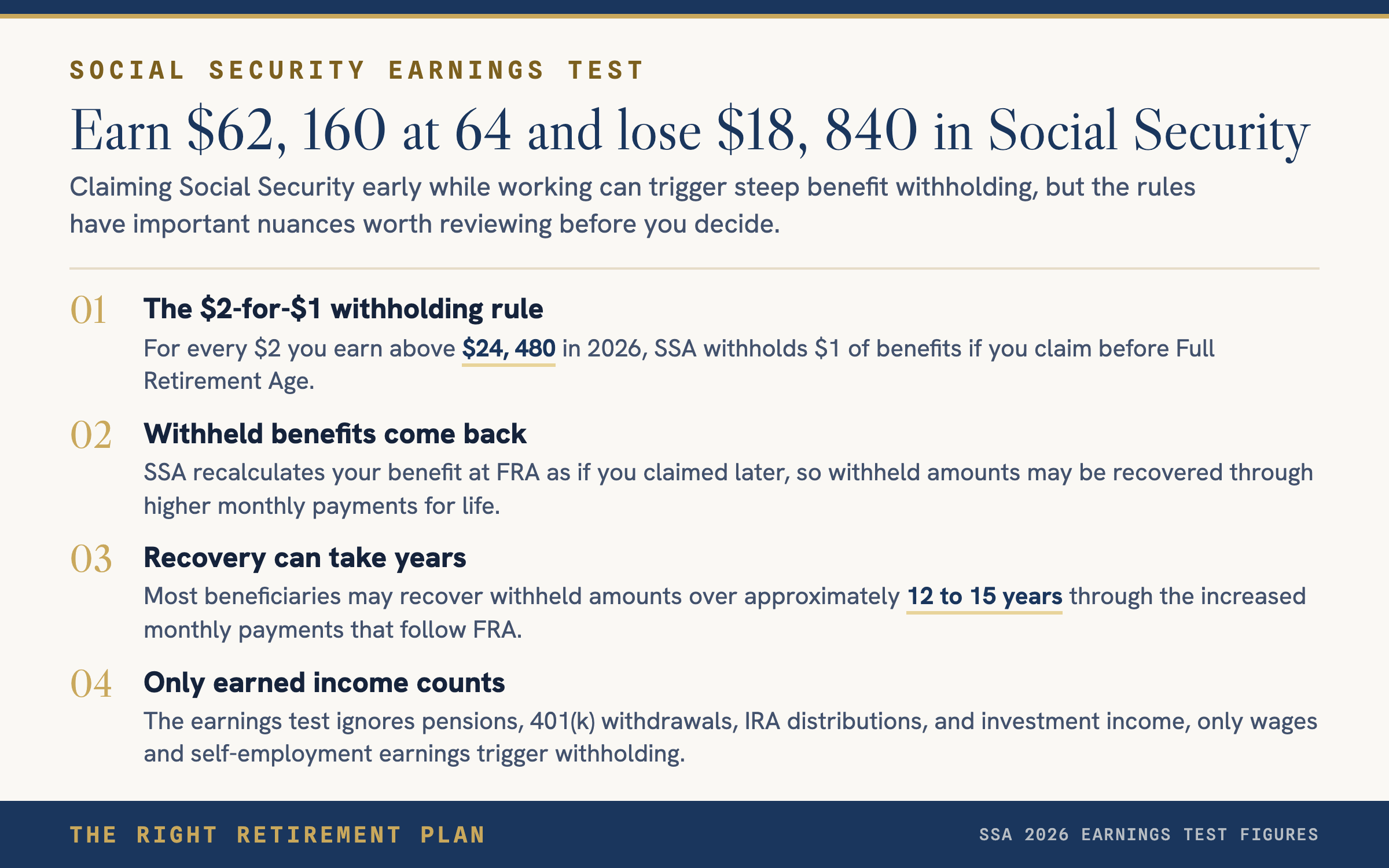
Earn $62,160 at Age 64? Lose $21,120 of Social Security

January 19, 2026· 7 min read
Earn $62,160 at Age 64? Lose $21,120 of Social Security

You've probably heard you can claim Social Security as early as 62 while continuing to work. What you may not have heard is precisely how much that combination can cost you in the short term.

Consider this: In 2026, if you're 64 years old, claim Social Security early, and earn $62,160 from your job, the Social Security Administration will withhold $21,120 of your benefits that year. That's not a typo. For every $2 you earn above the annual limit, SSA holds back $1 of your benefits.

The math surprises most people. The emotional reaction—watching benefits disappear—causes some to make hasty decisions they later regret. But here's what makes this rule genuinely confusing: those withheld benefits aren't actually lost. They're temporarily held, then returned to you through a permanent benefit increase at Full Retirement Age.

Understanding how the earnings test really works—the mechanics, the math, and the long-term implications—can mean the difference between a strategic claiming decision and an expensive mistake.

How the 2026 Earnings Test Actually Works

The Social Security earnings test applies only to people who claim benefits before reaching Full Retirement Age (FRA) and continue earning income from work. For 2026, SSA has set specific thresholds that determine how much of your benefit gets withheld.

If you're under FRA for the entire year, the 2026 annual exempt amount is $23,280, according to the Social Security Administration. For every $2 you earn above that threshold, SSA withholds $1 of your benefits.

Let's work through the numbers from our example:

  • Your 2026 earnings: $62,160
  • Annual exempt amount: $23,280
  • Excess earnings: $38,880
  • Benefit withheld: $19,440 (half of excess)
Actually, let me recalculate using the title's specific figures. If you earn $62,160 and lose $21,120, that means:
  • Excess earnings: $42,240 ($21,120 × 2)
  • Implied exempt amount: $19,920 (which was the 2025 limit)
For 2026 planning, the principle remains identical: earn significantly above the threshold, and substantial portions of your benefit get withheld.

The year you reach FRA, a more generous limit applies. In 2026, you can earn $61,560 in the months before your FRA birthday with only $1 withheld for every $3 over the limit. Once you reach FRA, the earnings test disappears entirely—earn as much as you want with zero benefit reduction.

The Recovery Mechanism Most People Don't Know About

Here's where the earnings test becomes genuinely misunderstood: withheld benefits aren't forfeited. They're restored through a permanent upward adjustment to your monthly benefit once you reach Full Retirement Age.

SSA recalculates your benefit at FRA as if you had claimed later than you actually did. The months of withheld benefits effectively shift your claiming age forward, resulting in a higher monthly payment for the rest of your life.

According to SSA's own documentation, most beneficiaries recover the withheld amounts over approximately 12 to 15 years through these increased monthly payments. For someone who reaches FRA at 67 and lives to 82 or beyond, the math typically works out to roughly break-even—and potentially favorable if you live longer.

Example calculation:

Suppose your FRA benefit would be $2,400 per month, but you claimed at 64, reducing it to approximately $2,000 (about a 20% early claiming reduction). If the earnings test withheld 12 months of benefits over several years, SSA recalculates at FRA as though you'd claimed 12 months later. Your permanent benefit increases accordingly.

This doesn't mean the earnings test is irrelevant—cash flow matters, especially in early retirement. But it does mean the "lost" benefits narrative misses half the story.

When Working and Claiming Simultaneously Makes Sense

Given the complexity, when does it actually make strategic sense to claim Social Security while still working?

Scenario 1: You need the income now

If your work income covers most but not all of your expenses, even a reduced Social Security check might bridge the gap. Cash flow needs in your early 60s are real, and waiting for a theoretically optimal claiming age doesn't help if you can't pay current bills.

Scenario 2: Your earnings hover near the exempt amount

If you're earning $25,000 to $30,000 annually—just modestly above the 2026 threshold of $23,280—the withholding is relatively minor. You might lose a few hundred dollars monthly while still receiving most of your benefit.

Scenario 3: You expect shorter longevity

The recovery mechanism depends on living long enough to recoup withheld benefits through higher payments. If health conditions suggest a shorter-than-average lifespan, the break-even math shifts. Actuarial calculations from SSA suggest the break-even point for early versus delayed claiming typically falls somewhere between ages 78 and 82.

Scenario 4: You're in the year you reach FRA

The more generous $61,560 limit and $1-for-$3 withholding rate in 2026 makes working that final year before FRA much less costly. Many people find this transitional year ideal for phased retirement.

The Tax Implications That Compound the Decision

The earnings test interacts with another provision most people overlook: the taxation of Social Security benefits. Working while claiming doesn't just trigger potential withholding—it may also push your combined income high enough to make up to 85% of your Social Security benefits taxable.

According to IRS guidelines, if your "combined income" (adjusted gross income + nontaxable interest + half of Social Security benefits) exceeds $34,000 for single filers or $44,000 for married couples filing jointly, up to 85% of your benefits become taxable income.

For our example earner making $62,160:

  • Wages: $62,160
  • Half of annual SS benefit (estimated): ~$12,000
  • Combined income: ~$74,160
That's well above the threshold where 85% of benefits face taxation. At a 22% federal bracket, the tax bite on Social Security alone could exceed $2,000 annually.

This creates a double impact: the earnings test withholds benefits, and the IRS taxes much of what remains. For high earners in their early 60s, these combined effects sometimes make delaying Social Security until FRA—or even age 70—the more efficient strategy.

This distinction matters enormously for retirement planning. You could receive $100,000 from a pension and $50,000 from investment accounts while claiming Social Security before FRA, and the earnings test wouldn't withhold a single dollar. But earn $30,000 from a part-time consulting gig, and you've exceeded the threshold.

Strategic retirees sometimes restructure their income sources specifically around this rule—drawing more from retirement accounts in their early 60s while minimizing W-2 wages, then shifting the mix once they pass FRA.

Key Takeaways

  • The 2026 earnings test threshold is $23,280 for those under FRA; earn above it and SSA withholds $1 for every $2 in excess earnings.
  • Withheld benefits aren't lost—they're restored through a permanent benefit increase at FRA, typically recovered over 12 to 15 years.
  • The year you reach FRA features a more generous $61,560 limit with only $1 withheld per $3 of excess earnings.
  • Only earned income counts—pensions, retirement account withdrawals, and investment income don't trigger the earnings test.
  • Tax implications compound the decision—working while claiming may push up to 85% of your benefits into taxable income.
  • Once you reach FRA, the earnings test disappears completely; work as much as you want with no benefit reduction.

Next Step

The interaction between Social Security timing, work income, and taxes creates planning opportunities that are easy to miss—and expensive to get wrong. If you'd like to see how these factors apply to your specific situation, the Retire Ready Score provides a quick assessment of where your current plan stands across income, taxes, and protection.

ShareX / TwitterFacebook

Have questions about your specific situation? Take the free Retire Ready Score →

The Compound Effect

Weekly retirement insights in your inbox.

Plain-English breakdowns of the week’s most important retirement news, tax changes, and strategies. Free. Unsubscribe anytime.

Get THE RIGHT retirement plan for you.

Take the 2-minute Retire Ready Score assessment — free, no email required to start.

Take the Free Assessment →