$79,200 RMD at Age 75 Could Push You Into the 32% Tax Bracket

February 13, 2026· 7 min read
$79,200 RMD at Age 75 Could Push You Into the 32% Tax Bracket

You spent decades building a $2 million 401(k). Now the IRS wants its share—on their schedule, not yours.

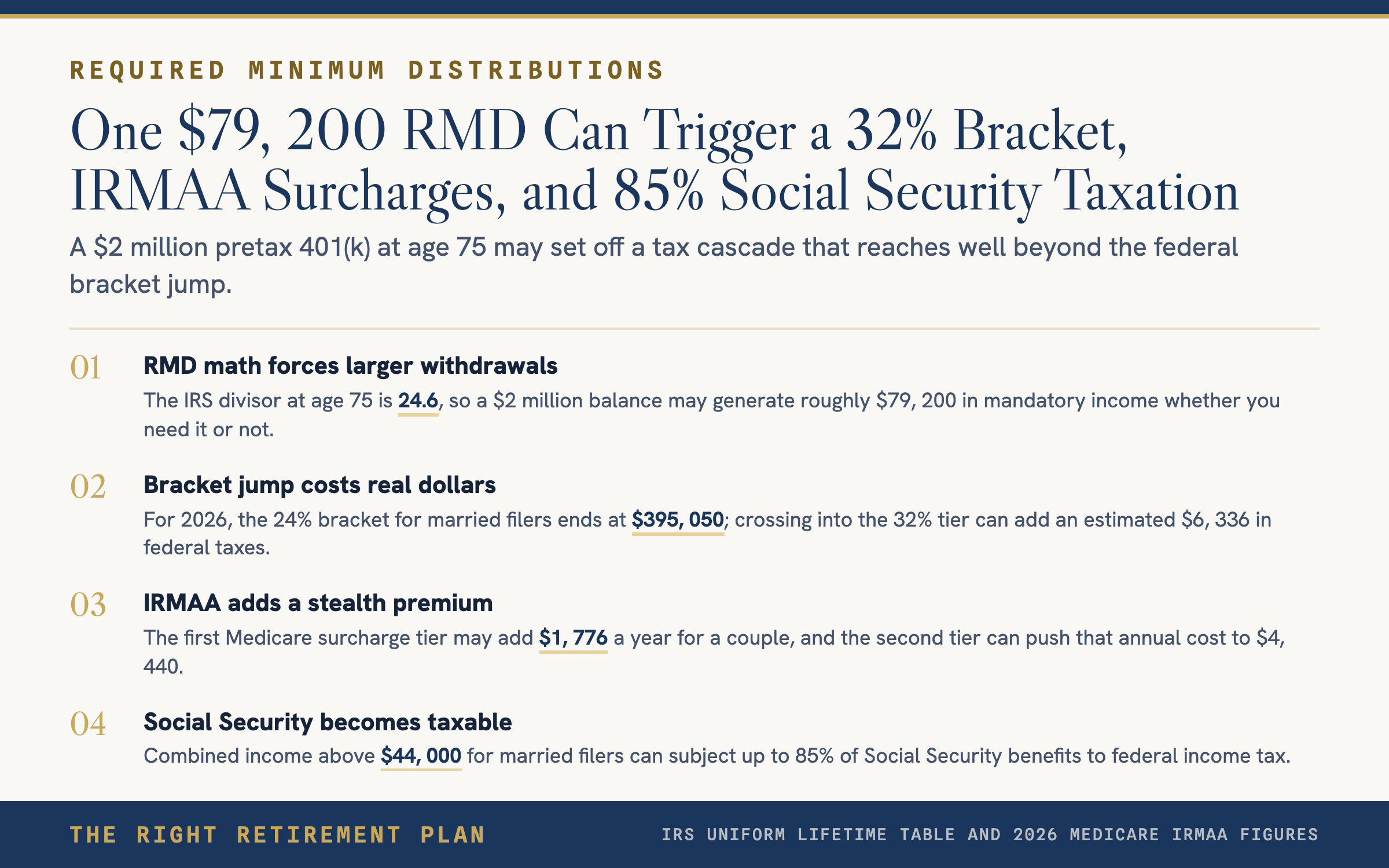
At age 75, a $2 million pretax retirement account generates a required minimum distribution of approximately $79,200. That single mandatory withdrawal could push a married couple from the 24% federal tax bracket into the 32% bracket, costing an additional $6,336 in federal taxes on the portion that crosses the threshold. But the bracket jump is just the beginning. That same income spike may trigger Medicare's Income-Related Monthly Adjustment Amount (IRMAA), adding $2,289.60 per year in additional premiums for a couple. And if your combined income exceeds $44,000, up to 85% of your Social Security benefits become taxable.

The math compounds in ways most retirees don't anticipate until the first tax bill arrives. Understanding how RMDs interact with tax brackets, Medicare premiums, and Social Security taxation could save you tens of thousands of dollars over a 25-year retirement.

How RMD Math Creates Bracket Creep

Required minimum distributions follow IRS life expectancy tables that force increasingly larger withdrawals as you age. For 2026, the Uniform Lifetime Table sets the divisor at 25.5 for age 73 (when RMDs now begin), dropping to 24.6 at age 75. A $2 million pretax balance divided by 24.6 equals $81,301—though market fluctuations typically adjust this figure. Using conservative assumptions, expect roughly $79,200 at 75.

Here's where bracket creep becomes dangerous. For 2026, the 24% bracket for married filing jointly ends at $395,050, and the 32% bracket begins immediately above that threshold. A couple with:

  • $50,000 in Social Security benefits (85% taxable = $42,500)
  • $30,000 in pension income
  • $79,200 in RMDs
...now reports $151,700 in taxable income before any other sources. Add a modest brokerage account generating $15,000 in dividends and capital gains, and you're at $166,700. Still safely in the 24% bracket this year—but the trajectory matters more than any single year.

By age 85, assuming 5% average growth, that same account generates an RMD of approximately $131,579. The account grew, but so did the mandatory withdrawal percentage. According to IRS Publication 590-B, the divisor at 85 is just 16.0, meaning you must withdraw 6.25% of the balance annually—regardless of whether you need the money.

This creates a paradox: the more successfully your retirement savings grow, the larger your mandatory tax bill becomes.

The IRMAA Multiplier Effect

Medicare's Income-Related Monthly Adjustment Amount operates as a stealth tax that compounds the damage from RMD-driven income spikes. For 2026, IRMAA thresholds for married couples filing jointly are:

  • Standard premium: MAGI up to $212,000
  • First surcharge tier: MAGI $212,001–$266,000 (adds $74.00/month per person)
  • Second surcharge tier: MAGI $266,001–$332,000 (adds $185.00/month per person)
  • Third surcharge tier: MAGI $332,001–$398,000 (adds $295.90/month per person)
These thresholds, published annually by CMS, are based on your tax return from two years prior. A single large RMD in 2026 affects your Medicare premiums in 2028.

Consider the couple above with $166,700 in taxable income. Their modified adjusted gross income (MAGI) for IRMAA purposes may differ slightly, but they're likely approaching or crossing the $212,000 threshold. Crossing into the first IRMAA tier costs $1,776 annually for a couple ($74 × 2 × 12 months). Cross into the second tier, and the annual surcharge jumps to $4,440.

According to research from the Employee Benefit Research Institute (EBRI), fewer than 8% of Medicare beneficiaries pay IRMAA surcharges—but that percentage rises sharply among households with significant pretax retirement assets. The irony: diligent savers are penalized for their success.

Social Security's 85% Taxation Trap

Most retirees know Social Security benefits may be taxable. Fewer understand exactly how the calculation works—or how RMDs can push more of their benefits into the taxable category.

The Social Security Administration uses "combined income" (adjusted gross income + nontaxable interest + half of Social Security benefits) to determine taxation:

  • Below $32,000 (married filing jointly): Benefits are tax-free
  • $32,000–$44,000: Up to 50% of benefits are taxable
  • Above $44,000: Up to 85% of benefits are taxable
With average Social Security benefits for retired workers reaching approximately $1,976 per month in 2026 (per SSA projections), a couple receiving combined benefits of $47,424 annually has $23,712 added to their combined income calculation. If their other income—including RMDs—brings AGI to $120,000, their combined income is $143,712. They're firmly in the 85% taxable category.

On $47,424 in benefits, 85% taxable means $40,310 added to taxable income. At the 24% bracket, that's an additional $9,674 in federal taxes attributable to Social Security—money that might have remained tax-free with different planning.

Strategic Approaches to RMD Management

The compounding nature of RMDs, IRMAA, and Social Security taxation creates planning opportunities for those who understand the mechanics. Several strategies may help manage the impact:

Roth conversions before RMDs begin. Converting pretax dollars to Roth accounts between retirement and age 73 creates taxable income now but eliminates future RMDs on converted amounts. According to Vanguard research, strategic conversions during lower-income years can reduce lifetime tax liability by 10–15% for households with significant pretax balances.

Qualified Charitable Distributions (QCDs). After age 70½, you may direct up to $105,000 annually (2026 limit, indexed for inflation) from an IRA directly to qualified charities. QCDs satisfy RMD requirements without adding to taxable income, potentially keeping you below IRMAA thresholds.

Asset location optimization. Holding tax-efficient investments (index funds, municipal bonds) in taxable accounts while keeping tax-inefficient assets (bonds, REITs) in tax-advantaged accounts can reduce overall tax drag. Morningstar research suggests proper asset location adds 0.20–0.75% annually to after-tax returns.

Timing large distributions. If you anticipate a year with unusually low income—perhaps before Social Security begins or after a spouse stops working—accelerating some pretax withdrawals during that window may reduce lifetime taxes.

None of these approaches eliminate taxes entirely. The goal is managing the timing and character of income to minimize the compounding effects across multiple systems.

The total marginal cost of that RMD may exceed 35–40% when all systems interact—yet most retirement projections model only federal income taxes. According to EBRI, fewer than one in five pre-retirees accurately estimate their tax burden in retirement. The ones who plan for these interactions keep more of what they saved.

Key Takeaways

  • A $2 million pretax 401(k) generates approximately $79,200 in mandatory withdrawals at age 75, growing to roughly $131,579 by age 85 assuming 5% growth.
  • RMD income may push retirees from the 24% bracket into the 32% bracket, creating an additional 8% federal tax on income above the threshold.
  • Medicare IRMAA surcharges add $1,776–$8,520 annually for couples whose income exceeds $212,000, based on tax returns from two years prior.
  • Combined income above $44,000 subjects up to 85% of Social Security benefits to federal taxation.
  • Roth conversions, qualified charitable distributions, and strategic timing may help manage the interaction between RMDs, IRMAA, and Social Security taxation.
  • The true marginal cost of RMDs often exceeds 35% when all systems interact—far higher than the nominal tax bracket suggests.

Next Step

Understanding how RMDs interact with your specific tax situation requires knowing where you stand today. The free Retire Ready Score assessment takes about two minutes and helps identify which of these factors may affect your retirement income most.

ShareX / TwitterFacebook

Have questions about your specific situation? Take the free Retire Ready Score →

The Compound Effect

Weekly retirement insights in your inbox.

Plain-English breakdowns of the week’s most important retirement news, tax changes, and strategies. Free. Unsubscribe anytime.

Get THE RIGHT retirement plan for you.

Take the 2-minute Retire Ready Score assessment — free, no email required to start.

Take the Free Assessment →